Houthis launch second wave of attacks on Red Sea vessels after deadly British-US airstrikes

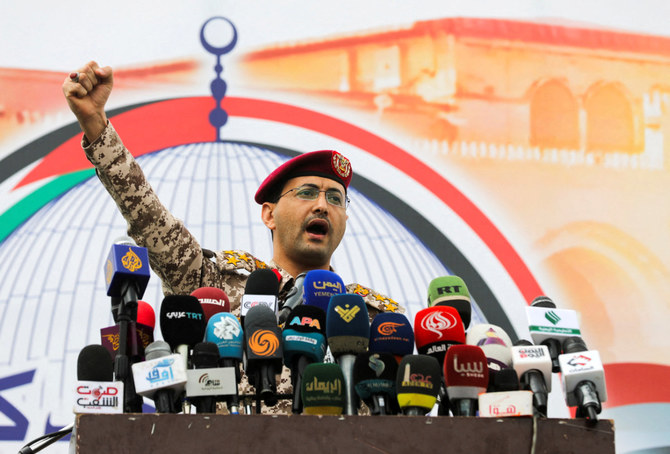
Houthi military spokesperson Yahya Sarea chants slogans in Sanaa, Yemen, after delivering a statement on the group's latest attacks against US and British naval vessels as well as commercial ships on the Red Sea. (REUTERS)
Short Url
Updated 02 June 2024
Follow

Houthis launch second wave of attacks on Red Sea vessels after deadly British-US airstrikes

  • Saturday's operations were the second in response to the latest US-British airstrikes in Yemen, says militia spokesman
  • US military said no injuries or damage were reported by US, coalition or commercial ships from the attacks

RIYADH: Houthi forces launched anti-ballistic missiles and armed drones targeting a US aircraft carrier, a US destroyer and three vessels in the Red Sea, the Iran-backed Yemeni militia’s military spokesman Yahya Saree said on Saturday.

The US military confirmed the attacks but said no injuries or damage were reported by US, coalition or commercial ships.

In a statement on X, the US Central Command said its forces destroyed one Iran-backed Houthi uncrewed aerial system in the southern Red Sea and saw two others crash into Red Sea.

US forces also destroyed two Houthi anti-ship ballistic missiles fired in direction of the US Navy ship Gravely, it said.

The attacks came a day after a Houthi official vowed to hit back after a joint British US airstrikes hit militia installations in Yemen on Thursday.

“We will meet escalation with escalation,” Mohammed Al-Bukhaiti, a Houthi official, wrote on X.

The Houthi militia, which controls the most populous parts of Yemen and is aligned with Iran, has attacked ships off its coast for months, saying it is acting in solidarity with Palestinians fighting Israel in Gaza.

Saree on Saturday said the group “targeted the American aircraft carrier, the Eisenhower, north of the Red Sea, with a number of missiles and drones,” adding that it was “the second targeting operation against the carrier during the past 24 hours.”

The spokesperson also added that the other operations have targeted a US destroyer and the ABLIANI ship in the Red Sea, along with “the MAINA ship that has been targeted twice in the Red Sea and in the Arabian Sea as well.”

Additionally, “the ship ALORAIQ has been targeted in the Indian Ocean,” he added.

On Friday, F/A-18 fighter jets from the USS Dwight D. Eisenhower aircraft hit a wide range of Houthi underground facilities, missile launchers, command and control sites, a vessel and other facilities, according to the US military.

The militia acknowledged that the joint British-US airstrikes killed at least 16 people and wounded 42 of its fighters. It was the highest publicly acknowledged death toll from the multiple rounds of strikes carried out over the Houthi attacks on shipping.

But the Houthis focused Friday morning on a strike they said struck a building housing Hodeida Radio and civilian homes in the port city on the Red Sea. Their Al Masirah satellite news channel aired images of one bloodied man being carried down stairs and others in the hospital, receiving aid. It said all the dead and nearly all the wounded from the strikes came from there.

The Houthis described all those killed and hurt in Hodeida as civilians. The rebel force that’s held Yemen’s capital, Sanaa, since 2014 includes fighters who often aren’t in uniform.

Other strikes hit outside of Sanaa near its airport, and communication equipment in Taiz, the broadcaster said. Little other information was released on those sites — likely signaling that Houthi military sites had been struck. One person was wounded in Sanaa.

“We confirm this brutal aggression against Yemen as punishment for its position in support of Gaza, in support of Israel to continue its crimes of genocide against the wounded, besieged and steadfast Gaza Strip,” Houthi spokesman Mohammed Abdulsalam posted on X.

The US and the UK have launched strikes against the Houthis since January, with the US regularly carrying out its own in the time since as well.

Abdul Malik Al-Houthi, the Houthis’ secretive supreme leader, offered an overall death toll for the strikes up to that point as 40 people killed and 35 others wounded. He didn’t offer a breakdown between civilian and combatant casualties at the time.

The Houthis have stepped up attacks on shipping in the Red Sea and the Gulf of Aden, demanding that Israel end the war in Gaza, which has killed more than 36,000 Palestinians there. The war began after Hamas-led militants attacked Israel on Oct. 7, killing about 1,200 people and taking around 250 hostage.

The Houthis have launched more than 50 attacks on shipping, killed three sailors, seized one vessel and sunk another since November, according to the US Maritime Administration. This week, they attacked a ship carrying grain to Iran, the rebels’ main benefactor.

On Wednesday, another US MQ-9 Reaper drone apparently crashed in Yemen, with the Houthis claiming they fired a surface-to-air missile at it. The US Air Force didn’t report any aircraft missing, leading to suspicion that the drone may have been piloted by the CIA. As many as three may have been lost in May alone.

(With Reuters & AP)


Netanyahu says Israel and Hamas will enter ceasefire’s second phase soon

Updated 08 December 2025
Follow

Netanyahu says Israel and Hamas will enter ceasefire’s second phase soon

  • Says the second phase addresses the disarming of Hamas and withdrawal of Israeli troops from Gaza
  • Second stage also includes the deployment of an international force to secure Gaza and forming a temporary Palestinian government

TEL AVIV, Israel: Israeli Prime Minister Benjamin Netanyahu said Sunday that Israel and Hamas are “very shortly expected to move into the second phase of the ceasefire,” after Hamas returns the remains of the last hostage held in Gaza.
Netanyahu spoke during a news conference with visiting German Chancellor Friedrich Merz and stressed that the second phase, which addresses the disarming of Hamas and the withdrawal of Israeli troops from Gaza, could begin as soon as the end of the month.
Hamas has yet to hand over the remains of Ran Gvili, a 24-year-old police officer who was killed in the Hamas-led Oct. 7, 2023, attack that sparked the war. His body was taken to Gaza.
The ceasefire’s second stage also includes the deployment of an international force to secure Gaza and forming a temporary Palestinian government to run day-to-day affairs under the supervision of an international board led by US President Donald Trump.
A senior Hamas official on Sunday told The Associated Press the group is ready to discuss “freezing or storing or laying down” its weapons as part of the ceasefire in a possible approach to one of the most difficult issues ahead.

Netanyahu says second phase will be challenging
Netanyahu said few people believed the ceasefire’s first stage could be achieved, and the second phase is just as challenging.
“As I mentioned to the chancellor, there’s a third phase, and that is to deradicalize Gaza, something that also people believed was impossible. But it was done in Germany, it was done in Japan, it was done in the Gulf States. It can be done in Gaza, too, but of course Hamas has to be dismantled,” he said.
The return of Gvili’s remains — and Israel’s return of 15 bodies of Palestinians in exchange — would complete the first phase of Trump’s 20-point ceasefire plan.
Hamas says it has not been able to reach all remains because they are buried under rubble left by Israel’s two-year offensive in Gaza. Israel has accused the militants of stalling and threatened to resume military operations or withhold humanitarian aid if all remains are not returned.
A group of families of hostages said in a statement that “we cannot advance to the next phase before Ran Gvili returns home.”
Meanwhile, Israeli military Chief of Staff Lt. Gen. Eyal Zamir on Sunday called the so-called Yellow Line that divides the Israeli-controlled majority of Gaza from the rest of the territory a “new border.”
“We have operational control over extensive parts of the Gaza Strip and we will remain on those defense lines,” Zamir said. “The Yellow Line is a new border line, serving as a forward defensive line for our communities and a line of operational activity.”
Germany says support for Israel is unchanged
Merz said Germany, one of Israel’s closest allies, is assisting with the implementation of the second phase by sending officers and diplomats to a US-led civilian and military coordination center in southern Israel, and by sending humanitarian aid to Gaza.
The chancellor also said Germany still believes that a two-state-solution is the best possible option but that “the German federal government remains of the opinion that recognition of a Palestinian state can only come at the end of such a process, not at the beginning.”
The US-drafted plan for Gaza leaves the door open to Palestinian independence. Netanyahu has long asserted that creating a Palestinian state would reward Hamas and eventually lead to an even larger Hamas-run state on Israel’s borders.
Netanyahu also said that while he would like to visit Germany, he hasn’t planned a diplomatic trip because he is concerned about an arrest warrant issued by the International Criminal Court, the UN’s top war crimes court, last year in connection with the war in Gaza.
Merz said there are currently no plans for a visit but he may invite Netanyahu in the future. He added that he is not aware of future sanctions against Israel from the European Union nor any plans to renew German bans on military exports to Israel.
Germany had a temporary ban on exporting military equipment to Israel, which was lifted after the ceasefire began on Oct. 10.
Israel kills militant in Gaza
The Israeli military said it killed a militant who approached its troops across the Yellow Line.
Gaza’s Health Ministry says Israeli forces have killed more than 370 Palestinians since the start of the ceasefire, and that the bodies of six people killed in attacks had been brought to local hospitals over the past 24 hours.
In the original Hamas-led attack in 2023, the militants killed around 1,200 people and took more than 250 others hostage. Almost all the hostages or their remains have been returned in ceasefires or other deals.
Israel’s offensive in Gaza has killed at least 70,360 Palestinians, according to Gaza’s Health Ministry, which operates under the Hamas-run government. The ministry does not differentiate between civilians and combatants, but says that nearly half the dead have been women and children. The ministry is part of Gaza’s Hamas government and its numbers are considered reliable by the UN and other international bodies.