


Saudi startups take lead in MENA funding space

MAGNiTT’s report show that Saudi startups raised $400 million in venture debt last year, a 602 percent growth compared to $57 million in 2022. (SPA)
Short Url
Updated 01 October 2024
Follow

Saudi startups take lead in MENA funding space

  • Sector garners over 53 percent of MENA venture debt financing in 2023

CAIRO: Saudi Arabia’s startup ecosystem has affirmed its leading position in the funding space, capturing over 53 percent of the region’s venture debt financing in 2023, according to MAGNiTT’s latest report.

The venture data platform revealed that Saudi startups raised a total of $400 million in venture debt last year, a 602 percent growth compared to $57 million in 2022.

Venture debt is a type of financing for early-stage companies that complements equity funding. It includes growth capital for expansion, equipment financing for asset acquisition, and accounts receivable financing for managing cash flow.

The Middle East and North Africa region saw a total of $757 million in venture debt financing in 2023, a 262 percent year-on-year growth.

The UAE followed Saudi Arabia with a total of $353 million in financing in 2023, a 222 percent yearly increase. Egypt came in third with $4 million, an 86 percent annual drop.

In terms of deal count, the Emirates leads the region with six transactions, indicating a 25 percent yearly decrease; Saudi Arabia with four, a 100 percent annual increase, and Egypt with two and a 75 percent year-on-year drop.

Fintech emerged once again as the sector of choice for investors, accumulating $601 million in financing, a 325 percent yearly increase.

Buy now, pay later giants Tabby and Tamara drove the sector’s triple-digit growth, amassing $600 million of fintechs’ total financing. 
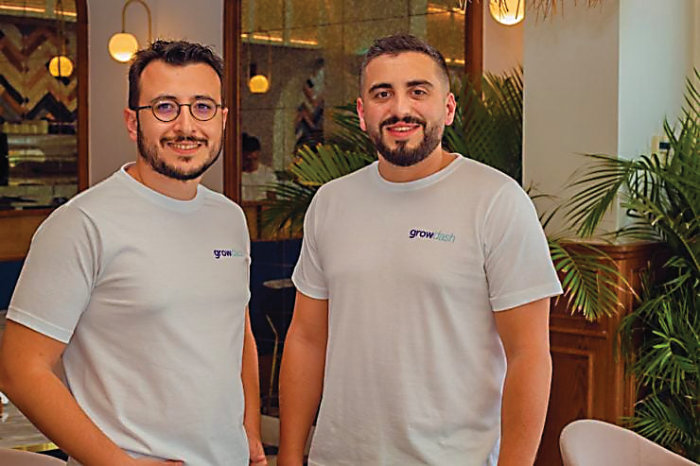


Founded in 2022 by Sean Trevaskis and Enver Sorkun, Growdash uses software solutions to boost restaurants’ marketing and operational efforts. (Supplied)

This is mainly due to the subsector’s capital-intensive nature and the growing demand for consumer credit financing tools.

Transport and logistics came in second with $150 million in venture debt, a 162 percent YoY increase, and e-commerce with $3 million, a 57 percent drop.

The leading investors by capital deployed were mainly foreign, with the top three from the US, namely, Goldman Sachs, Partners for Growth, and Atalaya, followed by CoVentures from South Africa and Shorooq Partners from the UAE.

Agritech startup iyris closes $16m series A round

Riyadh and Dubai-based agritech startup iyris, formerly known as RedSea, closed a $16 million series A funding round led by US-based Ecosystem Integrity Fund with support from Global Ventures, Dubai Future District Fund and Kanoo Ventures as well as Globivest, and Bonaventure Capital.

Founded in 2018 by Ryan Lefers, Mark Tester, and Derya Baran, iyris offers advanced commercial farming solutions for low to mid-tech farmers in hot climates worldwide.

Proceeds will enhance sales coverage and bolster iyris’ international sales pipeline for SecondSky greenhouse covers and nets.

Additionally, the funds will drive the development of innovative heat-blocking products and resilient plant genetics.

This investment underscores iyris’ dedication to empowering farmers to sustainably mitigate climate change impacts, address food security concerns, and achieve key UN Sustainable Development Goals.

BIM Ventures and SBI Holdings launch $100m joint investment fund

Saudi Arabia-based VC studio BIM Ventures has partnered with Japan’s SBI Holdings to launch a $100 million joint investment fund aimed at supporting Saudi startups.

The fund will provide startups with funding, expert guidance, and mentoring throughout their establishment and growth phases.

The memorandum of understanding for the fund was signed during the Saudi-Japan Vision 2030 Business Forum, under the auspices of the Ministry of Investment of Saudi Arabia.

UAE’s Growdash closes $1.8m seed round

Dubai-based foodtech software as a service solution Growdash closed $1.8 million in a seed funding round led by Oryx Fund and Oraseya Capital.

Founded in 2022 by Sean Trevaskis and Enver Sorkun, the company uses software solutions to boost restaurants’ marketing and operational efforts.

UAE foodtech startup GrubTech secures $15m in series B funding

UAE-based foodtech startup GrubTech has raised $15 million in its series B round, an extension of series A led by Jahez and including participation from Addition and Hambro Perks Oryx Fund.

Founded in 2019 by Mohamed Al-Fayed, Omar Rifai, and Mohamed Hamedi, GrubTech is a software integration and unified commerce platform that provides restaurants and cloud kitchens with software solutions to streamline operations.

TVM Capital Healthcare closes $250m Afiyah Fund

UAE-based healthcare private equity firm TVM Capital Healthcare has closed a $250 million Afiyah Fund LP.

The fund was led by JADA, a Public Investment Fund company, along with a group of Saudi, Gulf, and European investors.

The Afiyah Fund aims to support domestic and international health tech startups entering the market, with a focus on the key medical priorities of Saudi Vision 2030.

TVM Capital plans to mobilize $400 to $500 million in the Saudi healthcare sector, with anticipated co-investment offers from its LP base.

Proptech startup Holo secures pre-series A funding

UAE-based proptech startup Holo has raised an undisclosed amount in a pre-Series A funding round led by Dubai Future District Fund and Oryx Fund, with participation from Aditum Investment Management Limited.

Launched in 2020 by Michael Hunter and Arran Summerhill, Holo offers digital mortgage services that simplify the process of owning a home by allowing buyers and homeowners to explore refinancing options.

Holo plans to use the new capital to strengthen its market position in the UAE, grow its team, and expand its reach across the Gulf region, with an immediate focus on Saudi Arabia.

In February 2023, Holo closed a seven-figure seed round.

Shorooq Partners announces first close of $100m credit fund

UAE-based alternative investment manager Shorooq Partners has announced the first close of its $100 million second private credit fund.

The fund was established in collaboration with Korea’s IMM Investment Global, which joined as a minority partner.

The fund will assist MENA-based startups with an average ticket size of $10 million in sectors such as manufacturing, industrials, financing, and software services.

Founded in 2017 by Mahmoud Adi, Shane Shin, and Kunal Savjani, Shorooq Partners is an alternative investment manager across MENA.

Its first credit fund, now fully deployed, has invested in companies like Pure Harvest and Tamara.


Building bridges: Saudi Arabia leads Gulf-Asia tech leap

Updated 01 January 2026
Follow

Building bridges: Saudi Arabia leads Gulf-Asia tech leap

ALKHOBAR: Saudi Arabia is forging new academic connections with Asia as the Kingdom’s Vision 2030 accelerates reforms in education and innovation.

Two academics — Prof. Eman AbuKhousa, a data science professor at the University of Europe for Applied Sciences in Dubai, and Prof. Hui Kai-Lung, acting dean of the HKUST Business School in Hong Kong —emphasize that the Kingdom’s transformation is reshaping the development of artificial intelligence and fintech talent across the region.

For AbuKhousa, responsible AI is not just about technology; it is fundamentally about intention. “It is about aligning technology with human values: ensuring fairness, transparency, and accountability in every system we build.”

She highlighted that the Middle East’s heritage of trust and ethics gives the region a competitive advantage. “Institutions should embed ethics and cultural context into AI education and create multidisciplinary labs where engineers collaborate with social scientists and ethicists,” she said.

At the University of Europe for Applied Sciences in Dubai, AbuKhousa trains students to question data, identify bias, and integrate integrity into innovation. 

Asian universities like HKUST play a growing role in cross-border education partnerships with Saudi institutions.

“Educators must model responsible use by explaining how data is sourced and decisions are made,” she explained. “Ultimately, responsible AI is less about algorithms than about intention; teaching future innovators to ask not only ‘Can we?’ but ‘Should we?’”

She further noted:“Saudi Arabia’s Vision 2030 has turned digital education into a national movement placing technology and innovation at the heart of human development.”

AbuKhousa emphasized the transformative opportunities for women in the Kingdom: “Today, Saudi female students are designing models, leading AI startups, and redefining what digital leadership looks like.”

Prof. Hui views this transformation through the lens of fintech. “Fintech is deeply embedded in Vision 2030, serving as a key enabler of its three pillars: a vibrant society, a thriving economy, and an ambitious nation,” he said.

Hui stressed that Saudi Arabia’s investment capacity and modern regulatory framework “create a conducive environment for innovation.” Having collaborated with Aramco, The Financial Academy, and Prince Mohammed Bin Salman College of Business and Entrepreneurship, he highlighted the strategic potential of the Kingdom’s young population. “The Kingdom has one of the youngest populations in the world, with a median age below 30,” he said. 

Opinion

This section contains relevant reference points, placed in (Opinion field)

“This demographic presents a tremendous opportunity for higher education to shape future leaders, and our collaborations in Saudi Arabia are highly targeted to support this goal.”

AbuKhousa argued that universities must lead innovation rather than follow it. “Universities must evolve from teaching institutions into innovation ecosystems,” she said. “The real bridge between research and industry lies in applied collaboration: joint labs, shared data projects, and co-supervised capstones where students solve live industry challenges.”

“At UE Dubai, we’ve introduced an Honorary Senate of Business Leaders to strengthen that bridge, bringing decision-makers directly into the learning process,” she added.

DID YOU KNOW?

Vision 2030 has made digital education central to Saudi Arabia’s development strategy.

Women in Saudi Arabia are now designing AI models and leading startups.

Universities are transforming into innovation ecosystems bridging research and industry.

Cross-border collaborations with Hong Kong and Dubai are accelerating fintech and AI growth.

Hui noted that cross-border cooperation between Hong Kong and Saudi Arabia is growing rapidly. “Saudi Arabia’s scale, strategic location, and leadership in the Arab world offer Hong Kong an ideal partner,” he said. “Hong Kong’s academic and regulatory experience can help the Kingdom fast-track its digital transformation.”

He highlighted lessons from Hong Kong’s fintech journey. “Hong Kong’s fintech journey offers critical lessons for Saudi Arabia, particularly in creating a balanced ecosystem for innovation,” he said. “Education and regulation are both important. We need education at all levels and beyond schools to expose people to these ideas; having diverse and rich experiences also helps, as the education needs to be supplemented by real-life implementation and usage experience. That is what Hong Kong can offer.”

AbuKhousa emphasized that women’s participation in technology must extend beyond access to influence. “Empowering women in technology begins with reimagining representation: from inclusion to influence,” she said. “We need more women not only learning tech, but leading teams, designing systems, and shaping AI policy. Institutions must normalize women’s presence in decision-making spaces and provide visible mentorship networks to counter imposter syndrome.”

Both experts agreed that innovation must remain human-centered and accountable. “As AI becomes integral to financial systems, governments must strike a careful balance between innovation, data ethics, and compliance,” Hui said. “Establishing clear regulatory frameworks and transparency standards is crucial.”

AbuKhousa concurred, emphasizing the role of education in AI adoption: “Educators must position generative AI as a thinking partner, not a shortcut. The goal is to teach students how to use AI critically, not merely that they can.”

Hui predicts that “AI, blockchain, and cybersecurity will be transformative forces in the region’s financial sector.” AbuKhousa sees a similar momentum in education: “The Gulf is entering a defining phase where AI becomes the backbone of education and workforce development.”

The experts concluded that the Kingdom’s digital transformation, anchored in Vision 2030, is connecting classrooms, industries, and continents through human-centered innovation.