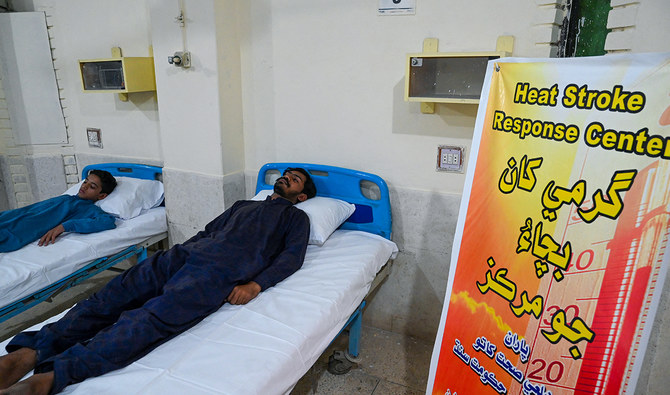
ISLAMABAD: The temperature in a small, enclosed room in Multan’s Nishtar Hospital is cooler than the temperature outside as three patients infused with an intravenous drip lay on beds and a round water cooler with the words “ORS,” meaning oral rehydration solution, sits at a table in the room.
This is the scene at the heat wave “bay,” a separate unit at the largest public hospital in the city, that is dedicated to heat stroke patients. The 1000-bed hospital, which has been functioning since 1953, has allocated two rooms of its Emergency Ward for patients who come in with cases of dehydration, high blood pressure, diarrhea and other risks associated with a heat stroke.
The initiative was taken after the Pakistan Meteorological Department (PMD) warned of multiple heat waves in the country till June. Parts of Pakistan have seen temperatures as high as 52.2 degrees Celsius (126°F) over the last week as South Asia swelters in a hot summer — a trend scientists say has been worsened by human-driven climate change.
“Definitely there are heat stroke patients coming in here at Nishtar Hospital,” Medical Superintendent Dr. Muhammad Kazim Khan told Arab News on Friday. “There are daily two to three heat stroke patients.”
The hospital has also been treating patients for dehydration, hypertension and other similar problems in recent weeks.
Khan said the hospital’s “heat stroke rooms” were equipped with central air conditioning, with patients having access to all medicines and ORS, a solution of water, salts and sugar to replenish electrolytes lost through dehydration.
In case of a heat stroke, patients spend up to eight hours at the facility before being discharged upon the physician’s advice, according to the medical superintendent.
“Otherwise, if they suffer any complications, then we shift them to a ward where after spending a day or two, they are again discharged,” he said.
Muhammad Mazhar, 50, said he sought treatment at the hospital Thursday night after suffering from diarrhea and vomiting. He was put on a drip and discharged after his condition improved, only to find the symptoms worsened on Friday.
“I came here again an hour ago and have been put on a drip again,” Mazhar told Arab News. “Right now, I am feeling better.”
Aamna Bibi, 45, was shifted to the hospital after she complained of stomach pain.
“I have been sick for the past five years,” she said. “I faint [whenever the heat gets too much] and I am also a heart patient and I also have diabetes.”
Mazhar said the weather in Multan had become “unbearable.”
“The heat in Multan is severe,” Mazhar said. “When a person goes out, it feels as if he is stepping on coals.”
Khan urged people to be careful during heat waves, advising them to avoid venturing outdoors unnecessarily and stay hydrated at all times by increasingly consuming water and juices.
Diabetes, heart diseases and respiratory illnesses, associated with heat stroke, could become “very dangerous” for patients during a heat wave, he warned.
“If we don’t get a season of rainfall and the temperature continues to remain this high, then no doubt there can be a lot of disaster,” the official said.
“And there may be chances of heat wave patients increasing.”


![]()

Heatstroke cases rise in Multan as Pakistan bakes under blistering heat wave
Short Url
https://arab.news/grrg5
Heatstroke cases rise in Multan as Pakistan bakes under blistering heat wave
- Doctors at Nishtar Hospital say increasing number of patients coming in with heatstroke, dehydration and diarrhea
- Pakistan saw temperatures surge past 50 degrees Celsius recently as heat wave grips Pakistan and India
Latest updates


Recommended


© 2026 SAUDI RESEARCH & PUBLISHING COMPANY, All Rights Reserved And subject to Terms of Use Agreement.