

Pakistan PM to strengthen economic ties, meet top investors in China next week – foreign office

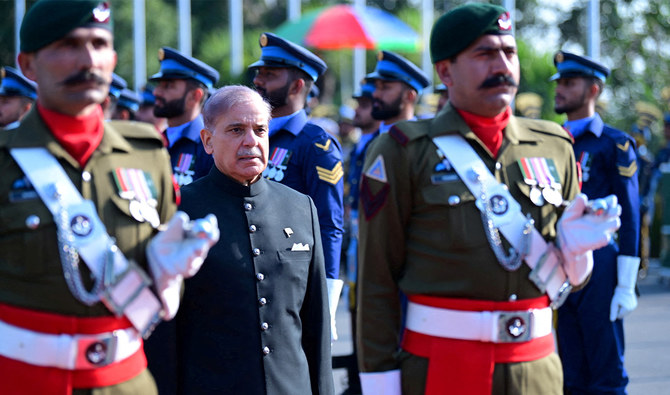
Pakistan's newly elected Prime Minister Shehbaz Sharif, inspects the honor guard at the Prime Minister's House in Islamabad, Pakistan on March 4, 2024. (REUTERS)
Short Url
Updated 31 May 2024
Follow

Pakistan PM to strengthen economic ties, meet top investors in China next week – foreign office

  • Shehbaz Sharif will start his four-day China visit from June 4 to set the ‘future trajectory’ of the strategic ties
  • PM will hold meetings with the Chinese president, senior officials and members of the business community

ISLAMABAD: Prime Minister Shehbaz Sharif’s upcoming four-day visit to China next week will prioritize meetings with top companies and investors, Pakistan’s foreign office said on Friday, highlighting the focus on strengthening economic ties between the two nations.

Earlier today, the PM asked Pakistani officials to carve out a “comprehensive plan” for business-to-business (B2B) engagements during his visit to China on June 4-8 as the South Asian country seeks to woo Chinese investors.

Sharif’s visit comes at a time when Pakistan is looking to boost foreign investment to support its fragile economy after averting a default last year, thanks to a $3 billion International Monetary Fund (IMF) bailout.

“An important aspect of the PM’s visit will be meetings with corporate executives of leading Chinese companies dealing in oil and gas, energy, ICT [information and communication technology], and emerging technologies,” foreign office spokesperson Mumtaz Zahra Baloch said.

She informed during her weekly media briefing Sharif would visit Beijing, Xi’an and Shenzhen, adding he would hold delegation-level talks with President Xi Jinping, Prime Minister Li Qiang, Chairman of the Standing Committee of the National People’s Congress Zhao Leji and heads of key government departments.

She said the PM would also address the Pakistan-China Business Forum attended by leading businesspeople, entrepreneurs and investors from both countries. He would also visit the economic and agricultural zones in China.

Baloch noted the cooperation between the two states during the visit would set the future trajectory of the Pakistan-China strategic partnership.

COUNTERTERRORISM

Asked if Islamabad had officially urged Beijing to talk to Kabul about the terror threat Pakistan faced, she said both countries had several channels of communication where everything including terrorism was discussed.

“So, these talks continue,” she said. “I am not in a position to share internal deliberations and privileged diplomatic conversations. Pakistan and China have been discussing issues relating to terrorism, relating to security of Chinese nationals in the country.”

The spokesperson informed the two countries had agreed to further strengthen cooperation in counterterrorism and security through a comprehensive approach.

“We have made a clear public statement about how we will work together to combat terrorism,” she added. “No attempt to undermine our cooperation and friendship will ever succeed.”

Earlier today, Pakistan’s interior secretary Muhammad Khurram Agha held a meeting with Afghanistan’s interim deputy interior minister Muhammad Nabi Omari in Kabul and shared with him findings of a March 26 suicide attack in northwest Pakistan that killed the five Chinese nationals and their Pakistani driver.

The Chinese workers were killed when a suicide bomber rammed his car into their vehicle while they were on their way to the Dasu hydropower project in Pakistan’s northwestern Khyber Pakhtunkhwa province.

Islamabad blamed the Tehreek-e-Taliban Pakistan (TTP) for the attack, with Pakistan’s interior minister saying last week the bombing was coordinated by TTP members from Afghanistan, asking Kabul to arrest and hand over the suspects involved in the crime.


Qatar, Pakistan resolve to boost strategic, economic cooperation at Doha talks

Updated 58 min 37 sec ago
Follow

Qatar, Pakistan resolve to boost strategic, economic cooperation at Doha talks

  • Both countries urge dialogue on Afghanistan amid renewed border tensions between Islamabad and Kabul
  • Discussions focus on bilateral trade and investment, energy, defense, manpower and labor and culture

ISLAMABAD: Pakistan and Qatar on Tuesday agreed to deepen their strategic and economic cooperation during high-level talks between Prime Minister Shehbaz Sharif and his Qatari counterpart Sheikh Mohammed bin Abdulrahman bin Jassim Al Thani, Sharif’s office said.

Sharif visited Qatar along with a high-level delegation on the invitation of Qatari emir Sheikh Tamim bin Hamad Al Thani. The Pakistani premier also held meetings with Qatar’s trade and defense ministers to discuss cooperation in various domains.

The visit came at a time when Pakistan is seeking closer economic engagement with Gulf partners amid its broader push to stabilize the economy and attract investment, while maintaining security and defense cooperation with key regional states.

During their meeting in Doha, PM Sharif and Qatar’s Sheikh Mohammed discussed bilateral relations and exchanged views on regional and international developments, according to the Pakistan prime minister’s office.

“They reaffirmed the strong brotherly relations between Pakistan and Qatar and expressed satisfaction at the growing momentum in political, economic and institutional ties,” Sharif’s office said.

“Discussions focused on enhancing cooperation in the fields of trade and investment, energy, defense, manpower and labor and culture, with both sides stressing the importance of their task force to accelerate cooperation in all these areas.”

Pakistan and Qatar maintain strong trade and investment ties. In 2022, the office of Qatar’s emir said the Qatar Investment Authority planned to invest $3 billion in Pakistan, targeting sectors including transport, aviation, education, health, media, technology and labor.

Nearly 300,000 Pakistanis live and work in Qatar, according to Pakistan’s foreign office, with many employed in health, education, engineering and public services, as well as construction and transport. The two countries engage through forums such as the Bilateral Political Consultations and the Joint Ministerial Commission.

Sharif said he had productive discussions with Qatar’s emir, Sheikh Tamim bin Hamad Al Thani, on how the two sides could transform their brotherly ties into mutually beneficial economic relationships. 

“We also took stock of the regional situation,” he said on X. “Pakistan and Qatar will continue to work together for peace and stability in the region and beyond.”

Prime Minister Shehbaz Sharif (second right) meets the Qatari Emir Qatar’s emir Sheikh Tamim bin Hamad Al Thani (left) in Doha, Qatar, on February 24, 2026. (PID)

DIALOGUE WITH AFGHANISTAN

Earlier, Sharif and Qatar’s Deputy PM Sheikh Saoud Al-Thani discussed the situation in Afghanistan and called for dialogue to support regional stability.

The meeting took place amid renewed tensions after Islamabad carried out airstrikes last week on what it described as Tehreek-e-Taliban Pakistan (TTP) targets inside Afghanistan. Kabul said the strikes killed civilians and vowed to respond to what it called a violation of its sovereignty.

“Regional developments were also discussed, in particular the situation in Iran and Afghanistan,” Sharif’s office said in a statement. “Both sides emphasized the importance of dialogue, de-escalation and collective efforts to promote peace and stability in the region.”

This was the second time in less than six months that Pakistan conducted airstrikes in Afghanistan. The last strikes triggered heavy, weeklong clashes between the neighbors along their border before Qatar and Turkiye mediated a ceasefire between them in Oct. last year.

Separately, Sharif held meetings with Qatar’s State Minister for Trade Dr. Ahmed bin Mohammed Al-Sayed and a delegation of the Qatar Businessmen Association (QBA), highlighting Pakistan’s investment-friendly reforms.

He invited QBA members to explore opportunities in infrastructure, logistics, energy, agriculture, technology and export-oriented manufacturing, his office said.