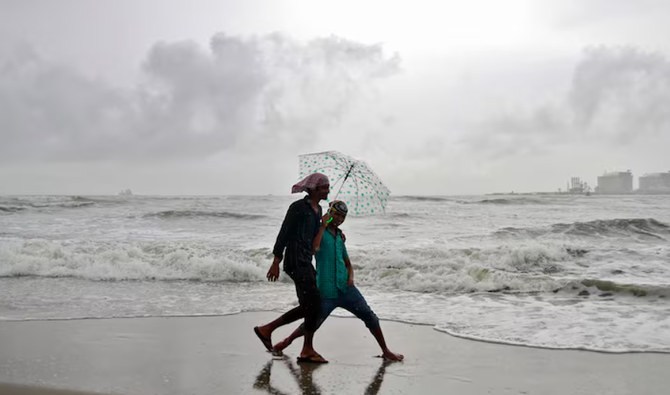
MUMBAI/NEW DELHI: Monsoon rains hit the coast of India’s southernmost state of Kerala on Thursday, two days sooner than expected, weather officials said, offering respite from a gruelling heat wave while boosting prospects for bumper harvests.
Summer rains, critical to spur economic growth in Asia’s third-largest economy, usually begin to lash Kerala around June 1 before spreading nationwide by mid-July, allowing farmers to plant crops such as rice, corn, cotton, soybeans and sugarcane.
The monsoon has covered nearly all of Kerala and most northeastern states, the state-run India Meteorological Department (IMD) said in a statement.
Conditions favored its spread to the neighboring states of Tamil Nadu, Karnataka, and the northeastern state of Assam during the next two to three days, it added.
That spells relief from a stifling heat wave that has driven maximum temperatures above 50 degrees Celsius (122 degrees Fahrenheit) in some northern and western regions.
The monsoon, the lifeblood of the nearly $3.5-trillion economy, brings nearly 70 percent of the rain India needs to water farms and recharge reservoirs and aquifers.
In the absence of irrigation, nearly half the farmland in the world’s second-biggest producer of rice, wheat and sugar depends on the annual rains that usually run from June to September.
India is likely to receive an average amount of rain in June, although maximum temperatures are likely to stay above normal, the IMD said, with the monsoon this year expected to be 106 percent of the long-term average.
In 2023, below-average rainfall depleted reservoirs, hitting food output, prompting government curbs on exports of commodities such as rice, wheat, sugar and onions.
Resumption of exports depends on how quickly production recovers in 2024, which hinges on a plentiful monsoon. That in turn could help rein in food inflation, which is still too high for the central bank’s comfort.


India’s key monsoon rains arrive early, promising respite from heat
https://arab.news/8k8cq
India’s key monsoon rains arrive early, promising respite from heat

- Monsoon rains hit the coast of India’s southernmost state of Kerala on Thursday, two days sooner than expected
- Rains spells relief from heat wave that has driven maximum temperatures above 50 degrees Celsius in some regions

Russia increasing hybrid threats around Sweden: Swedish military intelligence
- “Russia has, in certain cases, stepped up actions and increased its presence,” Nilsson said
- Russia was “constantly developing its capabilities and was ready to take greater risks and use them“
STOCKHOLM: Russia has stepped up its hybrid threat activities and seems willing to take greater risks in Sweden and the region, the head of Sweden’s military intelligence told AFP on Tuesday.
“Russia has, in certain cases, stepped up actions and increased its presence — and perhaps with a greater risk appetite — in our vicinity,” Thomas Nilsson, head of Sweden’s Military Intelligence and Security Service (MUST), told AFP.
He added that he believed Moscow would “unfortunately” continue doing so — regardless of whether it succeeds in Ukraine or not.
Nilsson did not cite any particular attacks, but MUST said in its yearly threat review released Tuesday that Russia “has developed a wide range of methods that can be used within the framework of hybrid warfare,” including disinformation, cyberattacks, economic sanctions, intelligence operations, and election interference.
“A certain desperation can set in, where you push even harder to reach your goals,” Nilsson said, referring to Russia.
Conversely, he said that if Russia were to succeed “that can lead to an increased appetite for risk.”
Russia was “constantly developing its capabilities and was ready to take greater risks and use them.”
“Including what I call advanced sabotage. Including assassination plots, serious arson, and attacks on critical societal infrastructure,” he said.
In its review, the agency noted that so far “the most risk-prone actions through sabotage and hybrid measures have mainly affected other allies.”
But Nilsson also told AFP that Sweden’s security situation had continued to deteriorate, as it has in previous years, particularly since Russia’s 2022 invasion of Ukraine.
Russia is also the main “military threat to Sweden and NATO,” the review stated, warning the threat was likely to grow as Russia increases resources for its armed forces.
“Alongside resources for the war in Ukraine, Russia is reinforcing its resources in the Baltic Sea region, as it is a strategically very important region for Russia, both economically and militarily,” MUST wrote in the review.
MUST said that the Baltic Sea build-up “has already begun,” but added that “the pace will be affected” by the course of the war in Ukraine as well as the Russian economy and the country’s relations with China.
The report came as Russian and Ukrainian negotiators were due to meet in Geneva for fresh US-brokered talks seeking to end the four-year war, as both sides accused the other of a fresh wave of long-range strikes.