

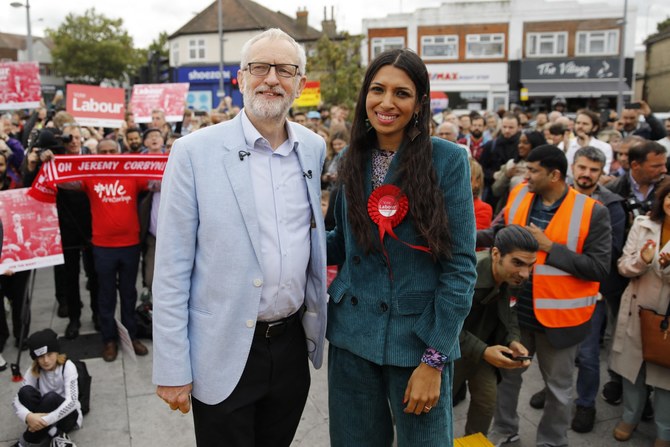

LONDON: Labour Party bosses have blocked a candidate from standing at the upcoming UK General Election because of a handful of interactions on social media platform X, formerly Twitter, over the past 10 years.
In one case, economist and academic Faiza Shaheen “liked” a video of a TV comedy sketch about Israel by acclaimed American comedian Jon Stewart, host of satirical news program The Daily Show. In another she wrote about her own experiences with Islamophobia within the Labour party.
Shaheen said she was informed on Wednesday night that she could not stand for the party at the election, after she was called to a meeting to discuss accusations of antisemitism and other misconduct. She told the BBC’s Newsnight program on Wednesday of her shock upon receiving the email confirming her candidacy had been blocked.
“Fourteen tweets since 2014 — 10 years,” she said. “Three of those were about the Green Party, me liking my friends’ tweets before I joined the Labour Party, and one of them was about my experiences of Islamophobia in the party.
“How am I not allowed to talk about my experiences of Islamophobia and the double standards that I’ve seen.”
I’m genuinely worried for my civil liberties under a @Keir_Starmer government.
Watch this, from @faizashaheen tonight on #newsnight pic.twitter.com/Qy2suvfuvd
— Aaron Bastani (@AaronBastani) May 29, 2024
Shaheen, an academic who specializes in the study of inequality, had been presented with a list of tweets earlier in the day, including one that included a clip from The Daily Show broadcast in July 2014. In it, host Stewart, who is of Jewish heritage, starts to discuss an Israeli ground offensive during the 2014 Gaza War. He is immediately surrounded and rebuked by four of the Comedy Central show’s correspondents who, as part of the show’s satirical commentary on the issue, accuse him of being a “self-hating Jew” for questioning the actions of Israel.
Shaheen’s interaction with video on social media prompted a complaint from the Jewish Labour Movement, which is affiliated with the Labour Party.
“It was the middle of the night, if you look at the time. I was probably with the baby, breastfeeding. I don’t even remember liking that tweet,” she said during her appearance on Newsnight.
She later accused the Labour Party of waging “a systematic campaign of racism, Islamophobia and bullying” and alleged that the party, led by Keir Starmer, has “a problem with black and brown people.”
Adding that she will challenge the party’s decision in the courts, she said: “This campaign of prejudice, bullying and spiteful behavior has finally been rewarded by Labour’s NEC (National Executive Committee) and my name has been added to the list of those not welcome in the candidate club. And it is no surprise that many of those excluded are people of color.”
Stewart reacted to the Labour Party’s action against Shaheen with a message on Twitter in which he wrote: “This is the dumbest thing the UK has done since electing Boris Johnson.”
The decision by Labour bosses to prevent Shaheen from standing in the Chingford and Woodford Green constituency in North East London comes as the party campaigns for the General Election on July 4, which many experts predict will result in a landslide victory for the party.
However, under Starmer, who became leader in 2020, the party has faced criticism on a number of issues, including its stance on the war in Gaza and its handling of internal matters.
In 2020, watchdogs ruled that the party was responsible for “unlawful” acts of antisemitic harassment and discrimination during the four-and-a-half years when Starmer’s predecessor, Jeremy Corbyn, was party leader.


