

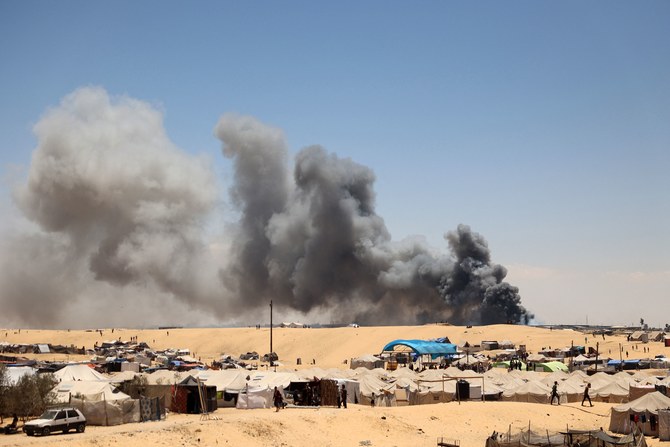
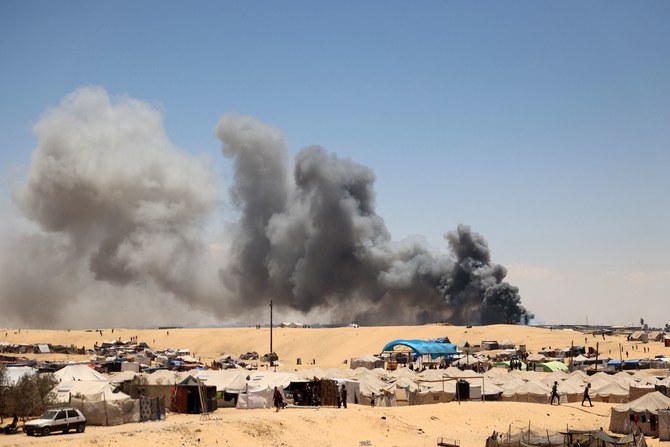
JERUSALEM: Israeli forces killed at least 12 Palestinians in a dawn airstrike on Rafah in southern Gaza on Thursday and fighting raged in several other areas of the coastal enclave, Gaza medics said.
Israel pressed on with its offensive on Rafah a day after saying its forces had taken control of a buffer zone along the nearby border between the Gaza Strip and Egypt, giving it effective authority over Gaza’s entire land frontier.
It said the buffer zone’s capture had cut off a route used by the Palestinian Islamist militant group Hamas to smuggle arms into Gaza during more than seven months of war, which has laid waste to much of the territory and raised fears of famine.
Gaza medical sources said the 12 Palestinians, whom it said were civilians, had been killed and an unspecified number of others wounded in an Israeli airstrike as they tried to recover the body of a civilian in the center of Rafah.
Another Palestinian civilian was killed in an airstrike on Al-Shati refugee camp west of Gaza City in the north of the densely populated enclave, the medics said.
Israel reported clashes in southern, central and northern Gaza but did not immediately comment on the reported deaths in Rafah, where hundreds of thousands of displaced Palestinians took refuge earlier in the war.
Israel has kept up raids on Rafah despite an order by the International Court of Justice (ICJ), the top UN court, to halt its attacks. Israeli forces say they are trying to root out Hamas fighters and rescue hostages being held there, and the ICJ also called for the release of hostages held in Gaza by Hamas.
More than 36,000 Palestinians have been killed in Israel’s air and land war in Gaza, with 53 of those killed in the past 24 hours, the Hamas-run enclave’s health ministry said.
Israel launched its offensive after Hamas fighters crossed from Gaza into southern Israel on Oct. 7 last year, killed 1,200 people and abducted more than 250, according to Israeli tallies.
The Israeli military said a soldier had been killed in fighting in northern Gaza, bringing to 292 Israel’s combat losses since its first Gaza ground incursion on Oct. 20.
TUNNELS, ARMS AND EXPLOSIVES
In an overnight call with US Secretary of Defense Lloyd Austin, Israeli Defense Minister Yoav Gallant underlined the continuing importance of Israeli operations in the Rafah area “due to concrete information regarding hostages held there.”
“Minister Gallant detailed IDF activities in the Rafah area where 20 terror tunnels have been identified,” the Israeli Defense Ministry said in a statement on the overnight call.
The Israeli military also said in a statement that tunnels used by Hamas for smuggling and moving fighters underground had been discovered during the latest raids, as well as large amounts of arms and explosives.
The Israeli statements did not say where the smuggling tunnels ran from. An Israeli official said on May 15 there were 50 tunnels connecting Rafah to the Sinai in Egypt, and voiced concern that Hamas could use them to smuggle senior operatives or hostages into Egyptian territory. Egypt on Wednesday denied the existence of any such tunnels.
The United States, Israel’s closest ally, reiterated its opposition to a major ground offensive in Rafah on Tuesday but said it did not believe such an operation was under way.
The US has, with Egypt and Qatar, been involved in efforts to mediate indirect talks between Israel and Hamas on arranging a ceasefire and the release of the remaining hostages. Those talks have stalled, with both sides blaming the other for the lack of progress.
As the war drags on, malnutrition has become widespread in Gaza as aid deliveries have slowed to a trickle, and the United Nations has warned of incipient famine.
Philippe Lazzarini, head of the UN agency for Palestinian refugees (UNRWA), also called for an end to what he said were Israeli attacks on UNRWA staff and buildings in Gaza.
In article for the New York Times, he said Israeli officials were “delegitimizing UNRWA by effectively characterizing it as a terrorist organization,” and he described a “dangerous precedent of routine targeting of UN staff and premises.”
His comments followed allegations by Israel in January that 12 of UNRWA’s 13,000 staff in Gaza took part in the Oct. 7 attack on Israel. Israel did not immediately respond to his remarks.
The Gaza war has also stoked violence in the Israeli-occupied West Bank, another territory where Palestinians seek statehood.
Israel said two soldiers were killed in an overnight hit-and-run by a Palestinian motorist in the West Bank city of Nablus. There was no immediate claim of responsibility from Palestinian factions.


