Close to 600,000 Afghans expelled from Pakistan since deportation drive launched last year

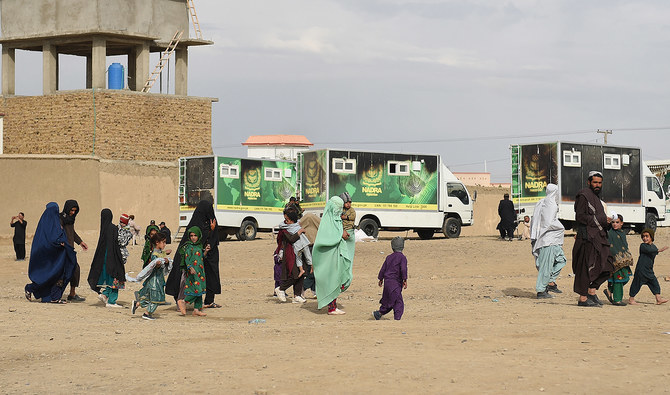
Afghan refugees walk near the Pakistan-Afghanistan border in Chaman on November 7, 2023, following Pakistan's government decision to expel people illegally staying in the country. (AFP)
Short Url
Updated 30 May 2024
Follow

Close to 600,000 Afghans expelled from Pakistan since deportation drive launched last year

  • Radio Pakistan says 13,206 Afghan nationals repatriated over last ten days
  • Islamabad blames Afghans for militant violence, smuggling, other crimes

ISLAMABAD: The repatriation of illegal foreigners living in Pakistan continues with more than 10,000 Afghan nationals expelled over the last ten days, state broadcaster Radio Pakistan said on Thursday, bringing the total number of those deported close to 600,000. 
The government launched a deportation drive last year after a spike in suicide bombings which the Pakistan government, without providing any evidence, says were carried out by Afghan nationals. Islamabad has also blamed them for smuggling, militant violence and other crimes. 
A cash-strapped Pakistan that was navigating its record inflation, alongside a tough International Monetary Fund bailout program last year, had also said undocumented migrants had drained its resources for decades.
“590,445 Afghans have so far been repatriated to Afghanistan,” Radio Pakistan said on Thursday. “According to the latest statistics, 13,206 Afghan nationals returned to their country over the last ten days.”
Until the government initiated the expulsion drive last year, Pakistan was home to over four million Afghan migrants and refugees out of which around 1.7 million were undocumented. 
Afghans make up the largest portion of migrants, many of whom came after the Taliban took over Kabul in 2021, but a large number have been present since the 1979 Soviet invasion of Afghanistan.
Islamabad insists the deportation drive is not aimed specifically at Afghans but at all those living illegally in Pakistan. 
In October 2023, Pakistan announced phase one of the “Illegal Foreigners’ Repatriation Plan” with a 30-day deadline for “undocumented” aliens to leave the country or be subject to deportation, putting 1.4 million Afghan refugees at risk.
In phase two of the “repatriation plan,” around 600,00 Afghans who held Pakistan-issued Afghan citizenship cards (ACCs) will be expelled while phase three was expected to target those with UNHCR-issued Proof of Registration (PoR) cards.
In April, the Ministry of States and Frontier Regions (SAFRON) issued a notification validating the extension of the POR card till June 30 this year.
Before the deportation drive, many people used to cross the Pak-Afghan border back and forth for business and personal purposes daily. The main entry points into Afghanistan are the borders in the Kandahar and Nangarhar provinces.
The deportation drive had led to a spike in tensions between Pakistan and the Taliban rulers in Afghanistan. The Taliban deny militants are using Afghan soil to launch attacks, calling Pakistan’s security challenges a domestic issue.


World Bank approves $700 million for Pakistan’s economic stability

Updated 6 sec ago
Follow

World Bank approves $700 million for Pakistan’s economic stability

  • Of this, $600 million will go for federal programs and $100 million will ⁠support a provincial program in Sindh
  • The results-based design ensures that resources are only disbursed once program objectives are achieved

ISLAMABAD: The World Bank has approved $700 million in ​financing for Pakistan under a multi-year initiative aimed at supporting the country’s macroeconomic stability and service delivery, the bank said on Friday.

The funds will be released under the bank’s Public ‌Resources for Inclusive ‌Development — Multiphase ‌Programmatic ⁠Approach (PRID-MPA) that ‌could provide up to $1.35 billion in total financing, according to the lender.

Of this amount, $600 million will go for federal programs and $100 million will ⁠support a provincial program in ‌the southern Sindh province. The results-based design ensures that resources are only disbursed once program objectives are achieved.

“Pakistan’s path to inclusive, sustainable growth requires mobilizing more domestic resources and ensuring they are used efficiently and transparently to deliver results for people,” World Bank country director Bolormaa Amgaabazar said in a statement.

“Through this MPA, we are working with the Federal and Sindh governments to deliver tangible impacts— more predictable funding for schools and clinics, fairer tax systems, and stronger data for decision‑making— while safeguarding priority social and climate investments and strengthening public trust.”

The approval ‍follows a $47.9 ‍million World Bank grant ‍in August to improve primary education in Pakistan’s most populous Punjab province.

In November, an IMF-World Bank ​report, uploaded by Pakistan’s finance ministry, said Pakistan’s fragmented ⁠regulation, opaque budgeting and political capture are curbing investment and weakening revenue.

Regional tensions may surface over international financing for Pakistan. In May, Reuters reported that India would oppose World Bank funding for Pakistan, citing a senior government ‌source in New Delhi.

“Strengthening Pakistan’s fiscal foundations is essential to restoring macroeconomic stability, delivering results and strengthening institutions,” said Tobias Akhtar Haque, Lead Country Economist for the World Bank in Pakistan.

“Through the PRID‑MPA, we are launching a coherent nationwide approach to support reforms that expand fiscal space, bolster investments in human capital and climate resilience, and strengthen revenue administration, budget execution, and statistical systems. These reforms will ensure that resources reach the frontline and deliver better outcomes for people across Pakistan with greater efficiency and accountability.”

In Sindh, the program is expected to increase provincial revenues, enhance the speed and transparency of payments, and broaden the use of data to guide provincial decision making. The program will directly support the increase of public resources for inclusive development, including more equitable and responsive financing for primary health care facilities and more funding for schools.