



DUBAI: The emerging Saudi artist Nasser Almulhim is an open book. A little over 10 minutes into our interview, Almulhim, speaking from his studio in Riyadh, admits to dealing with mental health issues, particularly depression. He copes, he says, by deep breathing, praying, walking barefoot on the grass, and getting in touch with his spiritual side. The topic arose when I asked about his childhood in Saudi Arabia, at a time when the country was much more restrictive.
“I never confronted this question, because I always feared looking back at memories. It wasn’t an easy lifestyle for men or women,” Almulhim, who was born in 1988, tells Arab News.
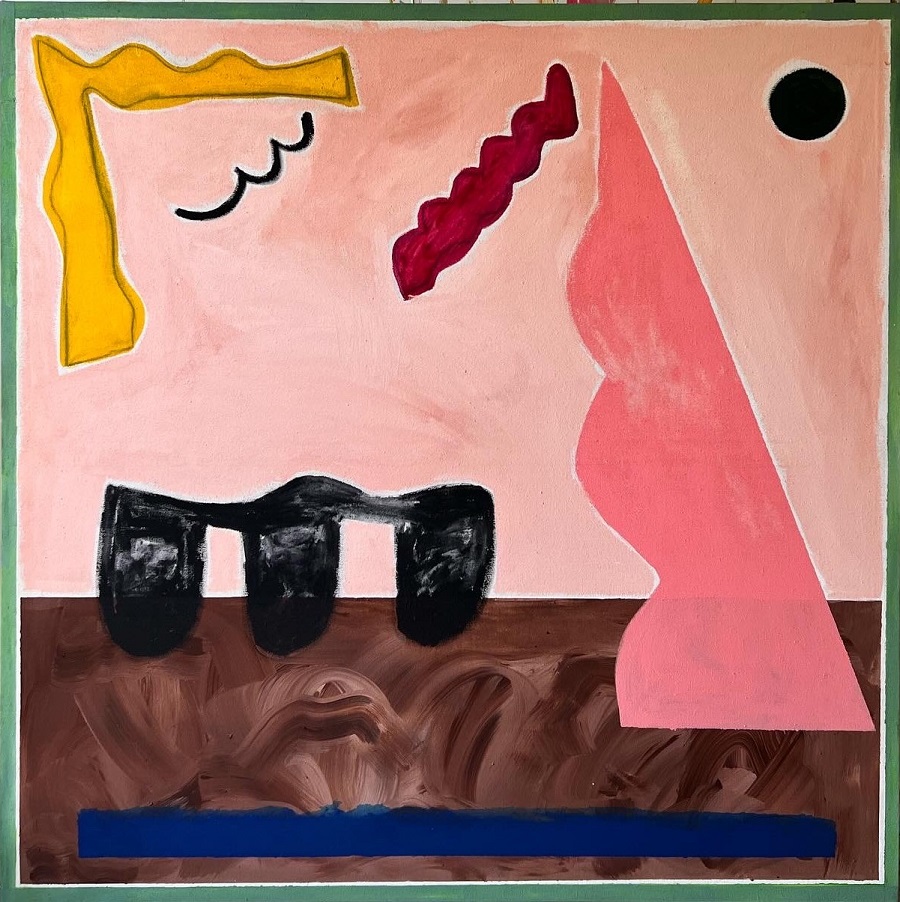
'Balance' by Nasser Almulhim. (Supplied)
Almulhim comes from a large family of four sisters and three brothers. They were raised in Riyadh’s Al-Malaz neighborhood, largely populated by an expat community of Sudanese, Egyptians and Jordanians, according to the artist. Interacting with people of different backgrounds enriched his upbringing.
“My parents raised me well and taught me to respect people from a young age,” he says. “It was a very simple lifestyle. We didn’t have much, but my family provided us with safety and a good education. I studied in a public school and we were in the street a lot. We were playing football and we used to spray paint, just being rebellious, and the police would come,” he says. “Art was dead back in the day. It was haram.”
Despite this, Almulhim, who enjoyed math and science as school subjects, was always sketching. “My parents saw something within me,” he says. It is also possible that Almulhim, who describes himself as a visual, nature-loving person, inherited his artistic sensibilities from his family. Almulhim says his grandmother was a poet, and his father was passionate about analog photography.

The aritst's 'Distance is Near.' (Supplied)
“I believe he has an artistic side, but he is not embracing it,” he says. “He has a beautiful vision, even with the way he decorated the house. It came from someone who was vulnerable and sensitive.”
During Almulhim’s high school years, he started to notice how ‘different’ he was as a Saudi, compared to other Arabs in the region. “We used to travel to Syria and Lebanon,” he recalls. “In Beirut, everyone was hanging out on the beach. People were doing their thing, and then I would come back to Riyadh, and it was the complete opposite. I would ask my dad, ‘Are we outsiders?’ And he would say, ‘There is a system. This is our tradition and culture.’ So I was always trying to do the opposite.”
After graduating from high-school, Almulhim, who didn’t speak English at the time, travelled all the way to Sydney, Australia, to study intensive English courses, and later moved to the US to pursue a bachelor’s degree. “The funny part is, I went there to study engineering,” he says, adding that the men in his family were doctors or engineers. At university, he spent time with creative people studying music and theatre, and they noticed something about him.
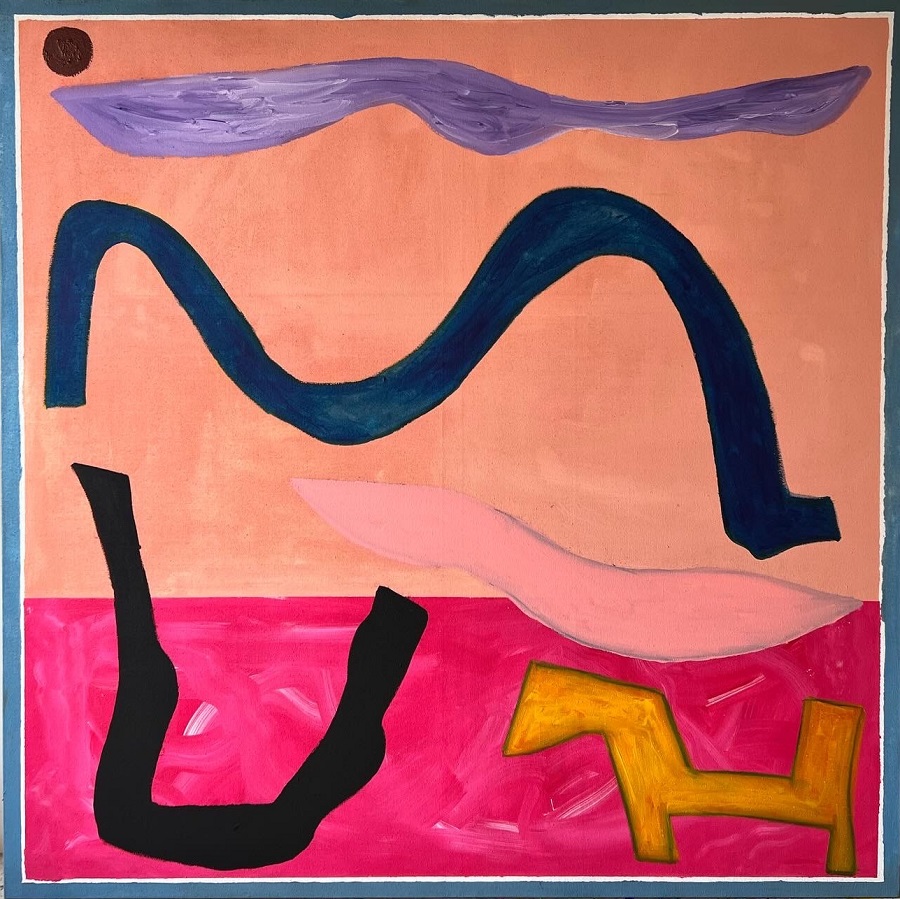
'Face Your Own Madness.' (Supplied)
“They saw me reading books, sketching, playing the guitar, watching art documentaries, and going to museums. They were telling me to shift my major. It was a big deal for me and for my family as well. I shifted to study fine arts, and it was the best decision I’ve ever made. I felt light, I felt like myself,” Almulhim, who graduated with a degree in studio art from the University of West Florida, says.
As reflected in his colorful paintings, Almulhim isn’t afraid of embracing his feminine side, something that stems from his close relationship with his sisters.
“I always felt comfortable talking to them, even about sensitive topics, which I couldn’t talk to my parents about. There was a gap,” he says. But, it has invited criticism from male viewers. “With using pink, for example, I’ve had men ask me, ‘Why are you using pink? You’re a man.’”
He says he wants to go “back to basics” with his painting, by appreciating beauty again.
“In art, beauty is my greatest inspiration. The late Lebanese artist Etel Adnan said that, nowadays in the art scene, we’ve neglected the idea of beauty and we’re just focused on the conceptual,” he says. “People like distraction, which makes sense because we live in distraction. But I feel like beauty is needed for your soul, your physical self, and being nice to other people.”
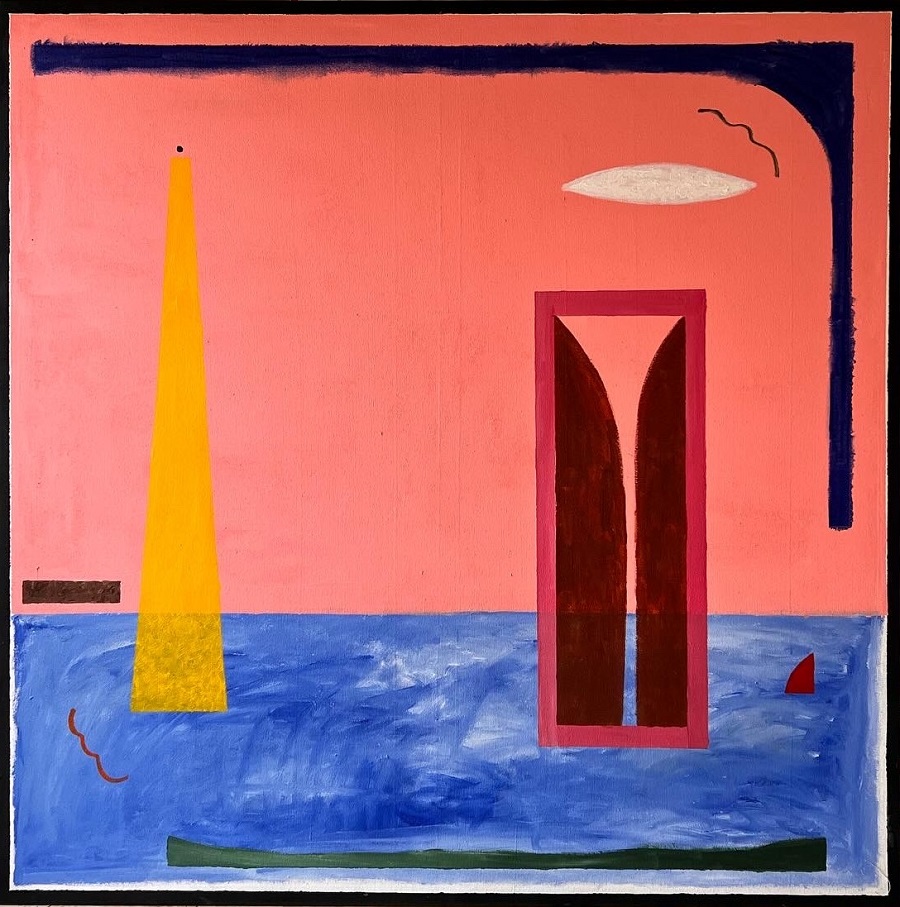
Nasser 'Gazing at The Sea Horizon.' (Supplied)
Almulhim fills his calming canvases, composed of floating geometric forms, with open spaces of color.
“In painting, I like colors that bring happiness and might heal you. It puts you in a state of mind that doesn’t numb you, but makes you disconnect from the distraction around you. I always say that art is therapy for me. Part of it is, I feel like I’m escaping, maybe from some pain that I need to heal from, and part of it is that I’m confronting that pain,” he explains, adding that he hopes to one day pursue a doctorate degree in art therapy. His paintings also contain a psychological and spiritual element, creating a universe of his own, where he is “channeling the Higher Power, Allah, this great universe, this divinity that is outside and within us.”
On June 6, Almulhim will open his new exhibition, “On In-Between,” at Tabari Art Space in Dubai. Through his new paintings, the artist is tackling the psychological stages of the subconscious, pre-consciousness, and consciousness.
“I’m telling the audience that we have to understand this world to heal and to know ourselves,” he says. “Also, it’s fine to flow between these two or three fields. I’m telling you as a humble human being, I am all of these things: My chaos, my order, my vulnerability, my beauty, my ugliness. I’m putting it all out there.”
Almulhim is also driven at this stage of his career by collaborating with fellow artists in the Arab region. He would like to set up art-residency exchanges, where artists from Iraq, Lebanon, Palestine and Jordan can work in his Riyadh space, and vice-versa. He says it was the ongoing tragedy in Gaza that sparked this idea.
“I’m an artist, but, above that, I’m a human being,” he says. “How can I help? How can I contribute? How can we learn from each other as Arabs and as citizens of the globe? I feel in our region, we are in need of this unity.”


