


Saudi Railways announces increased seating capacity of Haramain High-Speed Train for Hajj season

1 / 4
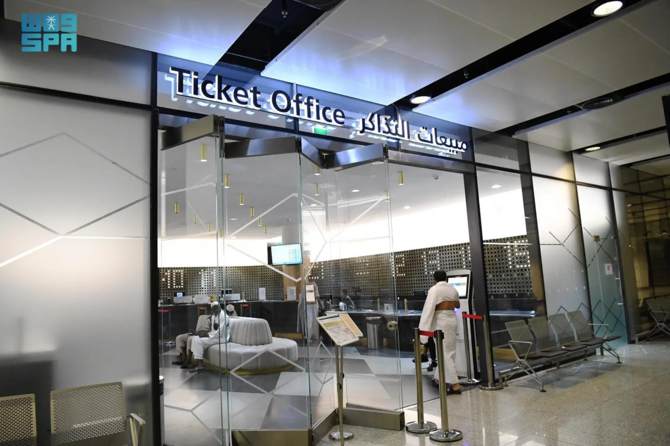
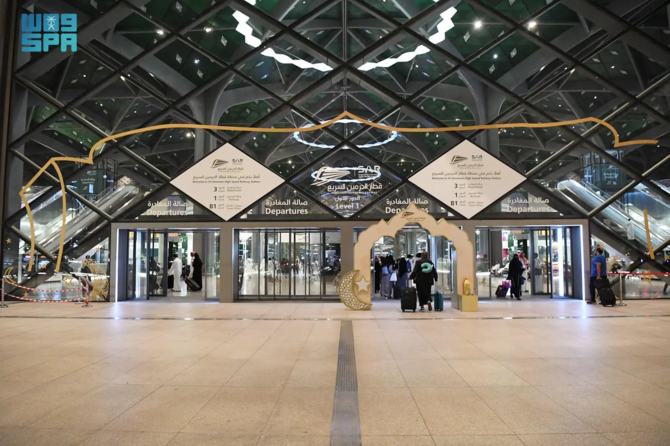
The railway passes through the main Jeddah station in the Sulaymaniyah district, King Abdulaziz Airport station in Jeddah, and King Abdullah Economic City. (SPA)
2 / 4
The railway passes through the main Jeddah station in the Sulaymaniyah district, King Abdulaziz Airport station in Jeddah, and King Abdullah Economic City. (SPA)
3 / 4
The railway passes through the main Jeddah station in the Sulaymaniyah district, King Abdulaziz Airport station in Jeddah, and King Abdullah Economic City. (SPA)
4 / 4
The railway passes through the main Jeddah station in the Sulaymaniyah district, King Abdulaziz Airport station in Jeddah, and King Abdullah Economic City. (SPA)
Short Url
Updated 30 May 2024
Follow

Saudi Railways announces increased seating capacity of Haramain High-Speed Train for Hajj season

RIYADH: Saudi Arabia Railways on Wednesday announced the readiness of the Haramain High-Speed Railway to receive pilgrims for this year’s Hajj season and said it has increased the number of available seats by about 100,000.

SAR revealed its operational plan for the season at its five stations linking Makkah to Madinah, bringing the total number of seats to 1.6 million, up from more than a 1.3 million seating capacity last year, the Saudi Press Agency reported.
The 453-kilometer railway passes through the main Jeddah station in the Sulaymaniyah district, King Abdulaziz Airport station in Jeddah, and King Abdullah Economic City. 
“This expansion also considers the addition of more than 430 new trips to last year’s trips, raising the number of trips scheduled in the operational plan for this year to more than 3,800” from May 9 to June 25, while the numbers of trips on peak days will be 126, SPA said.
The Haramain High-Speed Railway train ranks among the 10 fastest electric trains globally. It reaches 300 km per hour, and operates a fleet of 35 trains, with a capacity of 417 seats per train. It functions based on an environment-friendly system and zero carbon emissions, and plays an important role in preserving roads’ infrastructure by reducing road traffic.


Islamabad family opens their home to hundreds during Ramadan

Syed Mohammad Omar Shah has been running a daily iftar during Ramadan for almost a decade. (Supplied)
Updated 7 sec ago
Follow

Islamabad family opens their home to hundreds during Ramadan

  • Initiative runs on personal savings, avoids public donations and zakat restrictions
  • Even after Pakistan’s record 38% inflation peak in 2023, family refused to stop serving

ISLAMABAD: As the sun dipped toward the horizon in Islamabad earlier this week, Syed Mohammad Umar Shah’s modest apartment building quietly transformed. Pots simmered, oil crackled and trays of dates and fritters were lined up with care.

Inside, Shah, his wife and their children moved with practiced rhythm — not preparing a private family meal but dinner for more than 100 strangers gathered downstairs to break their Ramadan fast.

Shah, a 45-year-old salaried employee, has been running this daily iftar for almost a decade. He calls those who arrive each evening “Guests of Allah.”

In Ramadan, the Islamic holy month marked by fasting from dawn to sunset, hunger is meant to foster empathy.

Across Pakistan, communal meal spreads known as dastarkhwans are laid out nightly to feed laborers, passersby and the poor. Many are organized through mosques, charities or neighborhood committees.

The Shah family’s initiative operates differently. It runs from their own kitchen, funded largely through personal savings and a small circle of relatives and friends. There are no banners, no institutional sponsorship and no public donation boxes.

“We started from home. Whatever food we cooked at home, we simply began cooking a little extra and started giving it to those people,” Shah said.

“Our effort is always to cook properly, food that we ourselves eat at home. The quality must be clean and good.”

The family’s commitment endured through one of Pakistan’s most punishing economic periods in decades. Inflation peaked at 38 percent in May 2023, according to official data, driven by energy price adjustments, currency depreciation and fiscal reforms tied to a $7 billion IMF stabilization program.

Food prices surged, pushing millions closer to the poverty line. Even middle-income households felt the strain. “As inflation keeps rising, it is becoming difficult for us too because I am a salaried employee,” Shah said. “In the past, we offered a lot of variety … but now, since inflation is rising and salaries are not increasing proportionally, we serve within our means.”

Where the menu once featured dishes such as nihari and chapli kebabs, it has since been simplified. Today, the iftar spread includes pakoras, samosas, jalebis, bread, curry, dates and sharbat.

The family rotates meals every two weeks to avoid repetition and ensure variety. “People should step forward, especially in this inflation, when it is becoming difficult for many to afford food,” Shah added.

“They should see how they can help others.”

The work begins long before sunset. Preparation starts at sahoor, the pre-dawn meal before fasting commences, and continues through the day.

“Our work begins from sehri time because many items must be prepared,” said Mrs. Omer Shah, who managed the kitchen logistics. “For example, pakoras and samosas need preparation. For samosas, we knead the dough, roll it and prepare them in advance. We boil potatoes, chop onions; all this work begins at sehri time.”

Years of constant cooking has taken a toll. She previously required surgery on her hand to remove a lump developed from repetitive strain. Still, she continues overseeing the operation.

Mohammad Bhutta, a cook who had learned under her guidance, helps manage the scale.

“Baji (Mrs. Omer) taught me the work,” Bhutta said as he dipped jalebis into hot oil. “I cook food, bread and curry. We prepare jalebis, pakoras, samosas, dates, sharbat.”

Each evening, as the call to prayer marks sunset, plates are distributed outside. Laborers, sanitation workers and passersby sit shoulder to shoulder.

In a capital often defined by politics and bureaucracy, the daily gathering beneath Shah’s building offers a quieter portrait of Ramadan, one built not on institutional charity, but on family labor, personal sacrifice and the belief that generosity should mirror what one serves at one’s own table.

Unlike many Ramadan initiatives, the family chooses not to collect zakat, the obligatory Islamic alms that must be distributed to specific eligible categories under religious guidelines.

Accepting zakat would have required screening recipients, something Shah did not want to do.

“We have not placed any donation box outside, nor do we collect funds publicly,” Shah said.

And the goal, he insisted, went beyond feeding hunger: “When food is unique, good, not repetitive, and served with love and kindness and when you speak gently to people, heartfelt prayers naturally come out.”