

UK parliament dissolves ahead of election

Short Url
Updated 30 May 2024
Follow

UK parliament dissolves ahead of election

  • Five weeks of campaigning officially began as 650 seats of MPs became vacant at 2301 GMT
  • Prime Minister Sunak set the election for July 4, instead of later in the year as had been widely expected

LONDON: The British parliament dissolved on Thursday ahead of a July 4 general election, which looks set to bring Labour to power after 14 years of Conservative rule.

Five weeks of campaigning officially began as 650 seats of members of parliament (MPs) became vacant at one minute past midnight (2301 GMT) in line with the electoral schedule.
The first week of campaigning has seen a shaky start following Prime Minister Rishi Sunak’s rain-drenched election announcement, with many observers taking the downpour as a bad omen.
Sunak set the election for July 4, instead of later in the year as had been widely expected, in what observers said was an attempt to regain momentum as his party slides in opinion polls.
After 14 years in opposition, the Labour party now has the chance to win back power with its leader Keir Starmer, a former human rights lawyer, at the helm.

Trailing double digits behind Labour in polls, the ruling party also faced a mass exodus of parliamentarians, some throwing in the towel in the face of bleak chances of victory.
Some 129 MPs have so far announced that they will not be standing for re-election. Among them are 77 Conservatives, an unprecedented exodus for a governing party.
Among the Tories standing for re-election, some have made no secret of their annoyance at having been caught off guard by the July election date.
Steve Baker, Secretary of State for Northern Ireland, stood by his decision to continue his vacation in Greece, saying that he would be preparing his campaign there.
Signs of infighting also spilled into the open with one Tory MP backing a candidate from the right-wing populist Reform UK party in her constituency, before being promptly suspended by the Conservatives.

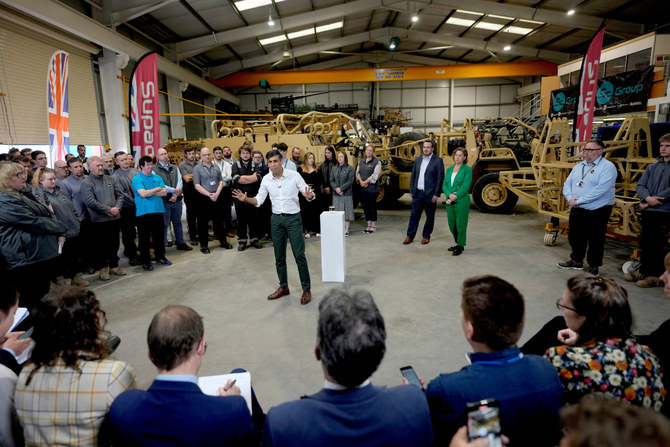
After the election announcement, Sunak traveled across the country, promoting Conservatives as the “safe” option.
His campaign met with some early snags, including a visit to the site where the Titanic was built drawing comparisons between his leadership and captaining a sinking ship.
Doubling down on older voters and right-wing supporters, Sunak’s campaign has seen pledges to bring back national service and what is billed as a £2.4 billion ($3 billion) tax break for pensioners.
However, Sunak’s week of intense campaigning and bid to surprise the country have done little to boost favor.
Polls put Labour on average at 45 percent of voting intentions, against 23 percent for the Tories, suggesting that, given the simple-majority voting system, Labour will enjoy a very large win.
In a bid to turn things around, Sunak is hoping to win points in the scheduled debates with Keir Starmer, the first of which is set to take place next Tuesday on ITV.

Meanwhile, Labour is seeking to capitalize on the public’s weariness with the Conservatives, who have seen five prime ministers since 2016 alongside a slew of scandals and economic woes.
It has tried to focus on its shift to the “natural party of business” after winning the backing of 120 industry leaders this week.
After a resounding defeat under left-wing leader Jeremy Corbyn in 2019, Starmer has pushed the party to the center in a bid to win back voters, including by purging Corbyn and making moves to root out anti-Semitism.
However, the past week has exposed the long-standing factional splits within the party, with MP Diane Abbott expressing her dismay at the party’s desire to bar her from candidacy.
Starmer has insisted that the fate of Abbott, who was suspended last year for comments on racism, had not yet been decided. But the treatment meted out to the highly respected 70-year-old, who has spent 37 years as a member of parliament, has provoked fierce criticism.
Starmer has also faced condemnation from leftist voters who accuse him of rolling back promises he made during his successful leadership campaign.


Trump says Zelensky ‘isn’t ready’ yet to accept US-authored proposal to end Russia-Ukraine war

Updated 08 December 2025
Follow

Trump says Zelensky ‘isn’t ready’ yet to accept US-authored proposal to end Russia-Ukraine war

  • Trump said he was “disappointed” and suggested that the Ukrainian leader is holding up the talks from moving forward
  • He also claimed Russia is “fine with it” even though Putin last week had said that aspects of Trump’s proposal were unworkable

KYIV, Ukraine: President Donald Trump on Sunday claimed Ukrainian President Volodymyr Zelensky “isn’t ready” to sign off on a US-authored peace proposal aimed at ending the Russia-Ukraine war.
Trump was critical of Zelensky after US and Ukrainian negotiators completed three days of talks on Saturday aimed at trying to narrow differences on the US administration’s proposal. But in an exchange with reporters on Sunday night, Trump suggested that the Ukrainian leader is holding up the talks from moving forward.
“I’m a little bit disappointed that President Zelensky hasn’t yet read the proposal, that was as of a few hours ago. His people love it, but he hasn’t,” Trump claimed in an exchange with reporters before taking part in the Kennedy Center Honors. The president added, “Russia is, I believe, fine with it, but I’m not sure that Zelensky’s fine with it. His people love it it. But he isn’t ready.”
To be certain, Russian President Vladimir Putin hasn’t publicly expressed approval for the White House plan. In fact, Putin last week had said that aspects of Trump’s proposal were unworkable, even though the original draft heavily favored Moscow.
Trump has had a hot-and-cold relationship with Zelensky since riding into a second White House term insisting that the war was a waste of US taxpayer money. Trump has also repeatedly urged the Ukrainians to cede land to Russia to bring an end to a now nearly four-year conflict he says has cost far too many lives.
Zelensky said Saturday he had a “substantive phone call” with the American officials engaged in the talks with a Ukrainian delegation in Florida. He said he had been given an update over the phone by US and Ukrainian officials at the talks.
“Ukraine is determined to keep working in good faith with the American side to genuinely achieve peace,” Zelensky wrote on social media.
Trump’s criticism of Zelensky came as Russia on Sunday welcomed the Trump administration’s new national security strategy in comments by the Kremlin spokesman published by Russia’s Tass news agency.

Dmitry Peskov said the updated strategic document, which spells out the administration’s core foreign policy interests, was largely in line with Moscow’s vision.
“There are statements there against confrontation and in favor of dialogue and building good relations,” he said, adding that Russia hopes this would lead to “further constructive cooperation with Washington on the Ukrainian settlement.”
The document released Friday by the White House said the US wants to improve its relationship with Russia after years of Moscow being treated as a global pariah and that ending the war is a core US interest to “reestablish strategic stability with Russia.”
Speaking on Saturday at the Reagan National Defense Forum, Trump’s outgoing Ukraine envoy, Keith Kellogg, said efforts to end the war were in “the last 10 meters.”
He said a deal depended on the two outstanding issues of “terrain, primarily the Donbas,” and the Zaporizhzhia Nuclear Power Plant.
Russia controls most of Donbas, its name for the Donetsk and neighboring Luhansk regions, which, along with two southern regions, it illegally annexed three years ago. The Zaporizhzhia Nuclear Power Plant is in an area that has been under Russian control since early in Moscow’s invasion of Ukraine and is not in service. It needs reliable power to cool its six shutdown reactors and spent fuel, to avoid any catastrophic nuclear incidents.
Kellogg, who is due to leave his post in January, was not present at the talks in Florida.
Separately, officials said the leaders of the United Kingdom, France and Germany would participate in a meeting with Zelensky in London on Monday.
As the three days of talks wrapped up, Russian missile, drone and shelling attacks overnight and Sunday killed at least four people in Ukraine.
A man was killed in a drone attack on Ukraine’s northern Chernihiv region Saturday night, local officials said, while a combined missile and drone attack on infrastructure in the central city of Kremenchuk caused power and water outages. Kremenchuk is home to one of Ukraine’s biggest oil refineries and is an industrial hub.
Kyiv and its Western allies say Russia is trying to cripple the Ukrainian power grid and deny civilians access to heat, light and running water for a fourth consecutive winter, in what Ukrainian officials call “weaponizing” the cold.
Three people were killed and 10 others wounded Sunday in shelling by Russian troops in Ukraine’s Kharkiv region, according to the regional prosecutor’s office.