Islamabad Gandhara symposium, with Buddhist leaders in attendance, highlights Pakistan’s ancient heritage 

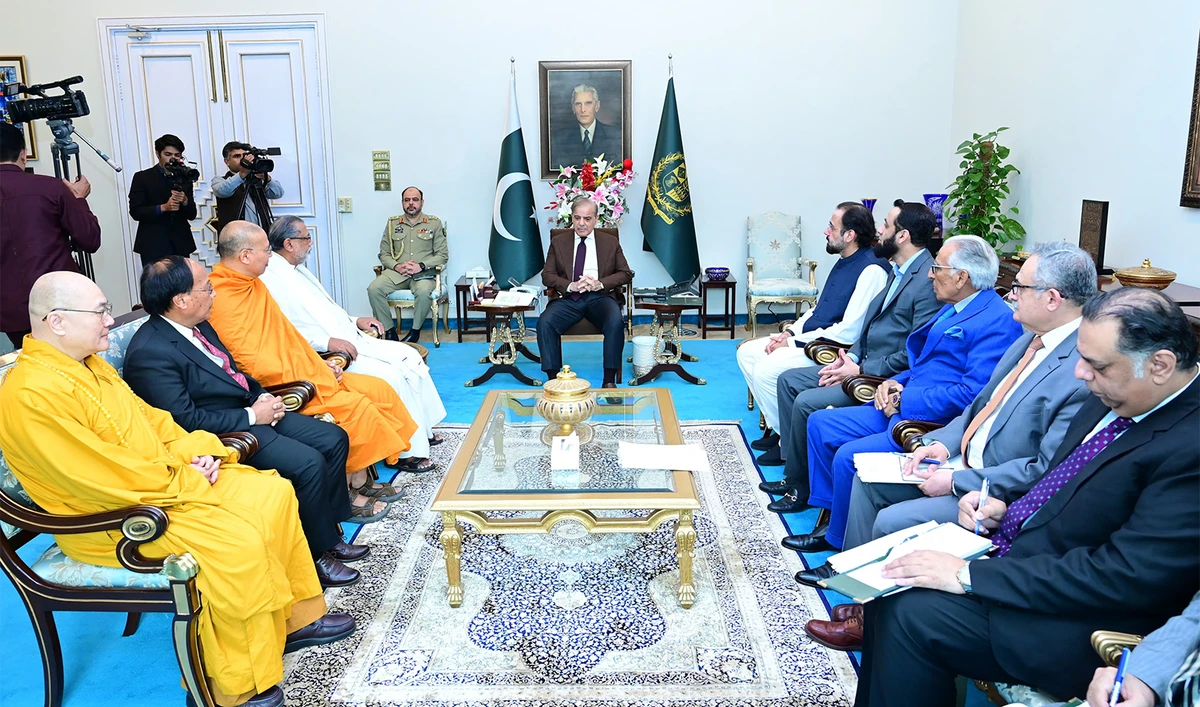
Pakistan Prime Minister Shehbaz Sharif (center) meets with visiting Buddhist leaders in Islamabad, Pakistan, on May 29, 2024. (PID)
Short Url
Updated 29 May 2024
Follow

Islamabad Gandhara symposium, with Buddhist leaders in attendance, highlights Pakistan’s ancient heritage 

  • Ministerial-level participants from Sri Lanka, Nepal, Thailand and Vietnam attend two-day symposium 
  • Symposium features contributions of Gandhara civilization in spread of Buddhism, discussions on inter-faith harmony

ISLAMABAD: A two-day symposium on Gandhara civilization held this week in Islamabad, attended by Buddhist leaders from several countries, put the spotlight on Pakistan’s ancient cultural roots dating back to thousands of years. 

Although Pakistan does not have a significant Buddhist population, several parts of the country were historically important centers of Buddhism during the Gandhara period, from around the 1st century BCE to the 7th century CE.

The Pakistani government has sought to develop religious tourism in these areas, mainly concentrated in the present-day Khyber Pakhtunkhwa and northern Punjab regions, and has regularly hosted Buddhist pilgrims and religious leaders in recent years.

Prime Minister Shehbaz Sharif on Wednesday met a Buddhist delegation visiting Islamabad to attend a two-day symposium on Gandhara civilization. 

“The Prime Minister highlighted that Pakistan was proud of its ancient Buddhist heritage, which flourished in northwest Pakistan in the shape of Gandhara art and culture, over two thousand years ago,” the Prime Minister’s Office (PMO) said in a statement.

The delegation comprised Sri Lanka’s Minister for Buddhasasana, Religious and Cultural Affairs Vidura Wikramanayaka, Vietnamese Buddhist leader Duc Tuan, Thailand’s Anil Sakya and Dr. Keshabman Shakya from Nepal, a statement from Sharif’s office said. 

The PMO said Sharif underscored the importance his government attached to interfaith harmony, adding that the Pakistani premier acknowledged Buddhist scholars’ and monks’ valuable contributions to promoting interfaith harmony.

The delegation appreciated Sharif’s commitment to fostering “a culture of inclusivity and respect for all religions,” the PMO said. It added that the Buddhist leaders commended Pakistan’s efforts to preserve and promote its Buddhist heritage sites and cultural artifacts.

The two-day symposium and exhibition titled “From Gandhara to the World,” organized by the Ministry of Foreign Affairs in Islamabad, kicked off on Tuesday. The event was organized in connection with the ‘Vesak Day,’ which commemorates Gautama Buddha’s birth and enlightenment.

Islamabad-based diplomats, government functionaries, scholars, artists and art lovers attended the symposium. 

Pakistan’s foreign office said foreign delegates, including ministerial-level participants from Sri Lanka, Nepal, Thailand and Vietnam attended the symposium as well.
Gun attack kills policeman, civilian during polio drive in northwest Pakistan

Updated 4 sec ago
Follow

Gun attack kills policeman, civilian during polio drive in northwest Pakistan

  • Pakistani authorities have temporarily suspended vaccination activities in Bajaur district
  • The campaign that started this week aims to vaccinate over 45 million children in Pakistan

PESHAWAR: A gun attack on a polio vaccination team in Pakistan’s northwestern Bajaur district killed a police constable and a civilian on Tuesday, prompting authorities to suspend vaccination activities in the area, officials said.

The attack took place in a small settlement of Bajaur’s Salarzai tehsil, near the Afghan border, where militants have targeted health workers and security personnel involved in polio campaigns in the past despite police escorts assigned to protect vaccination teams.

Pakistan and neighboring Afghanistan are the only two countries where polio remains endemic, and vaccination drives have frequently been disrupted by militant violence, misinformation and vaccine hesitancy.

Authorities routinely deploy police and paramilitary forces to guard polio teams, but attacks have continued in recent years.

“The incident occurred at approximately 12:20 p.m. in Village Tangi Loei Khel, UC Khar 2, when unidentified individuals opened fire on Constable Sajjad, killing him on the spot,” said Shadab Younas, a media officer at the Peshawar Emergency Operations Center.

A civilian bystander, Fazal Rahim, was also hit by gunfire and later died of his injuries after being taken to Khar Hospital, Younas continued, adding that the polio team itself was unharmed.

Global polio tracking data show that 30 of the 39 confirmed wild poliovirus type 1 cases worldwide in 2025 were reported in Pakistan, with the remainder in Afghanistan. Pakistan recorded 74 polio cases in 2024, a sharp rise from six cases in 2023 and just one in 2021, underscoring the fragility of eradication efforts.

Prime Minister Shehbaz Sharif condemned the attack and directed authorities to swiftly identify and bring the perpetrators to justice, according to a statement from his office.

He said the assault on those serving the nation’s polio eradication effort was “deeply regrettable” and reaffirmed that the campaign would continue with full resolve until the disease is eliminated.

The National Emergency Operations Center (NEOC) said the nationwide polio campaign was continuing for a second day, reporting that more than 13.3 million children were vaccinated across the country on the first day of the drive.

The campaign, which started on Dec. 15 and will continue until Dec. 21, aims to administer oral polio drops to more than 45 million children across the country.

Health officials urged parents and communities to cooperate with vaccination teams and ensure children under five receive the drops.

Pakistan and Afghanistan are conducting the polio campaign simultaneously, the NEOC said.