

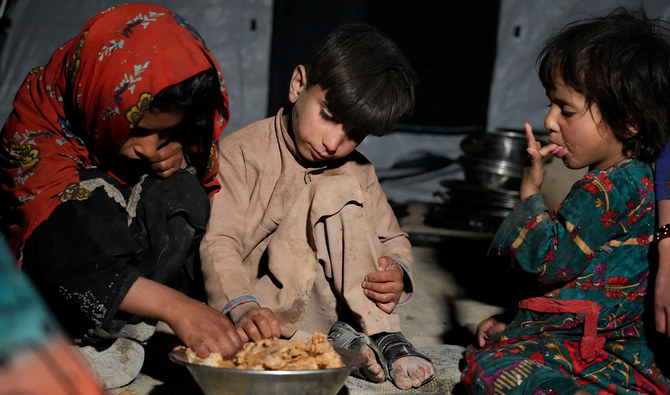

ISLAMABAD: About 6.5 million children in Afghanistan were forecast to experience crisis levels of hunger in 2024, a nongovernmental organization said.
Nearly three out of 10 Afghan children will face crisis or emergency levels of hunger this year as the country feels the immediate impacts of floods, the long-term effects of drought, and the return of Afghans from neighboring Pakistan and Iran, according to a report released late Tuesday by Save The Children.
New figures from global hunger monitoring body Integrated Food Security Phase Classification forecast that 28 percent of Afghanistan’s population, about 12.4 million people, will face acute food insecurity before October. Of those, nearly 2.4 million are predicted to experience emergency levels of hunger, which is one level above famine, according to Save the Children.
The figures show a slight improvement from the last report, released in October 2023, but underline the continuing need for assistance, with poverty affecting half of the population.
Torrential rain and flash floods hit northern Afghanistan in May, killing more than 400 people. Thousands of homes were destroyed or damaged and farmland was turned into mud.
Save the Children is operating a “clinic on wheels” in Baghlan province, which was hit the worst by floods, as part of its emergency response program. The organization added that an estimated 2.9 million children under the age of 5 are projected to suffer from acute malnutrition in 2024.
Arshad Malik, country director for Save the Children in Afghanistan, said that the NGO has treated more than 7,000 children for severe or acute malnutrition so far this year.
“Those numbers are a sign of the massive need for continuing support for families as they experience shock after shock,” Malik said.
Children are feeling the devastating impacts of three years of drought, high levels of unemployment, and the return of more than 1.4 million Afghans from Pakistan and Iran, he added.
“We need long-term, community-based solutions to help families rebuild their lives,” Malik said.
More than 557,000 Afghans have returned from Pakistan since September 2023, after Pakistan began cracking down on foreigners it alleges are in the country illegally, including 1.7 million Afghans. It insists the campaign isn’t directed against Afghans specifically, but they make up most of the foreigners in the South Asian country.
In April, Save the Children said that a quarter-million Afghan children need education, food and homes after being forcibly returned from Pakistan.
Malik added that only 16 percent of funding for the 2024 humanitarian response plan has been met so far, but nearly half the population needs assistance.
“This is not the time for the world to look away,” he said.
Meanwhile, the European Union is allocating an additional 10 million euros (nearly $10.9 million) to the UN food agency for school feeding activities in Afghanistan. These latest funds from the EU follow an earlier contribution of 20.9 million euros ($22.7 million) toward the World Food Program’s school meal program in Afghanistan for 2022 and 2023.
The funding comes at a timely moment and averts WFP having to downsize its school meal program this year because of a lack of funding, the WFP said in a statement.
“Hunger can be a barrier to education. The additional EU funding to our long-standing partner WFP ensures that more children in Afghanistan receive nutritious food,” said Raffaella Iodice, chargé d’affaires of the EU’s delegation to Afghanistan.
The WFP’s statement said that the agency will be able to use the funding to distribute fortified biscuits or locally produced nutritious school snacks to pupils in more than 10,000 schools in the eight provinces of Farah, Ghor, Jawzjan, Nangarhar, Nuristan, Paktika, Uruzgan and Zabul.
Last year, WFP supported 1.5 million school-age children through this program.


