KARACHI: For the past eight years, Mariam Hassan’s biggest concern while out doing her work as a TV health reporter in Karachi has been to limit her water intake lest she has to use the toilet.
Hassan’s problem speaks to one of Pakistan’s most serious public health concerns: public toilets. World Bank data shows 79 million people in the country do not have access to a proper toilet while a recent UNICEF study says 25 million people still practice open defecation.
The lack of toilets for public use is not just a matter of public health but also about safety, women’s rights and human dignity, rights advocates and urban planners say. Indeed, the problem is especially difficult for women, who are not allowed to use the same toilet facilities as men in the conservative Muslim country.
“There is no place available for women and the places that are available are so dirty that you can’t even imagine going there,” Hassan told Arab News, echoing the sentiment of dozens of women interviewed on the subject this week in Karachi, Pakistan’s largest city and home to over 20 million people.
She recounted an instance in 2018 when she worked tirelessly from 7am until 10 at night covering a protest in the city’s Azizabad area without being able to find a single public restroom in the surroundings.
“At last our cameraperson took me to his relative’s house which was quite embarrassing as you’re going to a stranger’s house just to use the restroom,” Hassan said.
The Sindh High Court, troubled by how many Pakistanis don’t have access to public toilets in the country’s commercial hub, has ordered the government to build new facilities and do maintenance work on existing ones. During the proceedings of the case earlier this month, it was revealed that none of the 182 graveyards, 33 prominent markets, 42 roads, 970 bus stops and 133 hospitals in the city has public toilets on their premises.
Asked about the issue, Karachi Mayor Murtaza Wahab Siddiqui, whose Pakistan Peoples Party (PPP) has been ruling the Sindh province since 2008, acknowledged that access to toilets was an issue that had not received due attention in the provincial capital.
“Whether they are public parks, public spaces, buildings or shopping malls, these washrooms were part of the original plan,” he told Arab News. “And as an end result, today, it is evident that this basic necessity is not available to the public the way it should be in public areas.
“The existing toilets and washrooms that have either been encroached upon or converted [into other structures], we will speak to the relevant building associations through the Sindh Building Control Authority so that those washrooms can be reactivated to ensure that people have access to this basic necessity.”
Siddiqui said even before the high court’s ruling, steps had been taken by the Karachi Metropolitan Corporation (KMC) to refurbish old toilets in the city’s zoo and two parks and there were plans to construct washrooms along Karachi’s main thoroughfares and redo washrooms in shopping areas that had fallen into disrepair or been turned into shops or other facilities.
MOBILITY
Rights activists say public toilets are essential infrastructure for cities to guarantee citizens’ right to sanitation and their comfort to circulate in public spaces. In Karachi, the lack of public toilets has particularly impeded women’s ability to go about their daily business, whether as working women out in the field and traveling to jobs or housewives out for shopping or other errands.
“Women also need to travel, women can also go to the market, do shopping, and go to their jobs,” Muhammad Toheed, an urban planner and geographer, said. “Whether women are going on a trip or going to the market, they should mentally prepare themselves that they may not find a restroom facility along the way.”
Javed Ahmed, a city dweller in his 60s, reminisced about a time around three decades ago when the city used to have public toilets but said they had gradually disappeared due to a lack of maintenance and “societal conduct.”
“Later on, perhaps they also introduced mobile toilets. I have seen those vehicles that used to roam around, but they have vanished also,” he said, adding that people from the working classes, especially laborers and rickshaw and taxi drivers, and women, gravely required access to restrooms in public spaces.
“Throughout the city, if I may say, public toilets are nowhere to be seen, and if they are present somewhere, half of them are locked or closed,” Summaiya Khursheed, a working professional, said as she shopped at a local market.
“Just like water and food are your basic necessities, toilets are also among your basic needs. Entire markets have been built for women, but it’s not considered that toilets are also a basic necessity for women.”
Housewife Uzma Hassan outlined the steps women had to take before leaving home, knowing they would not be able to find usable toilets.
“It’s stressful that we have to do it before leaving. We mentally prepare ourselves before leaving, thinking that there won’t be any toilets available. [We worry about] what we would have to do and what not to do, and we shop hurriedly so we may get free quickly to go back home,” she told Arab News.
“There are so many markets open in Karachi, with all kinds of people living here but there should be toilets in these markets and parks. The Sindh government should think about this because it is a very big issue, especially for women.”


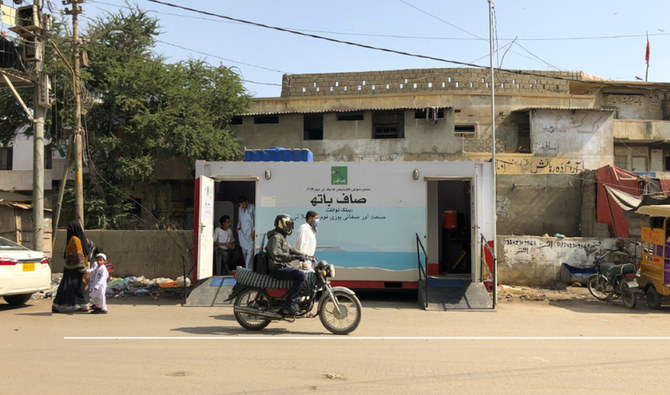
In Pakistan’s largest city, women are bound by a common misery: no public toilets
https://arab.news/46b4v
In Pakistan’s largest city, women are bound by a common misery: no public toilets

- Public toilets are a rare sight in Karachi, city of 20.3 million, which activists say severely impacts women’s mobility, safety
- Sindh High Court this month ordered local authorities to construct bathrooms in markets, parks, hospitals, other public places

Pakistan weighs Trump Gaza board amid expert calls for Muslim allies’ consultations
- Former diplomats warn board could sideline UN, legitimize US unilateral plans
- Analysts say Pakistan should assert independent positions if it joins the body
ISLAMABAD: Pakistan is weighing an invitation from US President Donald Trump to join a proposed international “Board of Peace” on Gaza, a move that has sparked debate among former diplomats and foreign policy experts who warned Tuesday it could sideline the United Nations and urge Islamabad to consult close Muslim allies.
The White House announced on Friday some members of the board, which is expected to supervise the temporary governance of Gaza under a fragile ceasefire in place since October and continue beyond that transitional phase.
These names included US Secretary of State Marco Rubio, Trump’s special Middle East envoy Steve Witkoff, former British prime minister Tony Blair and Trump’s son-in-law Jared Kushner. Trump himself would chair the board, according to a plan unveiled by the White House in October.
Pakistan’s foreign office confirmed on Sunday that Prime Minister Shehbaz Sharif had also received an invitation to join the proposed body, stressing that “the country will remain engaged with international efforts for peace and security in Gaza, leading to a lasting solution to the Palestine issue in accordance with United Nations resolutions.”
“Since the Trump ‘Board of Peace’ is more like an international NGO now, which would include [Indian Prime Minister Narendra] Modi and [Israel’s Benjamin] Netanyahu, Pakistan should carefully take a decision in consultation with its close Muslim allies like Turkiye, Saudi Arabia, Qatar, Jordan, Egypt and Indonesia, and it should be a joint decision of these countries together,” Former federal minister and analyst Mushahid Hussain told Arab News.
“Otherwise, there is no point in being in the queue just to please Trump,” he added.
Israel and the Palestinian group Hamas have agreed that a Palestinian technocratic administration would operate under the oversight of an international board during a transitional period.
Hussain said that if Pakistan did decide to join the board, it should use the platform to clearly articulate its long-held positions.
“Pakistan should play the role of boldly promoting the right of self-determination of the peoples of Palestine and Kashmir, both occupied territories, and oppose any aggression against Iran, as peace and occupation or aggression cannot coexist,” he said.
International affairs analyst and author Naseem Zehra said Pakistan’s participation could still be justified if it allowed Islamabad to assert independent positions on global conflicts.
“Donald Trump has invited 60 heads of states and prime ministers to become part of the peace board, which is more like an alternative to the United Nations,” she said, referring to media reports about the board’s mandate. “If Pakistan is invited among 60 countries, it is acceptable for Pakistan to participate, and with a seat at the table, Pakistan can share its own view of how global issues can be resolved.”
Zehra added that Pakistan’s past diplomatic conduct showed it could maintain principled positions while engaging internationally.
Former ambassador to the United States Maleeh Lodhi took a stronger view, warning that the initiative appeared designed to bypass established international mechanisms.
“Pakistan should not join the Board for many reasons,” she said. “Its aim is for President Trump to get international support and legitimacy for his unilateral plans not just in Gaza but beyond, without member states having any real power.”
“It is being set up to supplant the UN in its primary role of maintaining international peace and security, with Trump effectively calling all the shots,” she added.
When contacted, Pakistan’s Defense Minister Khawaja Asif declined to comment and referred queries to the foreign office.
However, the foreign ministry spokesman Tahir Andrabi did not respond to Arab News requests for comment by the time of filing.
Pakistan has consistently supported Palestinian statehood under United Nations resolutions and has publicly criticized Israeli military operations in Gaza, while also opposing broader regional escalations, including attacks on Iran.


