

Putin warns West not to let Ukraine use its missiles to hit Russia

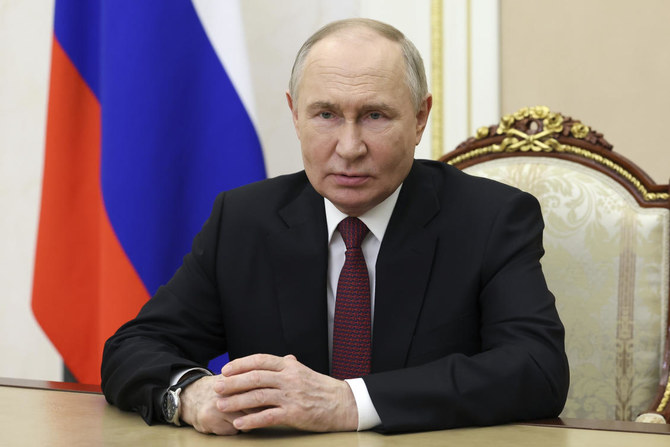
Russian President Vladimir Putin said on Tuesday Ukraine should hold a presidential election following the expiry of President Volodymyr Zelensky’s five-year term. (AP)
Short Url
Updated 28 May 2024
Follow

Putin warns West not to let Ukraine use its missiles to hit Russia

  • “Constant escalation can lead to serious consequences,” Putin told reporters in Tashkent
  • “If these serious consequences occur in Europe, how will the United States behave, bearing in mind our parity in the field of strategic weapons?“

MOSCOW: Russian President Vladimir Putin warned the West on Tuesday that NATO members in Europe were playing with fire by proposing to let Ukraine use Western weapons to strike deep inside Russia, which he said could trigger a global conflict.
More than two years into the deadliest land war in Europe since World War Two, Putin has increasingly spoken of the risk of a much broader global conflict as the West grapples with what to do about the advance of Russian troops in Ukraine.
NATO Secretary General Jens Stoltenberg told The Economist that alliance members should let Ukraine strike deep into Russia with Western weapons, a view supported by some NATO members but not by the United States.
“Constant escalation can lead to serious consequences,” Putin told reporters in Tashkent. “If these serious consequences occur in Europe, how will the United States behave, bearing in mind our parity in the field of strategic weapons?“
“It’s hard to say — do they want a global conflict?“
Putin said Ukrainian strikes on Russia with long-range weapons would need Western satellite, intelligence and military help — so the West would be directly involved. He said sending French troops to Ukraine would be a step toward a global conflict.
Speaking of NATO members in Europe, Putin said that small countries there “should be aware of what they are playing with,” as they had small land areas and very dense populations.
“This is a factor that they should keep in mind before talking about striking deep into Russian territory,” Putin said.

RUSSIAN ADVANCES TRIGGER DEBATE IN WEST
Russia’s 2022 invasion of Ukraine touched off the worst breakdown in relations with the West for 60 years, and the crisis is escalating into what diplomats say is its most dangerous phase to date.
The invasion has caused the deaths of tens of thousands of Ukrainian civilians, driven millions to flee abroad, and reduced neighborhoods and whole cities to rubble.
Russia, which controls 18 percent of Ukraine, is advancing and has opened a new front in the Kharkiv region, triggering a debate in the West about what else it can do after giving Kyiv hundreds of billions of dollars in aid, weapons and intelligence.
Western leaders and Ukraine have played down Russia’s warnings about the risk of a broader war involving Russia, the world’s biggest nuclear power, and NATO, the world’s most powerful military alliance led by the United States.
Ukraine says it should be able to hit behind Russian lines, including against Russian sovereign territory, to fight back.
But Russian officials say Moscow’s patience is wearing thin after repeated Ukrainian attacks on Russian cities, oil refineries, and, in recent days, even against elements of its nuclear early warning system.
Asked by Russian state television about the legitimacy of Ukrainian President Volodymyr Zelensky, Putin said the only legitimate authority in Ukraine now was parliament, and that its head should be given power.
Zelensky has not faced an election despite the expiry of his term due to martial law which was imposed after the invasion.


New Zealand mosque killer appeal causing ‘distress’ to victims: lawyer

Updated 2 sec ago
Follow

New Zealand mosque killer appeal causing ‘distress’ to victims: lawyer

WELLINGTON: Appeal hearings for a white supremacist who shot dead 51 people at two New Zealand mosques in 2019 caused “immense distress” to his victims, a lawyer representing the state said Friday as proceedings wrapped up.
Brenton Tarrant, a 35-year-old Australian former gym instructor, admitted carrying out New Zealand’s deadliest modern-day mass shooting before being sentenced to life in jail in August 2020.
The convicted killer argued this week in Wellington’s Court of Appeal that “torturous and inhumane” detention conditions had made him incapable of making rational decisions when he pleaded guilty, according to a court synopsis of the case.
As a week of hearings came to a close on Friday, Crown lawyer Madeleine Laracy urged the court to dismiss Tarrant’s case because he had no legal defense to offer at trial and conviction was certain, state broadcaster RNZ reported.
She urged the court to give closure to the victims and the wider Muslim community.
“There are literally hundreds of directly harmed victims in this case and keeping this case alive is a source of immense distress for those individuals,” Laracy said, according to RNZ.
The three judges did not give a decision on Friday in his case.
Tarrant is being held in a specialist unit for prisoners of extreme risk at Auckland Prison, seldom interacting with inmates or other people.

- Life sentence -

On Monday, he gave evidence via video link and said he did not have the “mind frame or mental health required” to give an informed guilty plea in 2020.
But Laracy told the three-judge panel on Friday that Tarrant was always going to end up in prison whether he had pleaded guilty or not.
“He was between a rock and a rock,” she said.
Tarrant’s lawyers, whose names are suppressed for security reasons, said his prison conditions were unlike anything else in the system.
If the court upholds Tarrant’s conviction, it will also need to consider an appeal against his sentence.
If his conviction is overturned, the case will be sent to the High Court for a retrial.
Armed with an arsenal of semi-automatic weapons, Tarrant attacked worshippers at two mosques in Christchurch on March 15, 2019.
He published an online manifesto before the attacks and then livestreamed the killings for 17 minutes.
His victims were all Muslim and included children, women and the elderly.
His penalty of life imprisonment without parole was the stiffest in New Zealand history.
There were heavy restrictions on who could be in court during the appeal hearing, with only counsel, media and court officials allowed.
Families and friends of those killed or wounded in the attacks were invited to watch proceedings in Christchurch remotely by video with a one-hour delay.