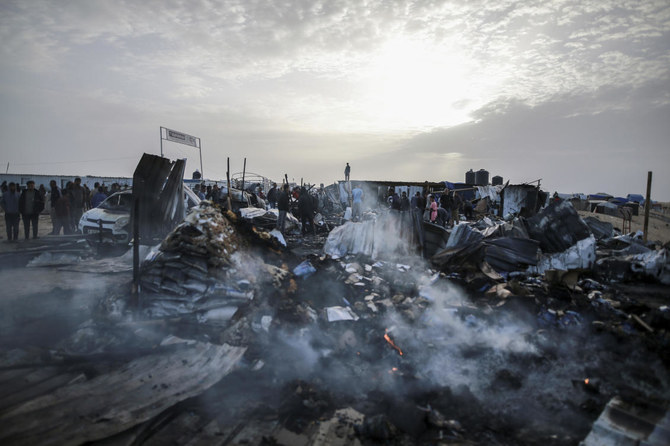
Israeli army says it used small munitions in Rafah airstrike, and fire was caused by secondary blast

Palestinians look at the destruction after an Israeli strike where displaced people were staying in Rafah, Gaza Strip, on May 27, 2024. (AP)
Short Url
Updated 28 May 2024
Follow

Israeli army says it used small munitions in Rafah airstrike, and fire was caused by secondary blast

  • Daniel Hagari, the chief military spokesman, said Tuesday that the military fired two 17-kilogram munitions that targeted two senior Hamas militants
  • He said the military is looking into the possibility that weapons were stored in the area

DEIR AL-BALAH, Gaza Strip: The Israeli military says an initial investigation into a strike that sparked a deadly weekend fire in a tent camp in the southern Gaza city of Rafah has found the blaze was caused by a secondary explosion.
Rear Adm. Daniel Hagari, the chief military spokesman, said Tuesday that the military fired two 17-kilogram (37-pound) munitions that targeted two senior Hamas militants. He said the munitions would have been too small to ignite a fire on their own and the military is looking into the possibility that weapons were stored in the area.
Palestinian health officials say at least 45 people, around half of them women and children, were killed in Sunday’s strike. The fire also could have ignited fuel, cooking gas canisters or other materials in the densely populated camp housing displaced people.
The strike caused widespread outrage, including from some of Israel’s closest allies. Prime Minister Benjamin Netanyahu said it was the result of a “tragic mishap.”
New strikes in the same western Tel Al-Sultan district of Rafah that was hit Sunday killed at least 16 Palestinians, the Palestinian Civil Defense and the Palestinian Red Crescent said Tuesday. Residents reported an escalation of fighting in the southern Gaza city once seen as the territory’s last refuge.
An Israeli incursion launched in early May has caused nearly 1 million to flee from Rafah, most of whom had already been displaced in the war between Israel and Hamas. They now seek refuge in squalid tent camps and other war-ravaged areas.
The United States and other allies of Israel have warned against a full-fledged offensive in the city, with the Biden administration saying that would cross a red line and refusing to provide offensive arms for such an undertaking. On Friday, the International Court of Justice called on Israel to halt its Rafah offensive, an order it has no power to enforce.
Netanyahu has vowed to press ahead, saying Israeli forces must enter Rafah to dismantle Hamas and return hostages taken in the Oct. 7 attack that triggered the war.
Israel says it is carrying out limited operations in eastern Rafah along the Gaza-Egypt border. But residents reported heavy bombardment overnight in Tel Al-Sultan.
“It was a night of horror,” said Abdel-Rahman Abu Ismail, a Palestinian from Gaza City who has been sheltering in Tel Al-Sultan since December. He said he heard “constant sounds” of explosions overnight and into Tuesday, with fighter jets and drones flying over the area.
He said it reminded him of the Israeli invasion of his neighborhood of Shijaiyah in Gaza City, where Israel launched a heavy bombing campaign before sending in ground forces in late 2023. “We saw this before,” he said.
Sayed Al-Masri, a Rafah resident, said many families have been forced to flee their homes and shelters, with most heading for the crowded Muwasi area, where giant tent camps have been set up on a barren coastline, or to Khan Younis, a southern city that suffered heavy damage during months of fighting.
“The situation is worsening” in Rafah, Al-Masri said.


Editorial: The threat of Yemen’s fragmentation is far reaching

President of Yemen’s Presidential Leadership Council Rashad Mohammed Al-Alimi. (SABA Net)
Updated 7 sec ago
Follow

Editorial: The threat of Yemen’s fragmentation is far reaching

  • The southern issue is a just cause — one that must be addressed in any future political settlement and not reduced to the ambitions of any single individual, including the likes of Aidarous Al-Zubaidi

RIYADH: As Yemen’s political landscape continues to shift at a dizzying pace, it is worth pausing to reflect on the official Saudi position — and the commentary of some of our leading Saudi columnists — regarding the recent unilateral moves by the Southern Transitional Council (STC) in the governorates of Hadramout and Al-Mahrah. These actions, taken without the consent of the Presidential Leadership Council (PLC) or coordination with the Arab Coalition, represent a dangerous gamble with the future of a fragile nation — one that Saudi Arabia, like its Arab neighbors, wishes only peace, stability, and prosperity.
There is no ambiguity in the Kingdom’s stance: it has worked tirelessly to preserve calm in Hadramout and Al-Mahrah, steering both regions away from military escalation and toward peaceful solutions. In a bid to contain the situation, Saudi Arabia, in coordination with its brothers and partners in the United Arab Emirates and the PLC, dispatched a joint team to negotiate with the STC. The goal was clear — facilitate the withdrawal of STC forces and hand over military sites to the National Shield Forces.
Yet despite Riyadh’s call for de-escalation and its appeal to the STC to prioritize national interest and social cohesion, the Council has persisted in its confrontational posture, seemingly indifferent to the grave consequences of its actions.
Observers in Riyadh will note that the Kingdom remains steadfast in its support for the PLC and Yemen’s internationally recognized government. Its commitment to Yemen’s stability is not rhetorical — it is political, economic, and developmental. Saudi Arabia’s vision is to shepherd Yemen from the shadows of conflict into an era of peace, prosperity, and regional integration. This is not merely a function of geography or shared borders; it is a reflection of the Kingdom’s religious, political, and economic responsibilities in the Arab and Islamic world.
From this vantage point, the newspaper firmly believes that the STC’s unilateral actions in Hadramout constitute a blatant violation of Yemen’s transitional framework. They undermine the legitimacy of the recognized government, threaten the fragile peace, and jeopardize the political process. Worse still, they echo the very tactics employed by the Houthi militias — an alarming parallel that should not be ignored.
It is therefore essential to reiterate the Kingdom’s position: the STC must withdraw its forces from Hadramout and Al-Mahrah, restoring the status quo ante. This is not a punitive demand, but a necessary step to safeguard national security and prevent further military flare-ups.
At the same time, Saudi Arabia has consistently affirmed that the southern issue is a just cause — one that must be addressed in any future political settlement. It is enshrined in the outcomes of Yemen’s National Dialogue and must be resolved inclusively, reflecting the aspirations of all southern Yemenis — not reduced to the ambitions of any single individual, including the likes of Aidarous Al-Zubaidi or other STC figures.
Ultimately, we urge the separatists to choose reason over recklessness. Partitioning Yemen will not bring peace — it will sow the seeds of future wars, embolden extremist actors, and pose a threat not only to Yemen’s internal cohesion but to regional and international stability. As Western and American policymakers know all too well: what happens in Yemen never stays in Yemen.