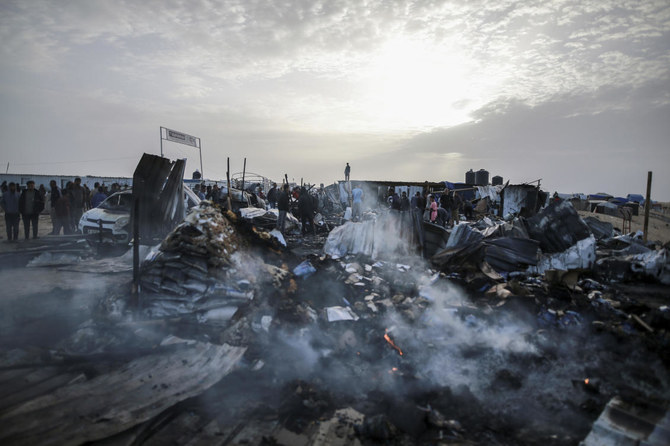
DEIR AL-BALAH, Gaza Strip: The Israeli military says an initial investigation into a strike that sparked a deadly weekend fire in a tent camp in the southern Gaza city of Rafah has found the blaze was caused by a secondary explosion.
Rear Adm. Daniel Hagari, the chief military spokesman, said Tuesday that the military fired two 17-kilogram (37-pound) munitions that targeted two senior Hamas militants. He said the munitions would have been too small to ignite a fire on their own and the military is looking into the possibility that weapons were stored in the area.
Palestinian health officials say at least 45 people, around half of them women and children, were killed in Sunday’s strike. The fire also could have ignited fuel, cooking gas canisters or other materials in the densely populated camp housing displaced people.
The strike caused widespread outrage, including from some of Israel’s closest allies. Prime Minister Benjamin Netanyahu said it was the result of a “tragic mishap.”
New strikes in the same western Tel Al-Sultan district of Rafah that was hit Sunday killed at least 16 Palestinians, the Palestinian Civil Defense and the Palestinian Red Crescent said Tuesday. Residents reported an escalation of fighting in the southern Gaza city once seen as the territory’s last refuge.
An Israeli incursion launched in early May has caused nearly 1 million to flee from Rafah, most of whom had already been displaced in the war between Israel and Hamas. They now seek refuge in squalid tent camps and other war-ravaged areas.
The United States and other allies of Israel have warned against a full-fledged offensive in the city, with the Biden administration saying that would cross a red line and refusing to provide offensive arms for such an undertaking. On Friday, the International Court of Justice called on Israel to halt its Rafah offensive, an order it has no power to enforce.
Netanyahu has vowed to press ahead, saying Israeli forces must enter Rafah to dismantle Hamas and return hostages taken in the Oct. 7 attack that triggered the war.
Israel says it is carrying out limited operations in eastern Rafah along the Gaza-Egypt border. But residents reported heavy bombardment overnight in Tel Al-Sultan.
“It was a night of horror,” said Abdel-Rahman Abu Ismail, a Palestinian from Gaza City who has been sheltering in Tel Al-Sultan since December. He said he heard “constant sounds” of explosions overnight and into Tuesday, with fighter jets and drones flying over the area.
He said it reminded him of the Israeli invasion of his neighborhood of Shijaiyah in Gaza City, where Israel launched a heavy bombing campaign before sending in ground forces in late 2023. “We saw this before,” he said.
Sayed Al-Masri, a Rafah resident, said many families have been forced to flee their homes and shelters, with most heading for the crowded Muwasi area, where giant tent camps have been set up on a barren coastline, or to Khan Younis, a southern city that suffered heavy damage during months of fighting.
“The situation is worsening” in Rafah, Al-Masri said.


![]()

Israeli army says it used small munitions in Rafah airstrike, and fire was caused by secondary blast
Short Url
https://arab.news/cab4f
Israeli army says it used small munitions in Rafah airstrike, and fire was caused by secondary blast
- Daniel Hagari, the chief military spokesman, said Tuesday that the military fired two 17-kilogram munitions that targeted two senior Hamas militants
- He said the military is looking into the possibility that weapons were stored in the area


Latest updates


© 2026 SAUDI RESEARCH & PUBLISHING COMPANY, All Rights Reserved And subject to Terms of Use Agreement.