Growing number of Indian women perform Hajj without male guardians

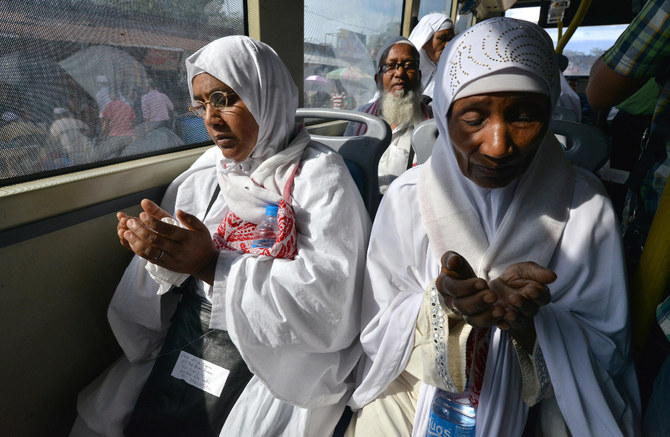
Indian pilgrims pray before leaving for the holy city of Makkah, in Guwahati. (File/AFP)
Short Url
Updated 28 May 2024
Follow

Growing number of Indian women perform Hajj without male guardians

  • More than 4,600 pilgrims registered in the ‘without mahram’ category
  • Most of them are from the southern state of Kerala

NEW DELHI: The number of Indian women going on Hajj without a male guardian has increased by nearly 20 percent since last year, the Haj Committee of India said on Tuesday.

With more than 200 million Indians following Islam, the Hindu-majority country has the world’s largest Muslim-minority population. Under the 2023 Hajj quota, 175,000 of them are traveling to Saudi Arabia this year for the spiritual journey that constitutes one of the five pillars of Islam.

The pilgrim breakdown is 51 percent male and 49 percent female, according to Haj Committee of India data, which also shows that the number of female pilgrims is on the rise, especially those traveling on their own.

Saudi Arabia last year lifted a rule that required female pilgrims to be accompanied by a mahram, or male guardian. India tweaked its Hajj policy accordingly in February 2023, and sent 4,000 pilgrims registered in the category for women traveling without a guardian.

“This time 4,665 women are going without mahram, and it was around 4,000 last year,” Haj Committee of India chairman A.P. Abdullakkutty told Arab News.

“It is heartening to see the growing number of female pilgrims every year. This signifies growing female empowerment among Muslim women and their growing confidence. Women are asserting their independence more than before.”

Most of the women traveling alone come from the southern state of Kerala, where Muslims constitute about 27 percent of the population, and Islam is the second-largest religion after Hinduism.

“Out of the 4,665 women going without mahram this time 3,000 are from Kerala,” Abdullakkutty said.

“The reason more women are going from Kerala is because the imams are more encouraging.”

This year, Hajj is expected to begin on June 14 and end on June 19. While the pilgrimage can be performed over five or six days, many pilgrims choose to arrive early for what may be a once-in-a-lifetime opportunity to fulfill their religious duty.

Hajj flights for Indian pilgrims started on May 9.

At least two of the flights will be run only by women and carry only female pilgrims. Both are Jeddah-bound and scheduled to depart from Kerala’s Kochi International Airport.


Isolated Kremlin critics lament lost future at Nemtsov memorial

Updated 4 sec ago
Follow

Isolated Kremlin critics lament lost future at Nemtsov memorial

  • Hundreds used to flock to the makeshift memorial on the anniversary of his death
  • Since Russia ordered troops into Ukraine it has intensified a crackdown on dissent, with almost no opposition to the Kremlin visible on the street

MOSCOW: On a bridge next to the Kremlin on a drizzly Friday morning, a lone Russian police officer stood looking at the half-dozen bunches of flowers laying in memory of slain opposition figure Boris Nemtsov.
The symbolism was almost too much.
Four years into Moscow’s full-scale offensive on Ukraine, which has seen President Vladimir Putin eradicate all forms of dissent and usher in strict military censorship laws that have silenced his critics, few Russians dared, or wanted, to pay tribute.
Nemtsov, a longtime Putin opponent, was shot and killed on February 27 2015, meters from the Kremlin’s red walls. He was 55.
Hundreds used to flock to the makeshift memorial on the anniversary of his death, which came on Friday.
This year, there was barely a trickle. Those who turned up were visibly nervous.
“So few people, they’ve all forgotten,” lamented one elderly man, who refused to give his name.
“Everybody is afraid,” a woman standing nearby added.
Since Russia ordered troops into Ukraine it has intensified a crackdown on dissent, with almost no opposition to the Kremlin visible on the street.
AFP reporters on Friday morning saw only around a dozen mourners alongside Western ambassadors laying red carnations.
“Keep moving, don’t gather in a crowd, don’t block the way for other citizens,” a police officer said through a megaphone.
Three days after Russia launched its offensive on Ukraine in 2022, protesters had staged an impromptu rally against the war at the memorial on the anniversary of Nemtsov’s death.
Nemtsov’s supporters have always accused Chechen leader and key Putin ally Ramzan Kadyrov of ordering his killing.
Kadyrov has rejected the claims.
Five Chechens were convicted of a contract killing but investigators never said who it was ordered by.

- ‘Everything is persecuted’ -

For his followers, Nemtsov is a totemic figure in Russian political life — seen as a once-future leader who might have taken the country on a different path.
“I come here every year,” said 79-year-old scientist Sergei at the bridge on Friday.
“Russia should have had — though unfortunately it didn’t work out — a leader exactly like Nemtsov,” he told AFP, declining to give his surname.
“Right now everything here is suppressed, everything is persecuted, people are sitting in prisons.”
A physicist by education, Nemtsov rose to fame in the 1990s as a young, liberal provincial governor, and was widely tipped to take over from Boris Yeltsin.
He gave his hesitant backing to Putin when the ex-KGB spy was tapped to enter the Kremlin instead, but became an early — and fierce — opponent of what he cast as the Russian leader’s creeping authoritarianism.
He had largely lost popularity and was only a marginal figure in Russian politics when he was killed in 2015. Still, his murder shocked the country and the world.
“The hopes of the whole country were pinned on him — of all the people who wanted it to be free here,” said Olga Vinogradova, a 66-year-old volunteer who tends to the pop-up memorial to Nemtsov on the bridge.
“When this man was killed, naturally, all of us were, we were all just executed at that moment. Because our hopes were destroyed,” she said.
“With this memorial, we remind people that there was a different path for Russia. And that there was a real person who could have led us down this path.”

- ‘Forced out’ -

Nemtsov had strongly opposed Putin’s 2014 annexation of Crimea from Ukraine and Moscow’s military backing for pro-Russian separatists in eastern Ukraine.
He was also a close and early ally of Alexei Navalny, who died in 2024 in an Arctic prison in what his supports say was a poisoning.
Open opposition to the Kremlin is unheard of inside Russia since the first days of the Ukraine offensive — when riot police cracked down hard on the thousands that took to the streets to protest.
All major critics of the Kremlin are in exile, prison or dead.
Those that remain have been silenced.
“Many have been forced out of the country, some have been killed,” said Gleb, a 23-year-old photographer.
A movement or person like Nemtsov was “impossible” to imagine right now, he said.
Still, he held on to a slither of hope.
“But everything can change at any moment.”