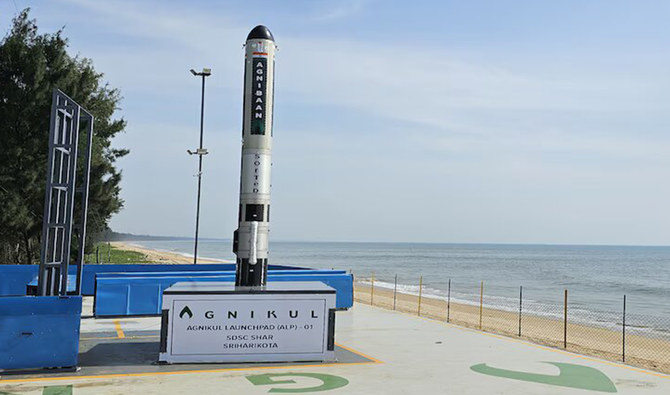
BENGALURU: India’s Agnikul Cosmos called off a test flight of its first rocket on Tuesday seconds before it was due to launch — the fourth such cancelation in the last three months.
Launches of India’s second privately built rocket, and first using a combination of gas and liquid fuel, had been aborted three times before because of technical issues, including one flight that was canceled about 90 seconds before lift-off.
The launch, scheduled for 5:45 a.m. IST (0015 GMT) on Tuesday, was first delayed less than six minutes before lift-off “due to a technical glitch in the countdown activities,” and officials set a new lift-off time of 9:25 a.m.
Only five seconds before lift-off, however, the launch was put on “temporary hold to check igniter performance,” then was called off altogether.
The mission was expected to last two minutes and test the new “semi-cryogenic” engine and 3D-printed parts. If successful, it would have represented a technological step for India, whose Indian Space Research Organization (ISRO) has not yet successfully flown a semi-cryogenic engine, which uses a mix of liquid and gas for propellant.
Agnikul Cosmos’ Agnibaan rocket is a customisable, 2-stage launch vehicle that can take up to 300 kg (about 660 lb) of payload to orbits about 700 km in altitude (435 miles), the company said. SpaceX’s Falcon Heavy can put up to 63,500 kgs to low Earth orbit.
India’s first privately developed rocket, from the company Skyroot, was flown from ISRO’s launch site in 2022.
Founded in 2017, Agnikul — whose name is derived from the Hindi and Sanskrit word for fire — runs the country’s first private launchpad and mission control center, while ISRO operates all other launchpads.


![]()

India’s space startup calls off maiden rocket launch for fourth time
Short Url
https://arab.news/5b4w7
India’s space startup calls off maiden rocket launch for fourth time
- Launches of India’s second privately built rocket had been aborted three times before because of technical issues
- Cosmos’ Agnibaan is customisable, 2-stage launch vehicle that can take up to 300 kg of payload to orbits 700 km in altitude
Latest updates


© 2026 SAUDI RESEARCH & PUBLISHING COMPANY, All Rights Reserved And subject to Terms of Use Agreement.