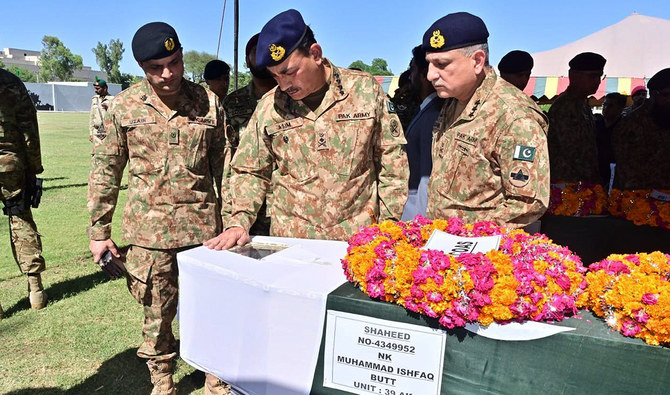
ISLAMABAD: Five Pakistan soldiers were killed in gunbattles with militants in the country’s northwestern Khyber Pakhtunkhwa province that borders Afghanistan, the Pakistani military said on Monday.
The soldiers were killed during an operation against militants in the Khyber district, which also left seven militants dead, according to the Inter-Services Public Relations (ISPR), the military’s media wing. Ten other militants were killed in an operation conducted in the Tank district.
“A large quantity of weapons, ammunition & explosives was also recovered from the killed terrorists, who remained actively involved in numerous terrorist activities against the security forces as well as the innocent civilians,” the ISPR said in a statement.
Sanitization operations were being conducted to eliminate any other threat in these areas, it added.
Monday’s deaths of five Pakistani soldiers were in addition to two other troops, including an army captain, who were killed the previous day in an operation against militants near Peshawar.
Pakistan’s northwestern tribal regions, which border Afghanistan, had long been plagued by the Tehreek-e-Taliban Pakistan (TTP) and other militant groups, until successive military operations since late 2000s drove the militants away.
Islamabad says TTP leaders have taken refuge in neighboring Afghanistan where they run camps to train fighters to launch attacks inside Pakistan. Kabul denies the allegation and says rising violence in Pakistan is a domestic issue for Islamabad.
Relations between Pakistan and Afghanistan have soured in recent months. Islamabad says Kabul is not doing enough to tackle militant groups targeting Pakistan.
On Sunday, Pakistan said it had arrested 11 militants who were involved in a suicide bombing that killed five Chinese engineers, alleging the attack was planned by the TTP in Afghanistan, a charge Kabul has previously denied.


![]()

Five soldiers, 17 militants killed in gunbattles in northwest Pakistan — military
Short Url
https://arab.news/nz4qt
Five soldiers, 17 militants killed in gunbattles in northwest Pakistan — military
- Monday’s deaths of five soldiers were in addition to two other troops, including an army captain, who were killed the previous day in Peshawar
- Islamabad says TTP leaders have taken refuge in neighboring Afghanistan where they run camps to train fighters to launch attacks inside Pakistan
Latest updates


© 2026 SAUDI RESEARCH & PUBLISHING COMPANY, All Rights Reserved And subject to Terms of Use Agreement.