

As Pakistan’s Jacobabad sizzles at 49°C, residents brace for ‘unbearable’ heat in coming months

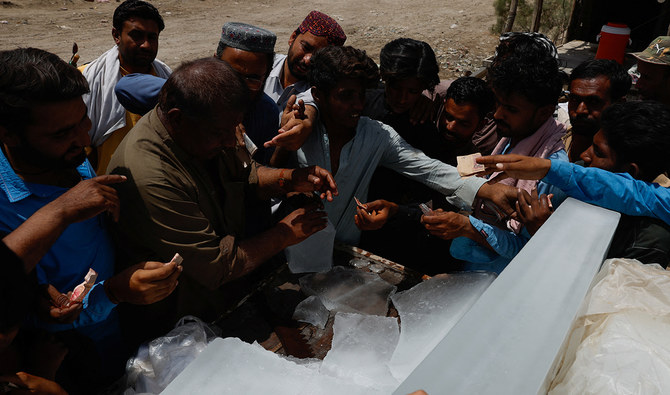
People buy ice blocks from a vendor during a hot summer day, as the heatwave continues in Jacobabad, Pakistan May 26, 2024. (REUTERS)
Short Url
Updated 27 May 2024
Follow

As Pakistan’s Jacobabad sizzles at 49°C, residents brace for ‘unbearable’ heat in coming months

  • Jacobabad in Pakistan’s southern Sindh province is counted among world’s hottest cities 
  • Residents say prolonged power crisis makes heat unbearable during summer months 

ISLAMABAD: The temperature in southern Pakistan’s Jacobabad city skyrocketed to 49° C on Sunday but residents said they feared the coming months would cause “unbearable heat” in the city, as many parts of the country remain in the grip of a heat wave. 

Jacobabad in Pakistan’s southern Sindh province is considered one of the hottest places on earth, where temperatures during the summer frequently cross 50° C. Prolonged power outages and water crisis mean the summer months are particularly harsh for the city’s roughly 300,000 residents. 

Pakistan’s disaster management authority warned earlier this month temperatures in certain areas of Pakistan’s Sindh and eastern Punjab provinces could surge to 40 degrees Celsius between May 15-30. 

But residents, however, are more concerned with what the coming months of June, July and August would bring. Zulfiqar Ali, the owner of a herbal medical shop in the city, said the breeze makes the current heat wave bearable. 

“The actual heat starts in June, July and August,” Ali told Reuters. “The winds stop totally at that time, so it becomes very humid. That heat is unbearable. We sweat so much that we cannot even work.”

Sharjil Ahmed, a school teacher, said residents consume cold drinks to beat the heat when the temperature crosses 50° C. However, power breakdowns make life difficult for the city’s residents. 

“Because of power load shedding, there is a shortage of ice most of the time,” Ahmed said. “We try to stay in the shade, under trees.”

Increased exposure to heat, and more heat waves, have been identified as one of the key impacts of climate change in Pakistan, with people experiencing extreme heat and seeing some of the highest temperatures in the world in recent years. The South Asian country of more than 241 million, one of the ten most vulnerable nations to climate change impacts, has also recently witnessed untimely downpours, flash floods and droughts.

Climate change-induced extreme heat can cause illnesses such as heat cramps, heat exhaustion, heatstroke, and hyperthermia. It can make certain chronic conditions worse, including cardiovascular, respiratory, and cerebrovascular disease and diabetes-related conditions, and can also result in acute incidents, such as hospitalizations due to strokes or renal disease.

According to the Global Climate Risk Index, nearly 10,000 Pakistanis have died while the country has suffered economic losses worth $3.8 billion due to climate change impacts between 1999 and 2018. A deadly heat wave that hit Pakistan’s largest city of Karachi, the capital of Sindh, claimed 120 lives in 2015.


Pakistan Supreme Court halts trial of prominent lawyer over alleged anti-military tweets

Updated 7 sec ago
Follow

Pakistan Supreme Court halts trial of prominent lawyer over alleged anti-military tweets

  • Top court orders lower court to pause proceedings after lawyers allege due-process breaches
  • Mazari-Hazir, husband face charges under cybercrime law that carry up to 14 years in prison

ISLAMABAD: Pakistan’s Supreme Court on Thursday halted the cybercrime trial of prominent human rights lawyer Imaan Mazari-Hazir and her husband, Hadi Ali Chattha, after their lawyers argued that a lower court had recorded witness testimony in their absence, violating due-process rules.

Mazari-Hazir, one of Pakistan’s most outspoken civil liberties lawyers, and Chattha are being prosecuted under the Prevention of Electronic Crimes Act (PECA) over posts on X that authorities say incited ethnic divisions and portrayed the military as involved in “terrorism.” Both reject the allegations. If convicted under the relevant PECA provision, they face a prison term of up to 14 years.

The case has drawn broad attention in Pakistan’s legal community because Mazari-Hazir, who has been repeatedly detained over her criticism of the security establishment, argues that the trial court ignored basic procedural guarantees despite her medical leave request. The case also comes as Pakistan faces sustained scrutiny over the use of PECA against activists, journalists and political dissenters, with lawyers arguing that lower courts often move ahead without meeting minimum fair-trial standards.

The couple’s lawyer, Riasat Ali Azad, said his clients filed a petition in the Supreme Court because the lower court had moved ahead improperly.

“Today, the Supreme Court of Pakistan has stayed the lower court proceedings, the trial court proceedings and has said that the [Islamabad] High Court should decide our pending revision petition for which a date has already been fixed,” he told reporters.

Azad said the violation was clear under Pakistan’s Code of Criminal Procedure, which requires evidence to be recorded in the presence of the accused.

“Yet, on that very day, evidence of four witnesses was recorded in their absence, and a state counsel was appointed to conduct cross-examination on their behalf,” he said. “All these things are against the right to a fair trial under Articles 10 and 10-A.”

A three-judge bench led by Justice Muhammad Hashim Khan Kakar ordered the trial court to pause proceedings and instructed the Islamabad High Court to hear the couple’s pending criminal revision petition first.

The trial had been scheduled to resume on Dec.15, but the Supreme Court’s stay now freezes proceedings before both the additional sessions judge and the special PECA court. 

The Islamabad High Court is expected to hear the criminal revision petition next week.

Chattha, who is also a lawyer, said the SC ruling underscored the need for procedural safeguards.

“It is a victory for the constitution and the law,” he said, arguing that the trial court had ignored their request to re-record witness statements in their presence.