

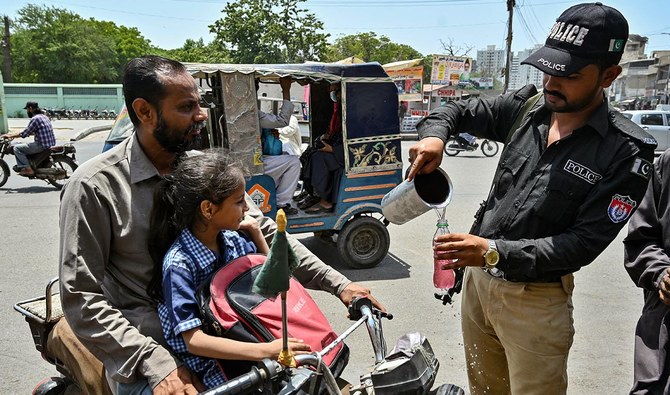

ISLAMABAD: Doctors in Pakistan’s Multan this week advised citizens to exercise caution during the ongoing heat wave, as the administration of the city’s main hospital said it has recorded an increase in the number of patients in recent days owing to the extreme temperature.
The Punjab Disaster Management Authority (PDMA) last week warned that the southern districts in Punjab, namely Multan, Bahawalpur, Rahim Yar Khan and Dera Ghazi Khan would experience a heat wave from May 21-27. Authorities in the province ordered schools to remain shut from May 25-31 due to the extreme heat.
Heat waves become severe and frequent due to climate change. These events, occurring in summer, are caused by slow-moving high-pressure systems leading to prolonged high temperatures.
“These days the temperature is rising already, it’s almost touching 48 and 47, so the patients are coming with minor symptoms,” Dr. Farooq Ahmad, medical superintendent at Multan’s Nishtar Hospital, told Reuters.
“During summer, we face two things, one is the heatwave, the other is the diarrhea season, both basically cause for dehydration and the losses and everything.”
Health experts advise citizens to take special precautions against the heat and not venture out unnecessarily.
“We try our best to inform people coming in [to the hospital about the dangers of heat stroke],” Dr. Ayub Qazi, deputy superintendent at the hospital, told Reuters.
“We tell them to not to leave their homes unnecessarily, and cover their heads when they do.”
Pakistan experienced its first severe heat wave in June 2015 when temperatures as high as 49 degrees Celsius struck the country’s south, causing the deaths of about 2,000 people from dehydration and heatstroke, mostly in the southern port city of Karachi.
Increased exposure to heat, and more heat waves, have been identified as one of the key impacts of climate change in Pakistan, with people experiencing extreme heat and seeing some of the highest temperatures in the world in recent years. The South Asian country of more than 241 million, one of the ten most vulnerable nations to climate change impacts, has also recently witnessed untimely downpours, flash floods and droughts.
Climate change-induced extreme heat can cause illnesses such as heat cramps, heat exhaustion, heatstroke, and hyperthermia. It can make certain chronic conditions worse, including cardiovascular, respiratory, and cerebrovascular disease and diabetes-related conditions, and can also result in acute incidents, such as hospitalizations due to strokes or renal disease.
According to the Global Climate Risk Index, nearly 10,000 Pakistanis have died while the country has suffered economic losses worth $3.8 billion due to climate change impacts between 1999 and 2018. A deadly heat wave that hit Pakistan’s largest city of Karachi, the capital of Sindh, claimed 120 lives in 2015.
In 2022, torrential monsoon rains triggered the most devastating floods in Pakistan’s history, killing around 1,700 people and affecting over 33 million, a staggering number close to the population of Canada. Millions of homes, tens of thousands of schools and thousands of kilometers of roads and railways are yet to be rebuilt.


