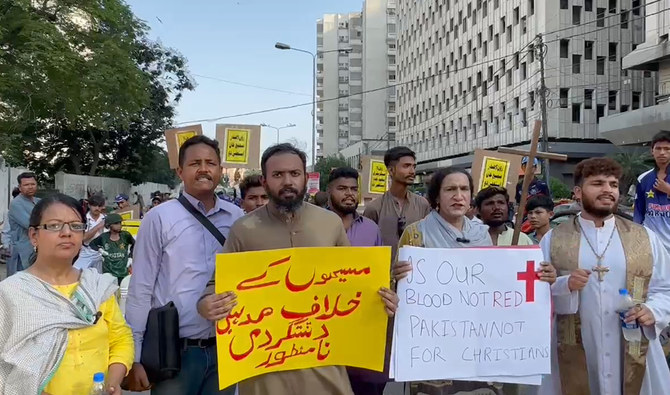

ISLAMABAD/KARACHI: Police in Pakistan’s eastern Punjab province dispersed a furious mob that targeted members of the Christian community on Saturday, leaving one man in critical condition following allegations of desecration of the Muslim scripture, as civil society activists called for an end to “vigilante justice” in the country.
The incident occurred in Sargodha district after some people accused their Christian neighbor of defiling the pages of the Holy Qur’an. The house and a small shoemaking factory owned and operated by the man were burned down in the ensuing rampage, which was followed by police action that led to clashes with the angry protesters.
The incident came within a year after another attack on the Christian community in August last year, when a mob in Jaranwala city burned churches and targeted several houses in a similar incident involving blasphemy allegations.
Speaking to Arab News over the phone, police official Inspector Azar Nadeem confirmed the incident and said the situation was now under control.
“A man named Nazir Masih was injured by the violent mob and is currently in a hospital in critical condition,” he said.
“The police have rescued 10 members of two Christian families in the area who were accused of blasphemy and transported them to a safe place,” he continued. “The police have also arrested 15 people from the area for their involvement in the incident and for pelting stones at the police officials after our teams reached the spot.”
Nadeem informed police contingents had been deployed across the city after the situation was pacified to keep things under control.
Blasphemy is an incendiary charge in Pakistan, where just an accusation can lead to mob lynchings.
Reacting to the development, Peter Jacob, Executive Director of the Center for Social Justice, said such incidents must be brought to an end.
“The Sargodha incident is yet another example of vigilante justice in our society that needs to be discouraged at all levels,” he told Arab News.
“Five extrajudicial killings were reported last year in Pakistan on blasphemy charges, and 552 people were accused of blasphemy only in Punjab last year,” he continued, adding that 94 people had been killed since 1994 across the country by violent mobs following blasphemy allegations.
“There is an urgent need to constitute a commission of inquiry to review the blasphemy laws and recurrent incidents, and parliament should play a role in stopping this madness through mass awareness campaigns,” he said.
Meanwhile, the Christian community in Karachi held a protest demonstration in front of the city’s press club, demanding an inquiry into the incident and expressing their concern over the mob attack.
“As a 27-year-old Pakistani Christian who has never been abroad since the day I was born to the moment I’m standing here, I and every Christian who calls themselves Pakistani live under fear, under pressure and under the constant threat of being, God forbid, accused of committing blasphemy,” Luke Victor, a rights activist and one of the organizers of the Karachi demonstration, told Arab News.
“This is not the first incident, as we saw last year in Jaranwala, which I believe is the world’s largest such incident in which 28 churches and over 100 Christian houses were burned in a single day,” he continued, adding that what had happened in Sargodha was an “extension of what has been happening in Punjab and across Pakistan for the past several years and decades.”
The Human Rights Commission of Pakistan also voiced concern over the safety of the Christian community in Sargodha following the mob violence.
So far, neither the federal nor the Punjab administration has issued a statement about the incident..