Zelensky says Ukrainian forces now control area where Russia pushed into Kharkiv region

1 / 2
Ukraine's President Volodymyr Zelensky (C) takes part in a meeting to address the operational situation in the Kharkiv region and preparations for the upcoming autumn and winter period, amid the Russian invasion of Ukraine. (Ukrainian Presidential Press Office via AP)
2 / 2
Burnt books are seen in a damaged workshop of Ukraine's largest printing house, ruined in a deadly Russian missile attack that killed seven civilians in Kharkiv, Ukraine, on May 24, 2024. (Ukrainian Presidential Press Office via AP)
Short Url
Updated 25 May 2024
Follow

Zelensky says Ukrainian forces now control area where Russia pushed into Kharkiv region

  • A late-night report by the General Staff said Ukrainian forces had repelled 10 Russian attacks in the area, including around Vovchansk.
  • Russian forces were using less infantry around Vovchansk and instead firing from a distance, with limited accuracy.

President Volodymyr Zelensky said on Friday that Ukrainian forces had secured “combat control” of areas where Russian troops staged an incursion this month in northern parts of Kharkiv region.

“Our soldiers have now managed to take combat control of the border area where the Russian occupiers entered,” Zelensky said in his nightly video address.
Zelensky’s comments, after holding a meeting of military and regional officials in Kharkiv, Ukraine’s second largest city, appeared to be at variance with comments by Russian officials.
Viktor Vodolatskiy, a member of Russia’s State Duma lower house of parliament, was quoted by Tass news agency as saying Russian forces controlled more than half the territory of the town of Vovchansk, 5 km (three miles) inside the border.
Vodolatskiy was quoted as saying that once Vovchansk was secured, Russian forces would target three cities in Ukraine’s eastern Donetsk region — Sloviansk, Kramatorsk and Pokrovsk.
Reuters was unable to verify independently battlefield accounts from either side.
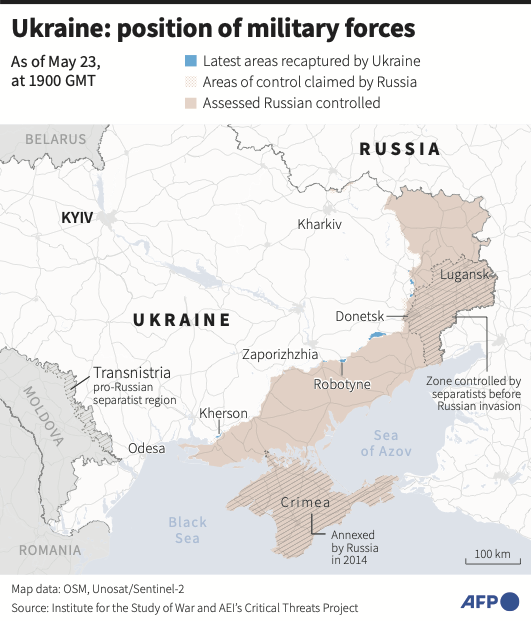
Russian forces pushed into border regions of Ukraine’s Kharkiv region this month and Russia’s Defense Ministry said they had secured control of about 12 settlements.
Zelensky and other Ukrainian officials had been reporting success in “stabilising” the area.
The Ukrainian military’s General Staff, in its evening report on Friday said the situation in Vovchansk was “tense but controlled by the defense forces.”
“The Russian army today launched air terror against this town — eight guided bombs hit the town,” it said. Attacks were launched on at least two other settlements north of Kharkiv.
A late-night report by the General Staff said Ukrainian forces had repelled 10 Russian attacks in the area, including around Vovchansk.
It also noted Russian forces had achieved “partial success” in areas near Kupiansk, further east in Kharkiv region, and the Pokrovsk sector where heavy fighting has been taking place further south in Donetsk region.
Ukrainian military bloggers said Ukrainian troops had been holding their ground around Vovchansk and Russian forces were using less infantry in the area and instead firing from a distance, with limited accuracy.


China voices support Venezuela amid US blockade, but makes no aid pledges

Updated 2 sec ago
Follow

China voices support Venezuela amid US blockade, but makes no aid pledges

BEIJING: China opposed what it said was “unilateral bullying” after Washington ordered a blockade of tankers entering and leaving oil-rich Venezuela, but did not say exactly how it would come to the South American country’s aid or offer any refuge for its embattled leader.
Earlier this week, US President Donald Trump
ordered a complete blockade of all sanctioned oil tankers attempting to leave Venezuelan waters, and those arriving, as Washington massed troops and warships in the region.
China is the biggest buyer of Venezuelan crude, which accounts for roughly 4 percent of its imports, with shipments in December on track to average more than 600,000 barrels per day, analysts have said.
Beijing opposes all forms of “unilateral bullying” and supports countries in safeguarding their sovereignty and national dignity, Chinese Foreign Minister Wang Yi told his Venezuelan counterpart Yvan Gil on a phone call on Wednesday.
Wang did not name the United States or Trump in the official readout of the call. Wang also did not elaborate on the form or extent of the support that China might or could offer to Venezuela, with which Beijing previously said it had forged an ironclad friendship.
The US is squeezing Venezuela’s principal source of revenue in its attempt to target terrorism, drug smuggling and human trafficking, according to Trump. Last week, the US Coast Guard
seized an oil tanker off the coast of Venezuela.
President Nicolas Maduro has said the US wants the OPEC nation’s crude oil resources, and the military build-up was to overthrow him. In an interview with Politico, Trump said Maduro’s days were “
numbered.”
For years, China has extended credit lines to Venezuela under loans-for-oil deals. In a meeting with Chinese President Xi Jinping in Moscow this year, Maduro told Xi that Venezuela was looking forward to expanding cooperation in trade and energy.
At the same time, Beijing has been making an intense effort to co-exist with the US, its most important trading partner. After months of acrimonious dispute over trade and tariffs, Trump and Xi in October managed to hammer out a consensus on how to handle thorny trade issues.
China says it opposes any acts that violate the UN Charter or encroach on the sovereignty and security of other countries.
“China believes the international community understands and supports Venezuela’s position in defending its legitimate rights and interests,” Wang said.
United Nations Secretary-General Antonio Guterres has urged the de-escalation of tensions, asking the US and Venezuela to honor their obligations under international law, including the UN Charter and any other applicable legal framework to safeguard peace in the region.
The presidents of Mexico and Brazil have also urged restraint and dialogue.
Russian President Vladimir
Putin, in a phone call to Maduro last week, “reaffirmed his support for the policy of N. Maduro’s government, aimed at protecting national interests and sovereignty in the face of growing external pressure.”