

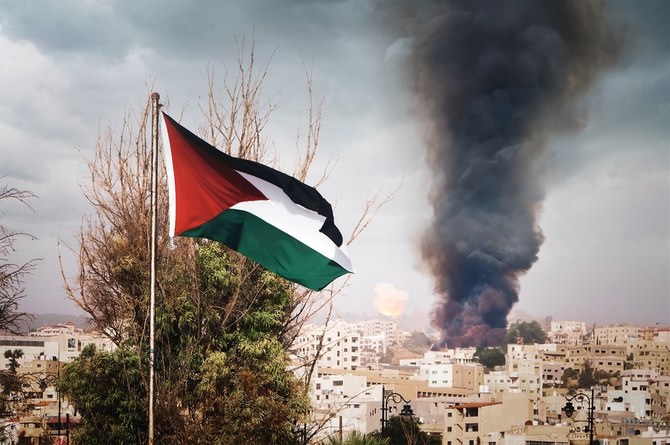

RIYADH: Nearly every Gazan is living in poverty as the Israel-Hamas war continues to have a “devastating impact” on the Palestinian economy, according to the World Bank.
An analysis by the organization sets out how the economic consequences of the conflict have spread beyond Gaza and into the West Bank, with widespread unemployment and underemployment combined with inflation causing a rapid decline in purchasing power for households in both areas.
Nearly half a million jobs across the territories have been lost since October 2023, and per capita gross domestic product declined by 12 percent in 2023.
Israel has bombarded the densely populated Gaza Strip following the Oct. 7 Hamas attack on Israeli communities. Israel says Hamas killed some 1,400 people including children, and took more than 200 hostages, some of them infants and older adults.
The fiscal situation of the Palestinian Authority has dramatically worsened, according to the World Bank, with a financing gap expected to reach $1.2 billion heightening the risk of disorderly adjustments and a potential imminent fiscal collapse.
In May 2023, the World Bank forecast the Palestinian economy to grow about 3 percent by the end of the year, after a 4 percent post-COVID-19 boost in 2022.
That analysis has been completely reversed by the conflict, with the organization now forecasting the Palestinian economy will contract anywhere between 6.5 percent and 9.4 percent during 2024.
“The northern governorates of Gaza are experiencing a full-blown famine, with food insecurity reaching catastrophic levels, particularly in the northern areas and extending southward,” said the World Bank’s latest report, adding: “At least one in four Gazan is experiencing catastrophic hunger, and 95 percent of the population is suffering from food insecurity.”
Most children in Gaza are at risk of “stunting” because of the famine, the analysis added.
Reflecting on the economic impact of the conflict, the report said the outlook of the Palestinian territories for the full year of 2024 “remains highly uncertain, depending on the severity and duration of the conflict, changes in Israeli policies in the West Bank, including those related to access to the Israeli labor market, and the outcome of the clearance revenue dispute.”
The Palestinian Authority is facing a significant decrease in clearance revenue transfers and shrinking domestic resource mobilization, coupled with a rigid current expenditure envelope, the World Bank said.
“The PA’s financing gap after aid for 2023 reached $682 million or 3.9 percent of GDP, and the situation is expected to worsen further in 2024, with a potential financing gap of up to $1.2 billion. A focus on fiscal policies, especially those improving spending efficiency, particularly regarding the unsustainable wage bill and enhancing tax mobilization, must remain a top priority in the reform agenda,” said the report.
The World Bank argued that the banking sector across the territories is “well regulated” by the Palestine Monetary Authority, which has “steadily been building the capabilities and resilience of local banks.”
The report added: “Presently, the banking system is well capitalized, liquid, and compliant with the Capital Adequacy Requirements set by the PMA. At the same time, institutional and economic difficulties are tilting the risks upward for the financial sector. Actively avoiding further instability is crucial to allow the financial sector to maintain its established function as a stable pillar during periods of economic challenges.”


