

SDAIA chief calls for strong legal frameworks to mitigate AI risks

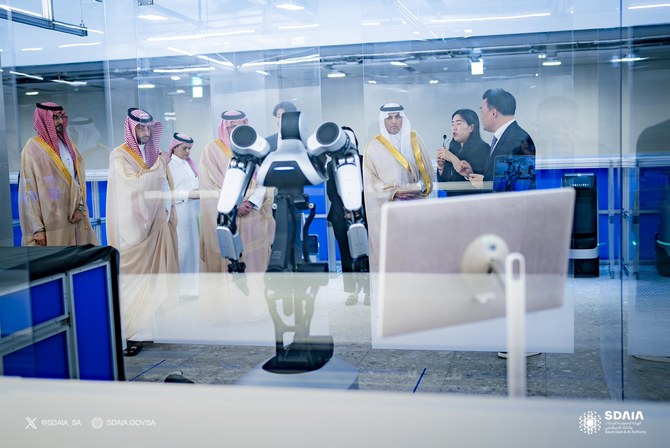
SDAIA President Abdullah bin Sharaf Al-Ghamdi visits a technology firm in Seoul. SPA
Short Url
Updated 07 June 2024
Follow

SDAIA chief calls for strong legal frameworks to mitigate AI risks

RIYADH: The chief of Saudi Arabia’s artificial intelligence authority took part in a top-level summit on AI held in South Korea from May 21-22.

Co-hosted by South Korea and the UK, the summit focused on international cooperation in data and AI, as well as preparations for the third edition of the Global AI Summit, hosted in Riyadh by the Saudi Data and AI Authority in September.

The authority’s president, Abdullah bin Sharaf Al-Ghamdi, in a roundtable discussion at the Seoul summit, said that AI technologies will “experience significant developments” that will result in more efficient and scalable models capable of handling a wider range of tasks.

He highlighted the significance of open-source AI, which fuels innovation and reshapes the technological landscape. A goal of the summit was to explore the transformative potential of open-source AI and open-access databases, he added.

“Open-source AI has the capability to add flexible character to technology, making advanced tools and algorithms accessible to a broad spectrum of creators, such as large companies and individual developers,” Al-Ghamdi said.

This inclusivity accelerates technological advancement through collaboration and ensures a level of transparency in the digital age, Al-Ghamdi added, calling for robust governance frameworks, international cooperation and continuous public awareness efforts to mitigate risks.

Governments require strategies that balance the need for open-source databases to fuel AI innovations while protecting individual privacy and ensuring data security, a balance that can be achieved through strict data protection laws and technical solutions, the SDAIA chief said.

As data flows transcend national borders, coordinating international standards for data access and privacy becomes critical, he added.

“This requires the presence of globally standardized data protection laws, where local regulations must adapt to address specific cultural and economic contexts. This coordination facilitates smoother data exchange, enhances security and privacy, and helps address global challenges collectively.”

By adopting open-source AI and open databases, “we can bring technology to a larger number of people, promote transparency, and foster a more inclusive technological landscape,” Al-Ghamdi said.

“However, this future also requires effective governance, strong regulatory frameworks, and proactive international collaboration to overcome risks and harness the full potential of AI responsibly.”

The Seoul summit was attended by technology and communications ministers as well as AI experts from countries around the world.


PIF’s Humain invests $3bn in Elon Musk’s xAI prior to SpaceX acquisition

Updated 18 February 2026
Follow

PIF’s Humain invests $3bn in Elon Musk’s xAI prior to SpaceX acquisition

JEDDAH: Humain, an artificial intelligence company owned by Saudi Arabia’s Public Investment Fund, invested $3 billion in Elon Musk’s xAI shortly before the startup was acquired by SpaceX.

As part of xAI’s Series E round, Humain acquired a significant minority stake in the company, which was subsequently converted into shares of SpaceX, according to a press release.

The transaction reflects PIF’s broader push to position Saudi Arabia as a central hub in the global AI ecosystem, as part of its Vision 2030 diversification strategy.

Through Humain, the fund is seeking to combine capital deployment with infrastructure buildout, partnerships with leading technology firms, and domestic capacity development to reduce reliance on oil revenues and expand into advanced industries.

The $3 billion commitment offers potential for long-term capital gains while reinforcing the company’s role as a strategic, scaled investor in transformative technologies.

CEO Tareq Amin said: “This investment reflects Humain’s conviction in transformational AI and our ability to deploy meaningful capital behind exceptional opportunities where long-term vision, technical excellence, and execution converge, xAI’s trajectory, further strengthened by its acquisition by SpaceX, one of the largest technology mergers on record, represents the kind of high-impact platform we seek to support with significant capital.” 

The deal builds on a large-scale collaboration announced in November at the US-Saudi Investment Forum, where Humain and xAI committed to developing over 500 megawatts of next-generation AI data center and computing infrastructure, alongside deploying xAI’s “Grok” models in the Kingdom.

In a post on his X handle, Amin said: “I’m proud to share that Humain has invested $3 billion into xAI’s Series E round, just prior to its historic acquisition by SpaceX. Through this transaction, Humain became a significant minority shareholder in xAI.”

He added: “The investment builds on our previously announced 500MW AI infrastructure partnership with xAI in Saudi Arabia, reinforcing Humain’s role as both a strategic development partner and a scaled global investor in frontier AI.”

He noted that xAI’s trajectory, further strengthened by SpaceX’s acquisition, exemplifies the high-impact platforms Humain aims to support through strategic investments.

Earlier in February, SpaceX completed the acquisition of xAI, reflecting Elon Musk’s strategy to integrate AI with space exploration.

The combined entity, valued at $1.25 trillion, aims to build a vertically integrated innovation ecosystem spanning AI, space launch technology, and satellite internet, as well as direct-to-device communications and real-time information platforms, according to Bloomberg.

Humain, founded in August, consolidates Saudi Arabia’s AI initiatives under a single entity. From the outset, its vision has extended beyond domestic markets, participating across the global AI value chain from infrastructure to applications.

The company represents a strategic initiative by PIF to diversify the Kingdom’s economy and reduce oil dependence by investing in knowledge-based and advanced technologies.