US, Canada squads at the Twenty20 World Cup are a melting pot of nationalities

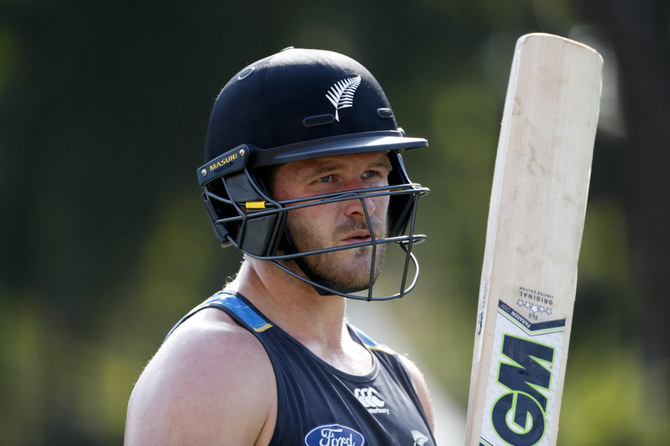
Former New Zealand allrounder Corey Anderson is the US team's most recognized member. The 33-year-old Anderson played 13 Tests, 49 one-day internationals and 31 T20 internationals for New Zealand between 2013 and 2018. (File/AP)
Short Url
Updated 23 May 2024
Follow

US, Canada squads at the Twenty20 World Cup are a melting pot of nationalities

  • The team provides a snapshot of US cricket at this formative stage, as Major League Cricket jostles for its place in a crowded sporting market
  • Canada will be led by the veteran left-armer spinner Saad bin Zafar, who was born in Pakistan
  • The US meet Canada in the tournament opener on June 1 and then there’ll be a step up for both teams in Group A

NEW YORK: The US cricket team which will co-host the Twenty20 World Cup may be a fitting cross-section of its country as a roster of migrants, a melting pot of nationalities and cultures.

The 15-man squad includes players born in India, Pakistan, New Zealand and South Africa. Home-grown players include vice-captain Aaron Jones, who was born in Queens, and allrounder Steven Taylor, of Hialeah, Florida.

The team provides a snapshot of US cricket at this formative stage, as Major League Cricket jostles for its place in a crowded sporting market. The squad includes foreign players drawn to America by the MLC and local players given the chance to play cricket at a professional level in the United States

The home team’s most recognized member is the former New Zealand allrounder Corey Anderson. The 33-year-old Anderson played 13 Tests, 49 one-day internationals and 31 T20 internationals for New Zealand between 2013 and 2018 in a career limited by injuries.

He earned a place in cricket history for his 36-ball century in a one-day international between New Zealand and the West Indies on New Year’s Day, 2014. Anderson also has played in T20 leagues in Australia, India, the Caribbean and UAE before finding an MLC home at the San Francisco Unicorns.

Anderson made his first half-century for the US in their T20 win over Canada last month.

Mumbai-born Harmeet Singh, who played for India at two Under-19 World Cups, was the star for the 19th-ranked US team earlier this week in an upset win over Bangladesh. It the only the second win over a full ICC member for the US

He scored 33 from the 13 deliveries he faced and shared an unbeaten, match-winning 62-run partnership with Anderson, who was unbeaten on 34.

“It means a lot to us to put on a show against Bangladesh. We are no walkovers,” Harmeet told ESPNcricinfo. “I think our potential is immense.”

The US meet Canada in the tournament opener on June 1 and then there’ll be a step up for both teams in Group A, which also includes India and Pakistan, fierce cricket rivals with enormous support, and Ireland.

Among the other foreign-born players on the US squad coached by ex-Australia batter Stuart Law is right-arm fast bowler Ali Khan, who moved with his parents from Pakistan to the US when he was 18.

He first played for the US team in 2016 and has also has played in the Indian Premier League, Caribbean Premier League and Pakistan Premier League, in Global T20 Canada and the Afghanistan Premier League.

Captain Monank Patel, a wicketkeeper-batsman, was born in India and settled in New Jersey after moving permanently to the US in 2016. He played at a junior level for Gujarat in India and played the first of his 47 one-day internationals and 23 T20 internationals for the US in 2019.

Andries Gous, another wicketkeeper-batsmen, was born in Welkom, South Africa, played for South Africa at under-19 level and played 60 first-class matches before relocating to the US in 2021. He and Patel were the highest scorers for the US in the recent five-match series against Canada.

Allrounder Milind Kumar is another India-born player who accumulated nine centuries in 60 first-class appearances for Delhi before making his home in the US

The Canada team scheduled to meet the US in the opening match is also a team drawn from many places and shaped by the evolution of a professional league at home.

Canada will be led by the veteran left-armer spinner Saad bin Zafar, who was born in Pakistan. He moved to Canada to study and was first named in the Canadian T20 team in 2008. Now 37, he has played 38 T20 internationals and once took two wickets without conceding a run in four overs in a T20 against Panama.

Jamaica-born batter Aaron Johnson, Pakistan-born left-arm fast bowler Kaleem Sana and Guyana-born right-arm quick Dillon Heyliger reflect the international makeup of the team which is coached by former Sri Lanka international Pubudu Dassanayake.


Pakistan bowler Tariq and his unusual delivery courts controversy at the T20 World Cup

Updated 4 sec ago
Follow

Pakistan bowler Tariq and his unusual delivery courts controversy at the T20 World Cup

  • Offspinner’s unconventional bowling action has already mesmerized some of the big names
  • As is often the case in cricket, the reasons for Usman Tariq’s potential illegal delivery are complicated
ISLAMABAD: With a momentary pause in his delivery and his statue-like pose at the crease, Pakistan spin bowler Usman Tariq has created plenty of attention at cricket’s Twenty20 World Cup.
Just enough, it seems, to throw off opposing batters.
With it has come a fair share of controversy — that his pause-and sling style of bowling is an illegal delivery, or in cricket parlance, chucking. He’s already been reported twice, but cleared, by Pakistani cricket authorities.
The 28-year-old offspinner’s unconventional bowling action has already mesmerized some of the big names in shortest format of the game and has seen him taking three wickets against an inexperienced United States in Sri Lanka this week in what was his first T20 World Cup game.
As is often the case in cricket, the reasons for Tariq’s potential illegal delivery are complicated.
First there is the so-called “15-degree debate” — that bowlers cannot exceed the ICC’s 15-degree elbow flex limit, which is nearly impossible for on-field umpires to judge accurately in real time.
Another talking point has been the pause in Tariq’s delivery stride. Some critics, including former India cricketer Shreevats Goswami, compare it to a football penalty run-up that would be ruled illegal if the shooter stops midway.
Baffling the batters
Batters like Cameron Green of Australia and South African Dewald Brevis are a few notable players that were flummoxed by Tariq’s bowling action.
Power-hitter Brevis fell to Tariq’s only second ball in T20 international cricket in November. Green shook his head in disbelief and mocked Tariq’s bowling action close to the boundary line — but later apologized — when he walked back after slicing a wide delivery straight to the cover fielder during Pakistan’s 3-0 sweep of Australia at Lahore.
Tariq’s rise in T20 cricket has also seen him taking a hat-trick at Rawalpindi when he took 4-18 against Zimbabwe during the tri-series in November. He has taken 11 wickets off his 88 balls in only four T20 internationals.
It was no surprise when selectors included Tariq in the 15-man T20 World Cup squad, knowing that pitches in Sri Lanka would suit slow bowlers more than pacemen.
Tariq’s journey to top-level cricket wasn’t a smooth one. He was twice reported for suspect bowling action during country’s premier domestic T20 tournament — the Pakistan Super League — over the last two seasons, but on both occasions he was cleared after testing at the National Cricket Academy in Lahore.
“I have two elbows in my arm,” Tariq said. “My arm bends naturally. I have got this tested and cleared. Everyone feels I bend my arm and all that. My bent arm is a biological issue.”
Tariq has also featured in the Caribbean Premier League and with his deceptive bowling action he was the tournament’s second-highest wicket taker for champions Trinbago Knight Riders.
Long pause a problem
“The batters are struggling to read Tariq because of the long pause the moment he steps on the bowling crease,” former Pakistan captain Sarfaraz Ahmed, who has played with Tariq in the PSL’s Quetta Gladiators, said.
“The long pause disturbs all the concentration of batters and when he bowls a fastish (delivery, after a long pause), or even a slow ball, it leaves the batters clueless.”
Less than three months ago, Tariq said he had dreamed about playing against archrival India. And after Pakistan withdrew its boycott of Sunday’s game in the T20 World Cup, Tariq’s dream could come true if Pakistan uses five spinners against India.
“I wish there’s a match against India and I can win the game for Pakistan single-handedly,” Tariq said then. “My coaches have injected this thing in me that ‘you have to win matches single-handedly’.”
On Sunday against India, Tariq could do just that.