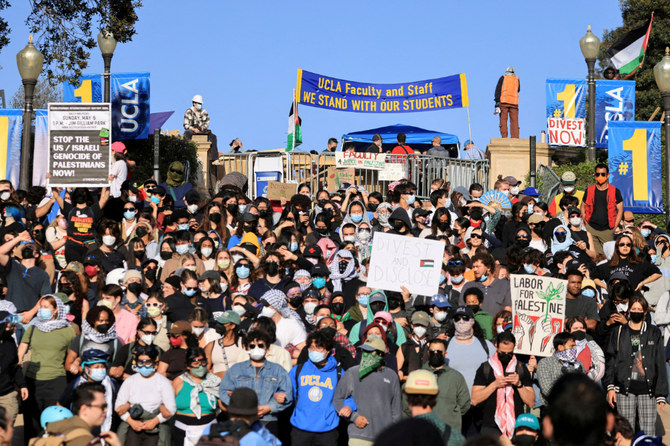
LOS ANGELES: The police chief at the University of California, Los Angeles, has been reassigned following criticism over his handling of recent campus demonstrations that included a mob attacking a pro-Palestinian encampment.
Chief John Thomas was temporarily reassigned Tuesday “pending an examination of our security processes,” said Mary Osako, UCLA vice chancellor for strategic communications, in a statement released Wednesday.
The Daily Bruin reported late Tuesday that Thomas said in a text to the campus newspaper, “There’s been a lot going on and, I learned late yesterday that I’m temporarily reassigned from my duties as chief.”
Neither Osako nor Thomas identified his reassigned role.
The reassignment of Thomas follows UCLA’s May 5 announcement of the creation of a new chief safety officer position to oversee campus security operations.
On April 30, counterdemonstrators attacked a pro-Palestinian encampment, throwing traffic cones, releasing pepper spray and tearing down barriers. Fighting continued for several hours before police stepped in, and no one was arrested. At least 15 protesters suffered injuries.
Thomas told the Los Angeles Times in early May that he did “everything I could” to provide security and keep students safe during days of strife that left UCLA shaken.
But his response was roundly criticized and prompted Chancellor Gene Block to order a review of campus security procedures. Block then announced that Rick Braziel, a former Sacramento police chief, would lead a new Office of Campus Safety that will oversee the UCLA Police Department.
“To best protect our community moving forward, urgent changes are needed in how we administer safety operations,” Block said in the May 5 statement.
Sporadic disruptions continued following the dismantling of a pro-Palestinian encampment and some 200 arrests on April 30.
Block has been summoned to Washington by a Republican-led House committee to testify Thursday about the protests on the Los Angeles campus.
The union that represents more than 250 officers who police the 10 UC campuses criticized Thomas’ reassignment.
“The UCLA administration owns the failure of any protest response, and the public should reject their attempts to shift blame to law enforcement,” Wade Stern, president of the Federated University Peace Officers’ Association, said in a statement Wednesday. “The response to protests appears ad hoc and devoid of the structured planning mandated by the UC system.”


![]()

UCLA police chief reassigned following criticism over handling of campus demonstrations
Short Url
https://arab.news/5gp9z
UCLA police chief reassigned following criticism over handling of campus demonstrations
- The reassignment of Thomas follows UCLA’s May 5 announcement of the creation of a new chief safety officer position
Latest updates


Recommended


© 2026 SAUDI RESEARCH & PUBLISHING COMPANY, All Rights Reserved And subject to Terms of Use Agreement.