

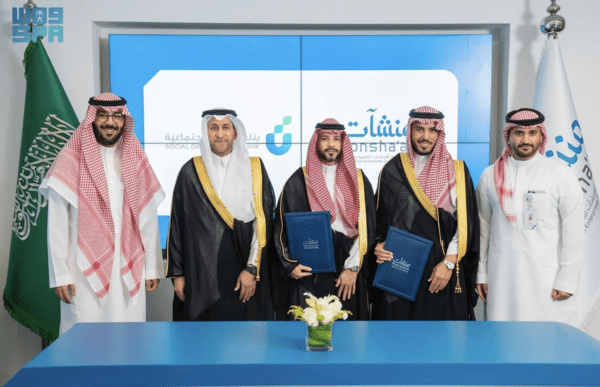
Saudi Monsha’at and Social Development Bank ink deal to boost SME financing

The agreement was signed In the presence of the CEO of the Social Development Bank, Sultan bin Abdulaziz Al-Humaidi, the Deputy Governor of Monsha’at for Planning and Development, Sulaiman bin Abdulrahman Al-Turaif, and the Executive Vice President of the Business Sector at the Social Development Bank, Muhammad Al-Arini. SPA
Short Url
Updated 01 October 2024
Follow

Saudi Monsha’at and Social Development Bank ink deal to boost SME financing

RIYADH: Saudi small and medium enterprises are set to receive a finance boost thanks to a new deal signed by the Kingdom’s Social Development Bank. 

The cooperation agreement, inked with the country’s SME general authority, also known as Monsha’at, will see the authority joining the bank’s Entrepreneurs Program, the Saudi Press Agency reported.  

This collaboration aims to provide the necessary financing solutions and facilities for the growth of SME projects and the expansion of their businesses. 

The program is a financing product aimed at supporting the assets and operating costs of new business entities in the Kingdom. 

This initiative aligns with Monsha’at’s objective to bolster the growth and competitiveness of SMEs by collaborating with strategic partners from various sectors, both locally and globally. The goal is to create an enabling environment and foster a leading society.  

Furthermore, it resonates with the bank’s vision to be pioneers in empowering social development tools and enhancing the financial independence of individuals, families, and entities toward a vibrant and productive society. 

Under the terms of the newly signed agreement, Monsha’at will work to provide training and advisory services to further empower entrepreneurs who benefit from the bank’s entrepreneurs program through support centers in Riyadh, Madinah, Jeddah, and Alkhobar.  

On the other hand, SDB will work to process the submitted lending applications and make the appropriate decisions regarding them, as well as other works agreed upon by the two parties.

The deal was signed during Finance Week, which Monsha’at organizes to introduce investment opportunities and government initiatives that serve the various sectors of SMEs. 

In February, a report released by Monsha’at revealed that the Kingdom’s SMEs totaled 1.3 million in the fourth quarter of 2023, marking a 3.1 percent increase from the previous three months. 

This growth was fueled by robust public investment, strong entrepreneurial drive, and the region’s leading venture capital investments, as highlighted in the report at the time. 

In September, a study released by the Centre for the Fourth Industrial Revolution in the Kingdom revealed that SMEs in Saudi Arabia are poised to lead the industrial sector into a new era driven by advanced digital technologies. 

The think tank’s report at the time underscored the pivotal role SMEs play in the sector and highlights key initiatives currently fostering digital transformation.


Middle East war economic impact to depend on duration, damage, energy costs, IMF official says

Updated 3 sec ago
Follow

Middle East war economic impact to depend on duration, damage, energy costs, IMF official says

  • Katz: Prolonged increase in energy prices could unanchor inflation expectations
  • IMF: 2026 global GDP outlook was solid, too early to judge war’s impact on growth
WASHINGTON: The Middle East war’s impact on the global economy will depend on its duration and damage to infrastructure and industries in the region, particularly whether energy price increases are short-lived or persistent, the International Monetary Fund’s number two official said on Tuesday. IMF First Deputy Managing Director Dan Katz told the Milken Institute Future of Finance conference in Washington that if there is prolonged uncertainty from the conflict and a prolonged impact on energy prices, “I would expect central banks to be cautious and ‌respond to the ‌situation as it materializes.”
He said the conflict could ​be “very ‌impactful ⁠on ​the global economy ⁠across a range of across a range of metrics, whether it’s inflation, growth and so on” but it was still early to have a firm conviction.
Prior to the US and Israeli air strikes on Iran and counterattacks across the region, the IMF had forecast solid global GDP growth of 3.3 percent in 2026, powering through tariff disruptions due in part to the continued AI investment boom and expectations of productivity gains.
Katz said ⁠that the economic impact from the Middle East conflict would ‌be influenced by its duration and further geopolitical ‌developments.
Earlier, the IMF said it was monitoring the ​conflict’s disruptions to trade and economic activity, ‌surging energy prices and increased financial market volatility.
“The situation remains highly fluid and ‌adds to an already uncertain global economic environment,” the Fund said in a statement issued from Washington. Katz said the IMF will look at the conflict’s direct impacts on the region, including damage to infrastructure, and disruptions to key sectors.
“Tourism is an important one. Air travel. Is ‌there physical damage to infrastructure, production facilities, and the big industry in particular that everyone will be focused on is, ⁠of course, the energy ⁠industry,” he said.
Oil rose further on Tuesday as Iran vowed to attack ships passing through the Strait of Hormuz. Brent crude oil , the global benchmark, surged to $83 per barrel, up 15 percent from its level on Friday.
Katz said he expected central banks to “look through” a temporary rise in energy prices, given their focus on core inflation. But central banks could respond if a more persistent energy shock results in “a destabilizing of inflation expectations.”
He said the post-COVID inflation spike of 2022 was influenced by energy impacts from Russia’s invasion of Ukraine, with more pass-through from headline inflation to core inflation.
“And so I’m sure central banks, as they are thinking about how the ​geopolitical situation is translating into ​energy markets, will be looking at the lessons of the pandemic and seeing if they can apply any of those lessons in setting monetary policy,” Katz said.