EU states give final endorsement to AI rules

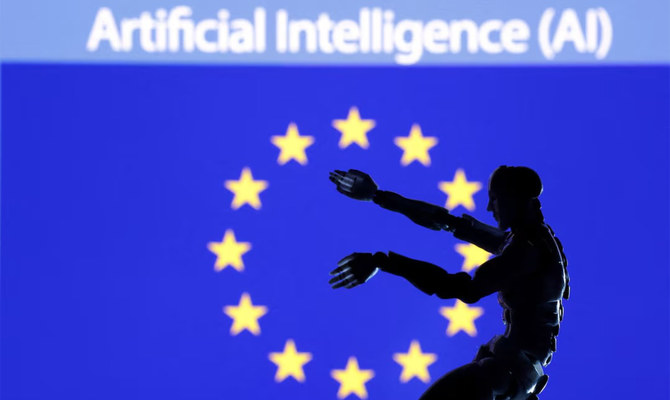
AI Artificial intelligence words, miniature of robot and EU flag are seen in this illustration. (Reuters/File)
Short Url
Updated 21 May 2024
Follow

EU states give final endorsement to AI rules

  • The EU says the law will protect citizens from AI’s dangers while harnessing the technology’s potential in Europe

RIYADH: EU states on Tuesday gave their final backing to landmark rules on artificial intelligence that will govern powerful systems like OpenAI’s ChatGPT.

The European Parliament had already approved the law in March and it will now enter into force after being published in the official EU journal in the coming days.

The EU says the law will protect citizens from AI’s dangers while harnessing the technology’s potential in Europe.

First proposed in 2021, the rules took on greater urgency after ChatGPT arrived in 2022, showing generative AI’s human-like ability to produce eloquent text within seconds.

Other examples of generative AI include Dall-E and Midjourney, which can produce images in nearly any style with a simple input in everyday language. The law known as the “AI Act” takes a risk-based approach: if a system is high-risk, a company has a tougher set of obligations to fulfill to protect citizens’ rights.

There are strict bans on using AI for predictive policing and systems that use biometric information to infer an individual’s race, religion or sexual orientation. Companies will have to comply by 2026 but rules covering AI models like ChatGPT will apply 12 months after the law becomes official.

Pledge

The world’s leading companies pledged at the start of a mini summit on AI to develop the technology safely, including pulling the plug if they can’t rein in the most extreme risks.

World leaders are expected to hammer out further agreements on artificial intelligence as they gathered virtually to discuss AI’s potential risks but also ways to promote its benefits and innovation.

The AI Seoul Summit is a low-key follow-up to November’s high-profile AI Safety Summit at Bletchley Park in the UK, where participating countries agreed to work together to contain the potentially “catastrophic” risks posed by breakneck advances in AI.

The two-day meeting — co-hosted by South Korea and the UK — also comes as major tech companies like Meta, OpenAI and Google roll out the latest versions of their AI models.

They’re among 16 AI companies that made voluntary commitments to AI safety as the talks got underway, according to a British government announcement. 

The companies, which also include Amazon, Microsoft, France’s Mistral AI, China’s Zhipu.ai, and G42 of the UAE, vowed to ensure safety of their most cutting edge AI models with promises of accountable governance and public transparency.

The pledge includes publishing safety frameworks setting out how they will measure risks of these models.


Saudi Arabia, WEF launch initiative to reshape global travel landscape

Updated 11 November 2025
Follow

Saudi Arabia, WEF launch initiative to reshape global travel landscape

  • ‘Beyond Tourism’ is global framework advancing sustainability, inclusivity, and resilience in the sector

RIYADH: Saudi Arabia has partnered with the World Economic Forum to launch the “Beyond Tourism” initiative, a global framework designed to drive a more sustainable, inclusive, and resilient future for the travel and tourism sector.

Announcing the initiative on his X account, Saudi Minister of Tourism Ahmed Al-Khateeb said he was “thrilled to announce the launch,” noting that it is “dedicated to shaping the future of travel and tourism and is built around 10 core principles.”

Al-Khateeb emphasized that Beyond Tourism underscores the sector’s vital role as “a bridge between cultures, a means to empower communities, and a source of opportunities for future generations.”

The initiative comes as the global travel and tourism industry undergoes a major structural shift — moving away from fragmented, business-as-usual models toward integrated, ecosystem-based strategies.

According to the World Economic Forum, the sector is projected to reach 30 billion tourist visits and contribute $16 trillion to global gross domestic product by 2034. Yet, it continues to face complex challenges including rising tension between visitors and residents, environmental pressures, workforce shortages, and exposure to geopolitical and climate disruptions.

“The global travel and tourism sector is entering a period of profound transformation, moving decisively from a fragmented, business-as-usual operating model to a holistic, ecosystem-based paradigm,” the WEF said in a statement.

The forum noted that past reliance on siloed policies — a weakness underscored during the COVID-19 pandemic — has proven insufficient to address today’s global challenges.

Its proposed ecosystem approach focuses on five key enablers: infrastructure, finance, technology and innovation, people and skills, and policy and governance. The model aims to convert systemic challenges into opportunities for inclusive and sustainable growth.

Several destinations have already demonstrated the benefits of this approach. Countries such as Portugal, New Zealand, Costa Rica, Singapore, and Indonesia have leveraged it to improve conservation outcomes, diversify economies, and strengthen sustainable tourism development.

By promoting global cooperation among governments, private-sector leaders, and local communities, the Beyond Tourism initiative seeks to unlock the full potential of the industry while safeguarding cultural and natural heritage for generations to come.