

Weather forecasters warn Pakistanis to stay indoors ahead of new heat wave

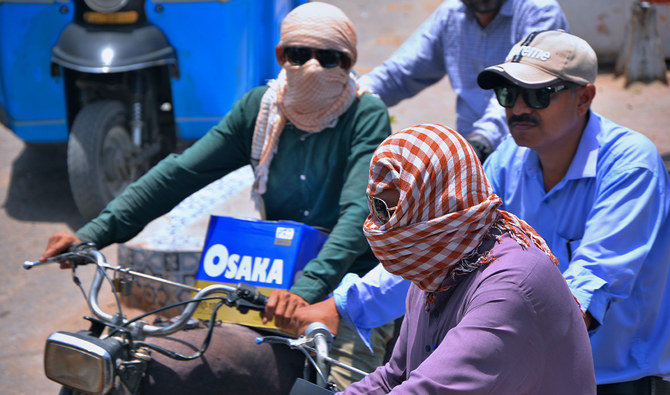
Motorcyclists cover their face with a scarf to protect themselves from heat as they travel on a road, in Hyderabad, Pakistan, on May 21, 2024. (P)
Short Url
Updated 21 May 2024
Follow

Weather forecasters warn Pakistanis to stay indoors ahead of new heat wave

  • Health officials say hospitals have been instructed to set up emergency heatwave response centers to treat people
  • Doctors say heatstroke is a serious illness that occurs when one’s body temperature rises quickly amid sweltering heat

ISLAMABAD: Authorities in Pakistan on Tuesday urged people to stay indoors as the country is hit by an extreme heat wave that threatens to bring dangerously high temperatures and yet another round of glacial-driven floods.

Pakistan’s most populous province, Punjab, is shutting all schools for a week because of the heat, affecting an estimated 18 million students.

“The sweltering heat will continue this month,” said Zaheer Ahmed Babar, a senior official at the Pakistan Meteorological Department. He added that temperatures could reach up to 6 degrees Celsius (10.8 Fahrenheit) above the monthly average. This week could rise above 40 degrees Celsius (104 Fahrenheit) in many parts of the country, Babar said.

It’s the latest climate-related disaster to hit the country in recent years. Melting glaciers and growing monsoons have caused devastating floods, at one point submerging a third of the country.

Pakistan recorded its wettest April since 1961, with more than double the usual monthly rainfall, according to the national weather center. Last month’s heavy rains killed scores of people while destroyed property and farmland, experts say the country witnessed heavier rains because of climate change.

Pakistan is still trying to recover from $30 billion in losses caused by devastating climate-induced floods that killed 1,739 people in 2022.

According to health officials, hospitals were instructed to set up emergency heatwave response centers so that those affected by the scorching temperatures could be quickly treated.

Doctors say heatstroke is a serious illness that occurs when one’s body temperature rises quickly because of sweltering heat, potentially causing some to fall unconscious. A severe heatstroke can cause disability or death.

Some areas in Pakistan are also currently facing hours-long power outages.

“We were without electricity for hours on Monday,” said Ibrar Abbasi, who lives on the outskirts of Islamabad.

Scientists have long warned that climate change, driven by the burning of fossil fuels, deforestation and certain agricultural practices, will lead to more frequent and prolonged bouts of extreme weather, including hotter temperatures.

Babar said another intense heat wave will hit the country in June, when the temperature is likely to reach 45 degrees (113 Fahrenheit). He said people should drink a lot of water and avoid unnecessary travel. Farmers and other livestock owners should take measures to protect their animals during extreme heat, he said.

However, many people, especially laborers and construction workers in the impoverished nation, ask how they can stay indoors as their families will suffer if they don’t work.

“I am not feeling well because of the stifling heat, but I have to work,” said Ghulam Farid, who owns a small general store in Sheikhupra, a city in Punjab province.

Construction workers were seen sitting near a road on the outskirts of the capital, Islamabad, hoping to get a job. Among them was Mohammad Khursheed, 52, who said he has noticed a change in the patterns of seasons.


From classrooms to screens: Pakistan schools go online amid Middle East war-driven oil crisis

Updated 4 sec ago
Follow

From classrooms to screens: Pakistan schools go online amid Middle East war-driven oil crisis

  • Government orders school closures, remote work and fuel cuts to conserve energy
  • Measures follow oil price surge linked to US-Israeli strikes on Iran and regional tensions

RAWALPINDI: Some schools in Pakistan shifted to online learning this week as authorities introduced emergency fuel-saving measures after global oil prices surged due to the escalating conflict involving the United States, Israel and Iran.

The government has ordered a series of austerity steps aimed at reducing fuel consumption, including temporary school closures, remote work arrangements for a portion of government and private sector employees, and sharp cuts in fuel allocations for official vehicles. The measures were introduced after international oil prices jumped amid fears the widening Middle East conflict could disrupt supplies passing through the Strait of Hormuz, a vital global energy shipping route, raising costs for import-dependent economies such as Pakistan.

Parents in cities including Rawalpindi said many educational institutions had already informed families through social media that classes would be conducted online while campuses remained closed.

“Hopefully, all the schools will remain closed today because many of the institutions have already shared the message on social media that we will be taking classes online for the students,” said Misam Abbas, a 30-year-old father of schoolchildren.

Pakistan’s education system is still recovering from severe disruptions during the COVID-19 pandemic, when schools across the country remained closed for extended periods and millions of students shifted to remote learning. 

The closures lasted around 10.5 months in some areas, affecting nearly 40 million school-age children, while limited Internet access and digital devices meant many students could not fully participate in online classes. Education experts say the prolonged shutdowns caused significant learning losses and pushed some children permanently out of the school system. 

Even after the pandemic, schooling in Pakistan has faced repeated interruptions due to environmental and health emergencies. In recent years, dense winter smog, extreme heatwaves and cold spells have frequently forced authorities to suspend classes, sometimes for 10 to 12 days at a time, shortening the academic year and disrupting teaching schedules. 

Analysts warn that repeated closures and the shift to online learning, often difficult for students without reliable Internet access, continue to strain an already fragile education system. 

For many families, the sudden switch to remote learning has also raised concerns about prolonged disruptions to education if the austerity measures remain in place.

“They [the government] should not close [schools] for a long time because it suffers a lot. The students… should think that they are to close the school for two to three days, not for all the weeks, not for two to three weeks because that can suffer the studies of these small kids,” Abbas said.

Pakistan imports most of its crude oil and refined petroleum products, making domestic energy costs highly sensitive to global price swings during geopolitical crises.

“Our situation should not be affected by the world’s situation. The world is already in a bad situation. But in our country, we should have some good system so that people cannot be affected by those circumstances,” Abbas said.