

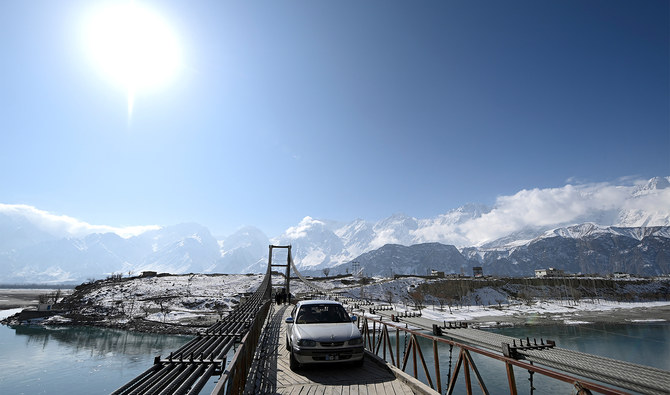

ISLAMABAD: The Pakistan Meteorological Department (PMD) on Monday warned of glacial lake outburst floods (GLOFs) in Pakistan’s northern Gilgit-Baltistan region and northwestern Khyber Pakhtunkhwa (KP) province, citing higher temperatures due to an expected heatwave from May 21 onwards.
A heatwave is expected to hit parts of Pakistan this week and temperatures in certain areas of the southern Sindh and eastern Punjab provinces may surge past 40 degrees Celsius, according to the country’s disaster management authorities.
Heatwaves, which occur in summer, are caused by slow-moving high-pressure systems leading to prolonged high temperatures. The World Meteorological Organization defines a heatwave as five or more consecutive days during which the daily maximum temperature surpasses the average maximum temperature by 5 °C (9 °F) or more.
“The daytime temperatures in Gilgit-Baltistan (GB) and Khyber Pakhtunkhwa (KPK) are expected to remain 4-6°C higher than normal from May 21 to 27 with chances of gusty wind/thunderstorm,” the PMD said in its GLOF alert.
“This atmospheric condition [will be] potentially increasing the likelihood of triggering a Glacial Lake Outburst Flood (GLOF) event or flash floods in the vulnerable snow-covered and glaciated areas of GB and Chitral.”
The Met Office advised the district administrations as well as local organizations and communities to remain vigilant during this period and take precautionary measures to avoid any untoward situation.

Labourers are silhouetted as they stand on scaffoldings at a construction site during a hot and humid day in Karachi, Pakistan on May 20, 2024. (REUTERS)
Pakistan experienced its first severe heat wave in June 2015 when temperatures as high as 49 degrees Celsius struck the country’s south, causing the deaths of about 2,000 people from dehydration and heatstroke. A heat wave in Sindh’s provincial capital of Karachi that year alone claimed 120 lives.
Increased exposure to heat, and more heat waves, have been identified as one of the key impacts of climate change in Pakistan, with people experiencing extreme heat and seeing some of the highest temperatures in the world in recent years. The South Asian country of more than 241 million, one of the ten most vulnerable nations to climate change impacts, this year experienced its “wettest April since 1961,” with at least 144 people killed in thunderstorms and house collapses.
Climate change-induced extreme heat can cause illnesses such as heat cramps, heat exhaustion, heatstroke, and hyperthermia. It can make certain chronic conditions worse, including cardiovascular, respiratory, and cerebrovascular disease and diabetes-related conditions, and can also result in acute incidents, such as hospitalizations due to strokes or renal disease.
Keeping the weather predictions in view, the government in Pakistan’s Punjab province on Monday announced the closure of public and private schools from May 25 till May 31.
“In view of the surge in temperature and heat wave in the province, all public and private schools shall remain closed for seven days with effect from 25th May 2024 to 31st May 2024,” the Punjab education department said in a notification, adding that exams could be conducted during these days with necessary precautions in place.
According to the Global Climate Risk Index, nearly 10,000 Pakistanis have died while the country has suffered economic losses worth $3.8 billion due to climate change impacts between 1999 and 2018.
In 2022, torrential monsoon rains triggered the most devastating floods in Pakistan’s history, killing around 1,700 people and affecting over 33 million, a staggering number close to the population of Canada. Millions of homes, tens of thousands of schools and thousands of kilometers of roads and railways are yet to be rebuilt.


