

Pope Francis calls anti-migrant attitudes at US border ‘madness’

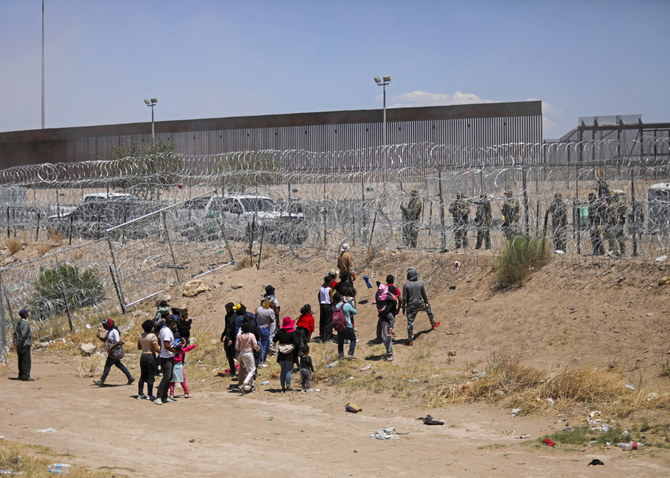
Migrants attempting to enter the United States through a barbed wire fence installed along the Rio Grande River are chased away with tear gas by Texas National Guard agents at the border with Ciudad Juarez, Chihuahua State, Mexico, on May 13, 2024. (AFP)
Short Url
Updated 20 May 2024
Follow

Pope Francis calls anti-migrant attitudes at US border ‘madness’

  • Record numbers of migrants fleeing poverty and violence have been seeking to enter the US, largely from Central America and Venezuela
  • The matter has emerged as a top political issue in the November US election, with Biden and challenger Trum, pushing the topic front and center

WASHINGTON: Pope Francis made a foray into the US election season with a rare television interview Sunday, calling harsh anti-migrant attitudes “madness” and criticizing right-wing US Catholic figures for overly conservative stances against his social teachings.

Speaking in his native Spanish through a translator for more than an hour, Francis told CBS News program “60 Minutes” that the closing by the state of Texas of a Catholic charity offering humanitarian assistance was absurd.
“That is madness. Sheer madness. To close the border and leave them there, that is madness. The migrant has to be received,” the pope said.
“Thereafter you see how you are going to deal with him. Maybe you have to send him back, I don’t know, but each case ought to be considered humanely,” Francis said.
Record numbers of migrants have been seeking to enter the United States, largely from Central America and Venezuela, as they flee poverty, violence and disasters exacerbated by climate change.
The matter has emerged as a top political issue in the November US election, with President Joe Biden’s Republican challenger, former president Donald Trump, pushing the topic front and center.
“The globalization of indifference” on migrants, Francis said, “is a very ugly disease.”

Francis, 87, also addressed criticisms by conservative US bishops who oppose his efforts to revisit certain teachings and traditions.
A “conservative is one who clings to something and does not want to see beyond that,” he said when asked about the bishops, adding “it is a suicidal attitude.”
Since his election in 2013, Pope Francis has insisted on the importance of a church open to all, including member of the LGBT community, but he has faced strong resistance from conservative Catholics.
There was a particularly strong reaction when Francis opened the door to the blessing of gay couples last year, especially in African countries.
Calling gay people “a human fact,” Francis said in the interview: “To bless each person, why not? The blessing is for all.”
The pontiff also touched on the controversial topic of sex abuse within the Catholic Church.
He has made combatting sexual assault in the Church one of the main missions of his papacy, and insisted on a “zero tolerance” policy following multiple wide-reaching scandals.
“Unfortunately, the tragedy of the abuses is enormous,” he told CBS, adding that abuse “cannot be tolerated.”
“When there is a case of a religious man or woman who abuses, the full force of the law falls upon them,” Francis said.
But, he added, “there has been a great deal of progress.”


Trump’s Iran war violates international law, experts say

Updated 3 sec ago
Follow

Trump’s Iran war violates international law, experts say

  • Mary Ellen O’Connell, a professor at the University of Notre Dame, said the attack on Iran “had no justification under international law“
  • “The US probably could have prevented any Israeli attack on Iran by virtue of the leverage afforded by critical US military support,” said Finucane

WASHINGTON: The United States insists it attacked Iran to curb “direct threats” from the Islamic republic, but legal experts say the dangers cited by Washington do not justify war under international law.
US and Israeli forces launched a massive air campaign against Iran on February 28, with Washington saying it aimed to curb nuclear and missile threats from Tehran. Yet the war has also decapitated the country’s government, and President Donald Trump is now demanding “unconditional surrender.”
The White House laid out Washington’s justification for the war during a news conference this week.
“This decision to launch this operation was based on a cumulative effect of various direct threats that Iran posed to the United States of America, and the president’s feeling, based on fact, that Iran does pose (an) imminent and direct threat,” Press Secretary Karoline Leavitt said Wednesday.
She went on to cite Iranian sponsorship of “terrorism,” its ballistic missile program and its alleged efforts to “create nuclear weapons and nuclear bombs.”
But Mary Ellen O’Connell, a professor at the University of Notre Dame, said the attack on Iran “had no justification under international law.”
“The law is clear that international disputes are to be resolved using peaceful means — negotiation, mediation, the intervention of international organizations,” said O’Connell, an expert in international law on the use of force and international legal theory.
The Trump administration has offered “vague mentions of imminent attacks by Iran and to prevent Iran from acquiring a nuclear weapon,” while the UN Charter “requires, at the least, that evidence of a significant attack by Iran be underway,” she said.

- ‘Even less plausible’ -

“No shred of such evidence has been provided. Nor is there any right whatsoever to start a war over a weapons program.”
While Leavitt cited threats from missiles and militants, US Secretary of State Marco Rubio offered a different justification for the war earlier in the week: fears that an Israeli attack would trigger reprisals against US forces.
Brian Finucane, senior adviser for the International Crisis Group’s US Program, said there were several issues with Rubio’s explanation, including that the Trump administration has since offered other rationales for the war.
“The US probably could have prevented any Israeli attack on Iran by virtue of the leverage afforded by critical US military support,” said Finucane, who previously worked in the Office of the Legal Adviser at the US Department of State.
The Iran war is not the only legally dubious military intervention by the Trump administration.
In early September, the United States began carrying out strikes on alleged drug-smuggling boats in the Caribbean and later the eastern Pacific — a campaign that has killed more than 150 people.
The US government has yet to provide definitive evidence that the vessels it targets are involved in drug trafficking, and legal experts and rights groups say the strikes likely amount to extrajudicial killings.
Trump also ordered strikes on Iranian nuclear sites last year, and sent US forces into Caracas in early January to seize leftist Venezuelan leader Nicolas Maduro, who is now on trial in the United States.
Finucane said Trump’s Friday demand for “unconditional surrender” by Iran “further undercuts prior justifications for US military action.”
“The administration has not even bothered to argue that Operation Epic Fury complies with international law, but certainly statements like this make any such argument even less plausible,” he said, referring to the Iran operation.