

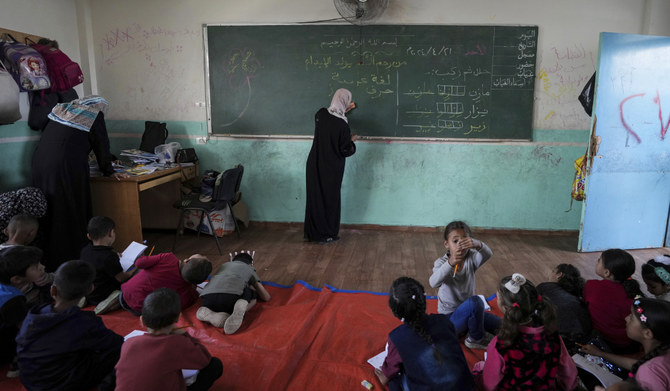

DEIR AL-BALAH: Atef Al-Buhaisi, 6, once dreamed of a career building houses. Now, all he craves is to return to school.
In Israel’s war with Hamas, Atef’s home has been bombed, his teacher killed, and his school in Nuseirat turned into a refuge for displaced people.
He lives in a cramped tent with his family in Deir Al-Balah in central Gaza. He sleeps clinging to his grandmother and fears walking alone, even during the day.
Since the war erupted on Oct. 7, all Gaza’s schools have closed — leaving hundreds of thousands of students like Atef without formal schooling or a safe place to spend their days. Aid groups are scrambling to keep children off the streets, and their minds are focused on something other than the war as heavy fighting continues across the enclave and has expanded into the southern city of Rafah and intensified in the north.

A Palestinian child eats bread in Khan Younis in the southern Gaza Strip amid the ongoing conflict between Israel and the Hamas movement. (AFP)
“What we’ve lost most is our children’s future and their education,” said Irada Ismael, Atef’s grandmother.
“Houses and walls are rebuilt, money can be earned again ... but how do I compensate for (his) education?”
Gaza faces a humanitarian crisis, with the head of the UN’s World Food Programme determining a “full-blown famine” is already underway in the north.
More than 35,000 Palestinians have been killed in the war, according to the Gaza Health Ministry.
About 80 percent of Gaza’s population has been driven from homes.
Much of Gaza is damaged or destroyed, including nearly 90 percent of school buildings, according to aid group estimates.
Children are among the most severely affected, with the UN estimating some 19,000 children have been orphaned and nearly a third under the age of 2 face acute malnutrition.
Education experts say that in emergencies, education takes a back seat to safety, health, and sanitation, but the consequences are lasting.
“The immediate focus during conflict isn’t on education, but the disruption has an incredibly long-term effect,” said Sonia Ben Jaafar of the Abdulla Al Ghurair Foundation, a philanthropic organization focused on education in the Arab world.
“The cost at this point is immeasurable.”
According to the UN, Gaza had a highly literate population that included more than 625,000 students and some 20,000 teachers before the war.
In other conflicts, aid groups can create safe spaces for children in neighboring countries — for example, Poland for shelter and schooling during the war in Ukraine.
That’s impossible in Gaza, a densely populated enclave between the sea, Israel, and Egypt. Since Oct 7, Palestinians from Gaza haven’t been allowed to cross into Israel. Egypt has let a small number of Palestinians leave.
“They’re unable to flee, and they remain in an area that continues to be battered,” said Tess Ingram of UNICEF.
“It’s very hard to provide them with certain services, such as mental health and psychosocial support or consistent education and learning.”
Aid groups hope classes will resume by September. But even if a ceasefire is brokered, much of Gaza must be cleared of mines, and rebuilding schools could take years.
In the interim, aid groups are providing recreational activities — games, drawing, drama, art — not for a curriculum-based education but to keep children engaged and in a routine in an effort for normalcy. Even then, advocates say, attention often turns to the war — Atef’s grandmother sees him draw pictures only of tents, planes, and missiles.
Finding free space is among the biggest challenges.
Some volunteers use the outdoors, make do inside tents where people live, or find a room in still-standing homes.
It took volunteer teachers over two months to clear one room in a school in Deir Al-Balah to give ad hoc classes to children. Getting simple supplies such as soccer balls and stationery into Gaza can also take months, groups report.
“Having safe spaces for children to gather to play and learn is an important step,” Ingram said, but “ultimately, the children of Gaza must be able to return to learning curriculum from teachers in classrooms, with education materials and all the other support schooling provides.”
This month, UNICEF had planned to erect at least 50 tents in Rafah for play-based numbers and literacy learning for some 6,000 children from preschool to grade 12. But UNICEF says Israel’s operation there could disrupt those plans.
Lack of schooling can take a psychological toll — it disrupts daily life and, compounded with conflict, makes children more prone to anxiety and nervousness, said Jesus Miguel Perez Cazorla, a mental health expert with the International Committee of the Red Cross.
Children in conflicts are also at increased risk of forced labor, sexual violence, trafficking, and recruitment by gangs and armed groups, experts warn.
“Not only are children vulnerable to recruitment by Hamas and other militant groups, but living amid ongoing violence and constantly losing family members makes children psychologically primed to want to take action against the groups they consider responsible,” said Samantha Nutt of War Child USA, which supports children and families in war zones.
Palestinians say they have seen more children take to Gaza’s streets since the war, trying to earn money for their families.
“The streets are full of children selling very simple things, such as chocolate and canned goods,” said Lama Nidal Alzaanin, 18, who was in her last year of high school and looking forward to university when the war broke out. There is nothing for them to do.”
Some parents try to find small ways to teach their children, scrounging for notebooks and pens and insisting they learn something as small as a new word each day. But many find the kids are too distracted with the world at war.
Sabreen Al-Khatib, a mother whose family was displaced to Deir Al-Balah from Gaza City, said it’s particularly hard for the many who’ve seen relatives die.
“When you speak in front of children,” Al-Khatib said, “what do you think he is thinking? Will he think about education? Or about himself, how will he die?”
On Oct. 7, 14-year-old Layan Nidal Alzaanin — Lama’s younger sister — was on her way to her middle school in Beit Hanoun when missiles flew overhead, she said. She fled with her family to Rafah, where they lived crowded in a tent.
Since Israel ordered evacuations there, she fled to Deir Al-Balah.
“It is a disaster,” she said.
“My dreams have been shattered. There is no future for me without school.”


