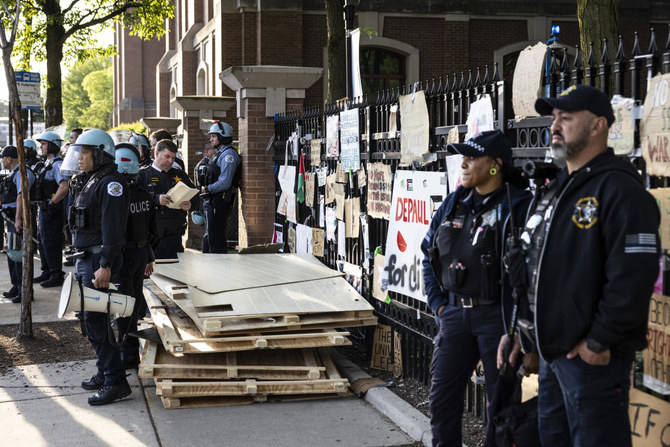
CHICAGO: Police began dismantling a pro-Palestinian encampment early Thursday at DePaul University in Chicago, hours after the school’s president told students to leave the area or face arrest.
Officers and workers in yellow vests cleared out tents and camping equipment at the student encampment, leaving behind yellow squares of dead or dying grass where the tents had stood. Front-loaders were being used to remove the camping equipment.
Just across the street from where the encampment was spread across a grassy expanse of DePaul’s campus known as “The Quad,” a few dozen protesters stood along a sidewalk in front of a service station, clapping their hands in unison as an apparent protest leader paced back and forth before them, speaking into a bullhorn.
All of the protesters at the encampment “voluntarily left” the area when police arrived early Thursday, said Jon Hein, chief of patrol for the Chicago Police Department.
“There were no confrontations and there was no resistance,” he said at a news briefing. “As we approached, all the subjects voluntarily left the area.”
Hein said, however, that two people, a male and female in their 20s, were arrested outside the encampment “for obstruction of traffic.”
The move to clear the campus comes less than a week after the school’s president said public safety was at risk.
The university on Saturday said it had reached an “impasse” with the school’s protesters, leaving the future of their encampment on the Chicago campus unclear. Most of DePaul’s commencement ceremonies will be held the June 15-16 weekend.
In a statement then, DePaul President Robert Manuel and Provost Salma Ghanem said they believe that students intended to protest peacefully, but “the responses to the encampment have inadvertently created public safety issues that put our community at risk.”
Efforts to resolve the differences with DePaul Divestment Coalition over the past 17 days were unsuccessful, Manuel said in a statement sent to students, faculty and staff Thursday morning.
“Our Office of Public Safety and Chicago Police are now disassembling the encampment,” he said. “Every person currently in the encampment will be given the opportunity to leave peacefully and without being arrested.”
He said that since the encampment began, “the situation has steadily escalated with physical altercations, credible threats of violence from people not associated with our community.”
Students at many college campuses this spring set up similar encampments, calling for their schools to cut ties with Israel and businesses that support it, to protest lsrael’s actions in the war with Hamas. The protests began as schools were winding up their spring semesters and are now holding graduation ceremonies.
Separately, some students and faculty were detained Wednesday after police removed an encampment and pro-Palestinian protesters briefly took over a lecture hall at the University of California, Irvine. There was a large law enforcement response when demonstrators demanding the university divest from Israel blocked the building’s entrance with a makeshift barricade. Police declared an unlawful assembly, cleared the building and took an unknown number of people into custody.
Also Wednesday, 11 members of a group protesting at the University of Tennessee in Knoxville who did not vacate the area despite repeated warnings were arrested for trespassing, the university said in a statement. Those arrested included three students and eight people who are not affiliated with the university. Any students who were arrested will also be referred to student conduct, officials said.
“The University of Tennessee respects individual’s rights to free speech and free expression and is committed to managing the campus for all,” the university said in the statement. “We will continue to be guided by the law and university policy, neutral of viewpoint.”
Tensions at DePaul flared the previous weekend when counterprotesters showed up to the campus in the city’s Lincoln Park neighborhood and prompted Chicago police to intervene.
The student-led DePaul Divestment Coalition, who are calling on the university to divest from Israel, set up the encampment April 30. The group alleged university officials walked away from talks and tried to force students into signing an agreement, according to a student statement late Saturday.
“I don’t want my tuition money to be invested in my family’s suffering,” Henna Ayesh, a Palestinian student at DePaul and Coalition member, said in the statement.
DePaul is on the city’s North Side. Last week, police removed a similar encampment at the University of Chicago on the city’s South Side.
The Associated Press has recorded at least 79 incidents since April 18 where arrests were made at campus protests across the US More than 2,900 people have been arrested on the campuses of 60 colleges and universities. The figures are based on AP reporting and statements from universities and law enforcement agencies.


![]()
![]()
![]()

Police dismantle pro-Palestinian encampment at DePaul University in Chicago


Short Url
https://arab.news/2rnq5
Police dismantle pro-Palestinian encampment at DePaul University in Chicago
- All of the protesters at the encampment “voluntarily left” the area when police arrived early Thursday
- The move to clear the campus comes less than a week after the school’s president said public safety was at risk


Latest updates


© 2026 SAUDI RESEARCH & PUBLISHING COMPANY, All Rights Reserved And subject to Terms of Use Agreement.