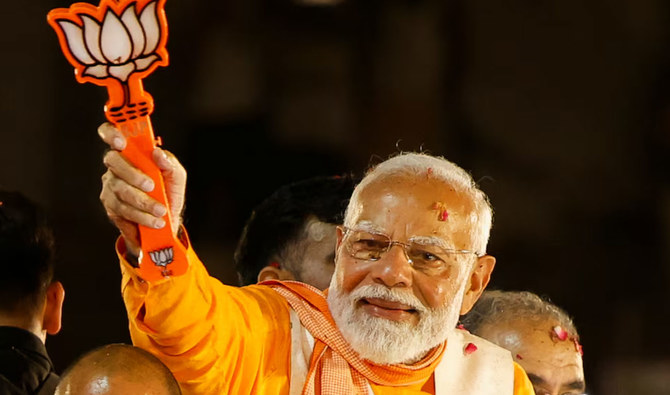
NEW DELHI: An AI video shows an ecstatic Narendra Modi sporting a trendy jacket and trousers, grooving on a stage to a Bollywood song as the crowd cheers. The Indian prime minister reshared the video on X, saying “such creativity in peak poll season is truly a delight.”
Another video, with the same stage setting, shows Modi’s rival Mamata Banerjee dancing in a saree-like outfit, but the background score is parts of her speech criticizing those who quit her party to join Modi’s. State police have launched an investigation saying the video can “affect law and order.”
The different reactions to videos created using artificial intelligence (AI) tools underscore how the use and abuse of the technology is increasing and creating worries for regulators and security officials as the world’s most populous nation holds a mammoth general election.
Easy to make AI videos, which contain near-perfect shadow and hand movements, can at times mislead even digitally-literate people. But risks are higher in a country where many of the 1.4 billion people are tech challenged and where manipulated content can easily stir sectarian tensions, especially at election time.
According to a World Economic Forum survey published in January, the risk to India from misinformation is seen higher than the risk from infectious diseases or illicit economic activity in the next two years.
“India is already at a great risk of misinformation — with AI in picture, it can spread at the speed of 100X,” said New Delhi-based consultant Sagar Vishnoi, who is advising some political parties on AI use in India’s election.
“Elderly people, often not a tech savvy group, increasingly fall for fake narratives aided by AI videos. This could have serious consequences like triggering hatred against a community, caste or religion.”
The 2024 national election – being held over six weeks and ending on June 1 – is the first in which AI is being deployed. Initial examples were innocent, restricted to some politicians using the technology to create videos and audio to personalize their campaigns.
But major cases of misuse hit the headlines in April including deepfakes of Bollywood actors criticizing Modi and fake clips involving two of Modi’s top aides that led to the arrest of nine people.
DIFFICULT TO COUNTER
India’s Election Commission last week warned political parties against AI use to spread misinformation and shared seven provisions of information technology and other laws that attract jail terms of up to three years for offenses including forgery, promoting rumors and enmity.
A senior national security official in New Delhi said authorities are concerned about the possibility of fake news leading to unrest. The easy availability of AI tools makes it possible to manufacture such fake news, especially during elections, and it’s difficult to counter, the official said.
“We don’t have an (adequate monitoring) capacity...the ever evolving AI environment is difficult to keep track of,” said the official.
A senior election official said: “We aren’t able to fully monitor social media, forget about controlling content.”
They declined to be identified because they were not authorized to speak to media.
AI and deepfakes are being increasingly used in elections elsewhere in the world, including in US, Pakistan and Indonesia. The latest spread of the videos in India shows the challenges faced by authorities.
For years, an Indian IT ministry panel has been in place to order blocking of content that it feels can harm public order, at its own discretion or on receiving complaints. During this election, the poll watchdog and police across the nation have deployed hundreds of officials to detect and seek removal of problematic content.
While Modi’s reaction to his AI dancing video — “I also enjoyed seeing myself dance” — was light hearted, the Kolkata city police in West Bengal state launched an investigation against X user, SoldierSaffron7, for sharing the Banerjee video.
Kolkata cybercrime officer, Dulal Saha Roy, shared a typed notice on X asking the user to delete the video or “be liable for strict penal action.”
“I am not deleting that, no matter what happens,” the user told Reuters via X direct messaging, declining to share their number or real name as they feared police action. “They can’t trace (me).”
Election officers told Reuters authorities can only tell social media platforms to remove content and are left scrambling if the platforms say the posts don’t violate their internal policies.
VIGGLE VIDEOS
The Modi and Banerjee dancing videos, with 30 million and 1.1 million views respectively on X, were created using a free website, Viggle. The site allows a photograph and a few basic prompts that are detailed in a tutorial to generate videos within minutes that show the person in the photograph dancing or making other real-life moves.
Viggle co-founder Hang Chu and Banerjee’s office did not respond to Reuters queries.
Other than the two dancing AI videos, one other 25-second Viggle video spreading online shows Banerjee appear in front of a burning hospital and blowing it up using a remote. It’s an AI altered clip of a scene from the 2008 movie, The Dark Knight, that shows Batman’s foe, Joker, wreaking havoc.
The video post has 420,000 views.
The West Bengal police believes it violates Indian IT laws, but X has not taken any action as it “strongly believes in defending and respecting the voice of our users,” according to an email notice sent by X to the user, which Reuters reviewed.
“They can’t do anything to me. I didn’t take that (notice) seriously,” the user told Reuters via X direct messaging.


Dance videos of Modi, rival turn up AI heat in India election
https://arab.news/gpu4u
Dance videos of Modi, rival turn up AI heat in India election

- Videos created using AI underscore how its use and abuse is increasing and creating worries for regulators
- WEF says risk to India from misinformation higher than risk from infectious diseases, illicit economic activity

Hungary to release 1.8 million barrels of crude oil from strategic reserves
- Croatia’s JANAF pipeline operator, however, said there was no need for Budapest to tap its reserves
- Hungary and Slovakia have been trying to secure supply since flows were halted on January 27
BUDAPEST: Hungary’s government will release about 1.8 million barrels of crude oil from its strategic reserves after a drone attack on the Druzhba pipeline late last month stopped oil flow, according to a government decree published late on Thursday.
Croatia’s JANAF pipeline operator, however, said there was no need for Budapest to tap its reserves after Hungary’s oil company MOL said on Friday JANAF must allow transit of Russian seaborne oil to Hungary and Slovakia during the Druzhba outage.
“At this moment, a significant quantity of non-Russian crude oil is being transported via JANAF’s pipeline for MOL Group, while three additional tankers carrying non-Russian oil, also for MOL Group, are on their way to the Omisalj Terminal,” JANAF said in a statement.
“There was no need to tap into (their) reserves since oil transport via the JANAF pipeline toward MOL’s refineries is being carried out continuously and without delays.”
Hungary and Slovakia, which have the only remaining refineries in the EU using Russian oil through Druzhba, have been trying to secure supply since flows were halted on January 27 following what Ukraine said was a Russian drone attack that damaged pipeline infrastructure.
Both countries have blamed Ukraine for the delay in restarting the flows for political reasons.
SCRAMBLE FOR CRUDE SUPPLIES
MOL is entitled to priority access to released crude oil reserves, and it will have access to the freed reserves until April 15 and has to return them by August 24, the Hungarian government decree said.
At the end of January, Hungary had enough crude oil and petroleum product reserves to cover 96 days, according to data on the Hungarian Hydrocarbon Stockpiling Association’s website.
As the two countries scramble to ensure supplies, MOL ordered tankers delivering Saudi, Norwegian, Kazakh, Libyan and Russian oil to supply its Hungarian and Slovak refineries and halted diesel deliveries to Ukraine earlier this week.
MOL said that first shipments were expected to arrive at the port of Omisalj in Croatia in early March. After that, it will take a further 5-12 days for the crude oil to reach its refineries.
The Slovak government has also declared an oil emergency situation and has pledged to release 1.825 million barrels of oil following a request from Slovakia’s Slovnaft refinery, which is owned by MOL.


