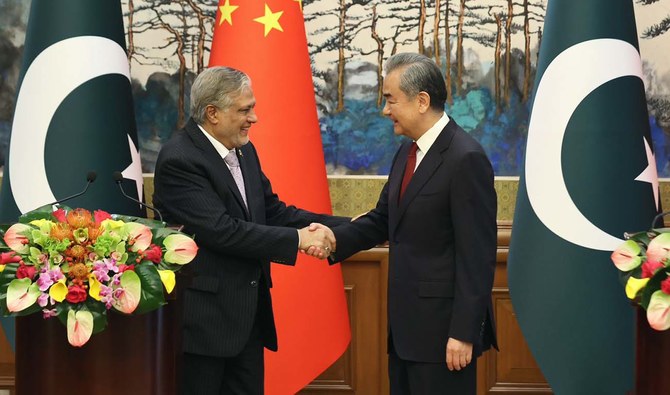

KARACHI: Deputy Prime Minister Ishaq Dar said on Wednesday Islamabad and China needed to finalize the modalities for other countries to be part of the multi-billion-dollar China-Pakistan Economic Corridor (CPEC) project, as Islamabad seeks to attract foreign investment into Pakistan.
Dar, who is also Pakistan’s foreign minister, was speaking at a joint press conference with his Chinese counterpart Wang Yi in Beijing, which the Pakistani official is visiting on a four-day official trip as Pakistan moves into phase two of CPEC, an initiative in which Beijing has pledged to invest $65 billion.
The project spans several phases, each with distinct goals and impacts on the region. The first phase began in 2015 and mainly focused on building critical infrastructure, particularly in the transportation and energy sectors. The second phase expands the focus to include industrial cooperation, agricultural development and the promotion of social and economic development. This phase is also expected to include the development of Special Economic Zones (SEZs), efforts to boost green energy production like hydropower and solar energy, and initiatives to modernize agriculture and increase exports.
In the past, Pakistan has invited Saudi Arabia, Turkiye, Germany, UAE, Iran, Indonesia and Afghanistan to join CPEC but there has been no progress on the invitation.
“As we embark on phase two of CPEC we look forward to developing corridors of growth, livelihood, innovation, green development, and inclusivity to carry forward our shared vision of making CPEC an inclusive and transparent project,” Dar said at the press conference.
“We also need to finalize the modalities for third party participation in CPEC.”
In 2022, then former prime minister Imran Khan welcomed all countries and international organizations to participate in the flagship project. PM Shehbaz Sharif has also invited other nations to join the project.
“We appreciate China’s development assistance to Pakistan and look forward to further enhancing China’s development footprint in Pakistan, to attract foreign investment in diverse sectors under the Special Investment Facilitation Council (SIFC),” Dar said, referring to a special body set up last year to oversee foreign investments. “I commend China’s readiness to deepen our financial bilateral trade and investment.”
Dar said his visit would help in accelerating the implementation of the Mainline-1 (ML-1) railway project, a $6.8 billion project to upgrade its railway lines, along with the realignment of the Karakoram Highway and strengthening “cooperation in agriculture, mining, minerals, energy, information technology and industrial sectors.”
The Pakistani official also condoled on behalf of the Pakistani leadership and people over the killing of five Chinese workers in a suicide bombing in Pakistan in March.
Vowing to bring the planners, financiers and perpetrators of the attack to justice, Dar said China and Pakistan would maintain close cooperation through bilateral channels in this regard.
“I have shared with his Excellency, the foreign minister, extensive and deliberate measures we have taken to protect Chinese interests in Pakistan while thanking China for acknowledging the sacrifices Pakistan has made against terrorism,” he said.
“Let me express our focus on that. We will not rest until the last menace of terrorism is finally eliminated from Pakistan.”