

Slovak PM’s ‘life in danger’ and in operating theater: interior minister

1 / 2
Slovakia’s Interior Minister Matus Sutaj Estok addresses the press with Deputy PM Robert Kalinak, F. D. Roosevelt University Hospital, Banska Bystrica, Slovakia, Wednesday, May 15, 2024. (AP Photo)
2 / 2
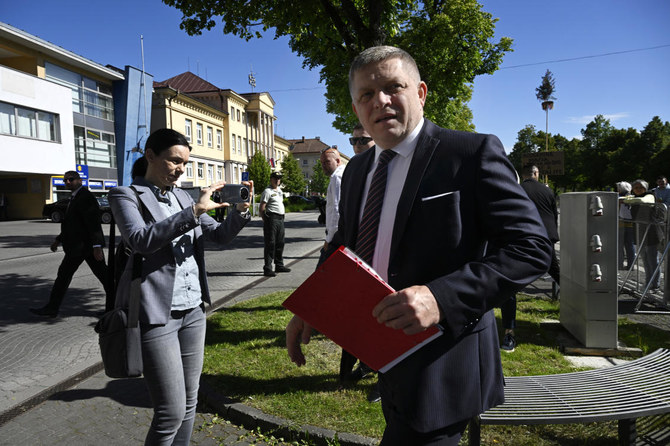
Slovakia’s Prime Minister Robert Fico arrives for a cabinet’s away-from-home session in the town of Handlova, Slovakia, Wednesday, May, 15, 2024. (AP Photo)
Short Url
Updated 15 May 2024
Follow

Slovak PM’s ‘life in danger’ and in operating theater: interior minister

  • Matus Sutaj Estok: ‘We received information from the operating doctors that the prime minister is in a critical condition and his life is in danger and he is still in the operating theater’
  • European Commission President Ursula von der Leyen condemned what she described as a ‘vile attack’

BANSKA BYSTRICA, Slovakia: Slovak Prime Minister Robert Fico’s life “is in danger” and he is still in the operating theater after being shot multiple times, the country’s interior minister said on Wednesday.
“We received information from the operating doctors that the prime minister is in a critical condition and his life is in danger and he is still in the operating theater,” Matus Sutaj Estok told reporters at the hospital where Fico is being treated.

Reports on TA3, a Slovakian TV station, said that Fico, 59, was hit in the stomach after four shots were fired outside the House of Culture in the town of Handlova, some 150 kilometers northeast of the capital, where the leader was meeting with supporters. A suspect has been detained, it said.
Police sealed off the scene, and Fico was taken to a hospital in Banska Bystrica.
The shooting in Slovakia comes three weeks ahead of crucial European Union Parliament elections, in which populist and hard-right parties in the 27-nation bloc appear poised to make gains.
Deputy speaker of parliament Lubos Blaha confirmed the incident during a session of Parliament and adjourned it until further notice, the Slovak TASR news agency said.
Slovakia’s major opposition parties, Progressive Slovakia and Freedom and Solidarity, canceled a planned protest against a controversial government plan to overhaul public broadcasting that they say would give the government full control of public radio and television.
“We absolutely and strongly condemn violence and today’s shooting of Premier Robert Fico” said Progressive Slovakia leader Michal Simecka. “At the same time we call on all politicians to refrain from any expressions and steps which could contribute to further increasing the tension.”
President Zuzana Caputova condemned “a brutal and ruthless” attack on the premier.
“I’m shocked,” Caputova said. “I wish Robert Fico a lot of strength in this critical moment and a quick recovery from this attack.”
Fico, a third-time premier, and his leftist Smer, or Direction, party, won Slovakia’s Sept. 30 parliamentary elections, staging a political comeback after campaigning on a pro-Russian and anti-American message.
Critics worried Slovakia under Fico would abandon the country’s pro-Western course and follow the direction of Hungary under populist Prime Minister Viktor Orbán.
Thousands have repeatedly rallied in the capital and across Slovakia to protest Fico’s policies.
Condemnations of political violence came from leaders across Europe.
European Commission President Ursula von der Leyen condemned what she described as a “vile attack.”
“Such acts of violence have no place in our society and undermine democracy, our most precious common good,” von der Leyen said in a post on X.
Leaders in Latvia and Estonia also quickly condemned political violence.
Polish Prime Minister Donald Tusk wrote on the social media network X: “Shocking news from Slovakia. Robert, my thoughts are with you in this very difficult moment.”


China executes 11 linked to Myanmar scam compounds

Updated 4 sec ago
Follow

China executes 11 linked to Myanmar scam compounds

  • Fraud compounds where scammers lure Internet users have flourished across Southeast Asia
  • The 11 people executed Thursday were sentenced to death in September by a court in Wenzhou
BEIJING: China executed 11 people linked telecom scam operations, on Thursday, state media reported, as Beijing toughens its response to the sprawling, transnational industry.
Fraud compounds where scammers lure Internet users into fake romantic relationships and cryptocurrency investments have flourished across Southeast Asia, including in the lawless borderlands of Myanmar.
Initially largely targeting Chinese speakers, the criminal groups behind the compounds have expanded operations into multiple languages to steal from victims around the world.
Those conducting the scams are sometimes willing con artists, and other times trafficked foreign nationals forced to work.
In recent years, Beijing has stepped up cooperation with regional governments to crack down on the compounds, and thousands of people have been repatriated to face trial in China’s opaque justice system.
The 11 people executed Thursday were sentenced to death in September by a court in the eastern Chinese city of Wenzhou, state news agency Xinhua said, adding that the court also carried out the executions.
Crimes of those executed included “intentional homicide, intentional injury, unlawful detention, fraud and casino establishment,” Xinhua said.
The death sentences were approved by the Supreme People’s Court in Beijing, which found that the evidence produced of crimes committed since 2015 was “conclusive and sufficient,” the report said.
Among the executed were “key members” of the notorious “Ming family criminal group,” whose activities had contributed to the deaths of 14 Chinese citizens and injuries to “many others,” Xinhua added.
Fighting fraud ‘cancer’
Fraud operations centered in Myanmar’s border regions have extracted billions of dollars from around the world through phone and Internet scams.
Experts say most of the centers are run by Chinese-led crime syndicates working with Myanmar militias.
The fraud activities — and crackdowns by Beijing — are closely followed in China.
Asked about the latest executions, a spokesman for Beijing’s foreign ministry said that “for a while, China has worked with Myanmar and other countries to combat cross-border telecom and Internet fraud.”
“China will continue to deepen international law enforcement cooperation” against “the cancer of gambling and fraud,” spokesman Guo Jiakun told a regular press conference.
The September rulings that resulted in Thursday’s executions also included death sentences with two-year reprieves to five other individuals.
Another 23 suspects were given prison sentences ranging from five years to life.
In November, Chinese authorities sentenced five people to death for their involvement in scam operations in Myanmar’s Kokang region.
Their crimes had led to the deaths of six Chinese nationals, according to state media reports.
The United Nations Office on Drugs and Crime warned in April that the cyberscam industry was spreading across the world, including to South America, Africa, the Middle East, Europe and some Pacific Islands.
The UN has estimated that hundreds of thousands of people are working in scam centers globally.