

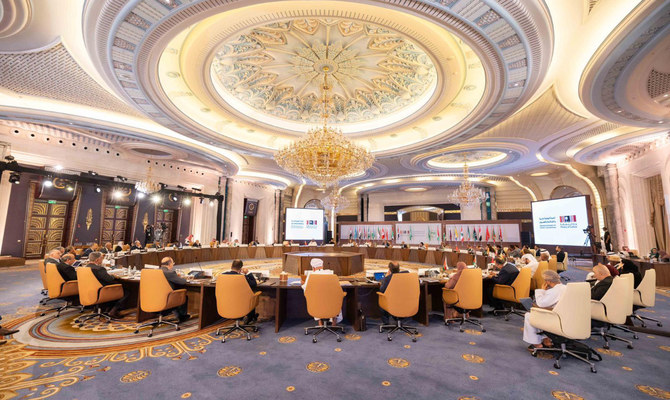
Arab League Educational, Cultural and Scientific Organization meetings begin in Jeddah

1 / 4
Hani bin Moqbel Al-Moqbel, Chair of the Executive Board, center, talks during the first day of the conference in Jeddah. (Supplied)
2 / 4
Ministers and other representatives from 22 Arab nations gathered in Jeddah on Tuesday for the start of the 121st session of the Executive Council of the Arab League Educational, Cultural and Scientific Organization. (Supplied)
3 / 4
Ministers and other representatives from 22 Arab nations gathered in Jeddah on Tuesday for the start of the 121st session of the Executive Council of the Arab League Educational, Cultural and Scientific Organization. (Supplied)
4 / 4
Ministers and other representatives from 22 Arab nations gathered in Jeddah on Tuesday for the start of the 121st session of the Executive Council of the Arab League Educational, Cultural and Scientific Organization. (Supplied)
Short Url
Updated 15 May 2024
Follow

Arab League Educational, Cultural and Scientific Organization meetings begin in Jeddah

  • Participants discuss challenges Arab nations face in fields of education, culture and science, and potential solutions, including knowledge sharing and innovation
  • The 121st session of the organization’s Executive Council on Tuesday and Wednesday will be followed on Friday by its General Conference

JEDDAH: Ministers and other representatives from 22 Arab nations gathered in Jeddah on Tuesday for the start of the 121st session of the Executive Council of the Arab League Educational, Cultural and Scientific Organization. The two-day session concludes on Wednesday and will be followed on Friday by the organization’s General Conference.

During the meetings, hosted by the Saudi National Committee for Education, Culture and Science, the participants will discuss important topics, initiatives and proposals related to knowledge sharing, scientific advancement, and innovation within the framework of the work of the organization, the Saudi Press Agency reported.

During the opening session, Hani Al-Moqbel, chairperson of ALESCO’s Executive Council, expressed deep concern about the ongoing crisis Palestinians face as a result of the war in Gaza between Israel and Hamas.

He unequivocally condemned and rejected a senseless and brutal conflict that has claimed the lives of countless civilians, including women, children and the elderly, and denounced as unacceptable the destruction by the Israeli military campaign of hospitals, religious sites, schools, cultural institutions and other infrastructure.

The council, led by its Saudi presidency, expressed its strong condemnation of the continued aggression, occupation and forced displacement in Gaza. Al-Moqbel said that such expressions are not merely procedural or symbolic, they represent a forward-thinking approach to fostering Arab unity, upholding core principles and bolstering shared values. In this way, he added, Arab nations can effectively tackle challenges and overcome hurdles on their paths to advancement.

Mohammed Walad Amar, the director general of ALECSO, highlighted the organization’s commitment to the promotion of the cultural heritage of Arab countries on the global stage. In keeping with this vision, he said, ALECSO has worked with several countries with the aim of securing recognition of more of their cultural treasures on the highly esteemed UNESCO World Heritage List.

As an example of its active engagement in these efforts, he noted that ALECSO took part in the UNESCO Culture and Education Ministers’ Conference in the UAE in February.

Other topics discussed on the opening day included challenges that Arab nations face in the fields of education, culture and science, innovative potential solutions to the problems, and ways to forge new partnerships that can broaden the horizons of education and thinking.


Saudi chef wins culinary competition

Updated 18 December 2025
Follow

Saudi chef wins culinary competition

  • Event aimed to empower chefs’ ability to showcase talent on global scale 
  • Bayan Abdullah Al-Sudani: It (has) encouraged me to participate in more challenging spaces

RIYADH: A Saudi has won the Saudi Elite Chefs competition at Horeca Riyadh.

The event, which was organized by the Culinary Arts Commission of the Ministry of Culture, in alignment with the ministry’s long-term goals, aimed to empower Saudi chefs’ ability to showcase their talent and creativity on a global scale.

Speaking to Arab News, the winner, Bayan Abdullah Al-Sudani, shed light on how the competition equipped her with confidence for the future, saying: “It was a big challenge, and I faced off against strong chefs. It (has) encouraged me to participate in more challenging spaces.”

On her future plans, Al-Sudani wants to give back to the industry, and added: “I look forward to opening the Bayan Academy soon so that I can support chefs and help them with the pastry sector specifically.”

Celebration and achievement were echoed throughout, and it was evident at the event that the culinary industry in the Kingdom is hungry for growth, recognition, and global competition.

Seba Zarea, general manager of strategy and program delivery at the Culinary Arts Commission, told Arab News of the many facets of the industry that the ministry was prioritizing.

Zarea said: “This competition is just one of the initiatives that the Culinary Arts Commission is working on. There are also local scholarships (and) vocational training. We are also working on attracting the best culinary schools to Saudi. For example, Le Cordon Bleu is opening next year in Misk City.”

Zarea stressed the rewards of events like the Saudi Elite Chefs competition, adding that the winner had a fast track to Bocuse d’Or and the World Pastry Cup — representing global opportunities to place both competitors and Saudi cuisine on the map.

Zarea added: “Food is a soft power and, in terms of tourism, food is a universal language so we codified the Saudi cuisine, an initiative started four years ago, and we came up with more than 1,300 codified recipes, items, and local produce from the Kingdom.”

Zarea went into depth on some of the behind-the-scenes efforts that have helped create the food that the Kingdom is able to showcase.

She shared the example of the Wild Plant Initiative, a program designed to explore plants of various regions in the Kingdom to discover new ingredients that can be integrated into Saudi cuisine.

These efforts go into helping to build an industry that is rooted in culture, creativity, and passion. 

In the same way that the Saudi Elite Chefs competition provides its winners and participants with the tools to bring their success to global attention, the Culinary Arts Commission works to elevate the Kingdom’s cuisine through tourism and hospitality.

Zarea said: “This sector is the easiest way to showcase the culture.”