

Israeli forces repeatedly target Gaza aid workers, says Human Rights Watch

1 / 6
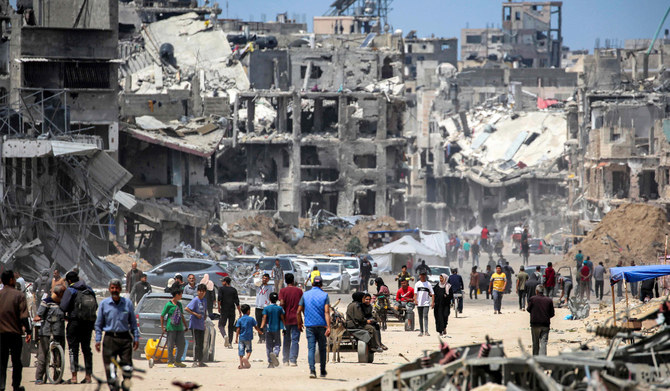
People move past destroyed buildings along a street in Khan Yunis in the southern Gaza Strip on May 14, 2024 amid the ongoing conflict in the Palestinian territory between Israel and Hamas. (AFP)
2 / 6
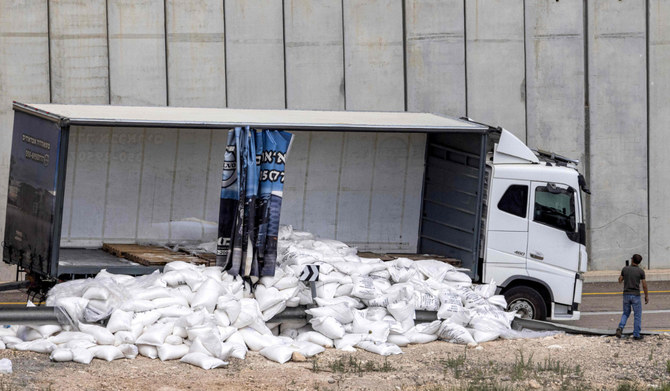
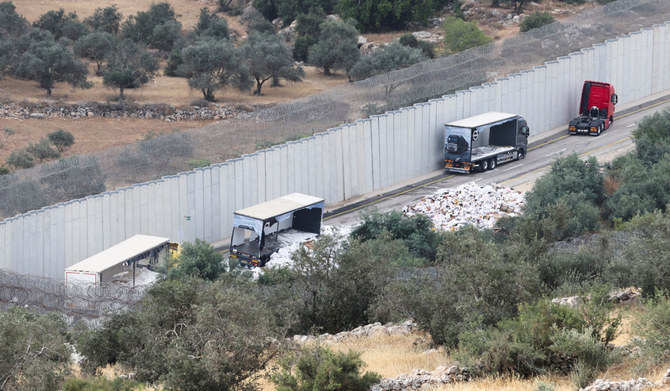
A man films with his phone a damaged trailer truck that was carrying humanitarian aid supplies parked along the Israeli side of Israel's controversial separation barrier with the West Bank near the village of Shekef on May 13, 2024, after it was vandalised by right-wing Israeli activists to protest against aid being sent to the Gaza Strip. (AFP)
3 / 6
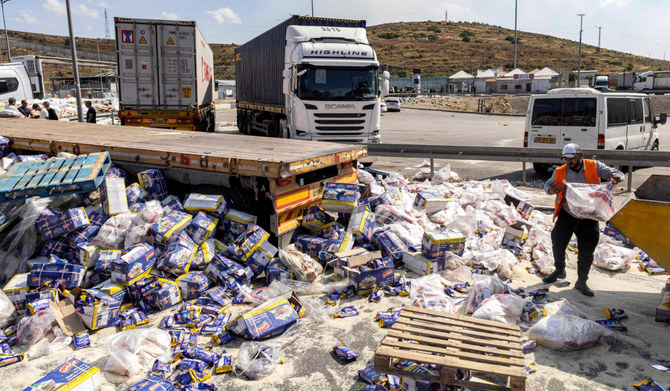
A worker clears spilled goods away from damaged trailer trucks that were carrying humanitarian aid supplies on the Israeli side of the Tarqumiyah crossing with the occupied West Bank on May 13, 2024, after they were vandalised by other activists to protest against aid being sent to the Gaza Strip. (AFP)
4 / 6
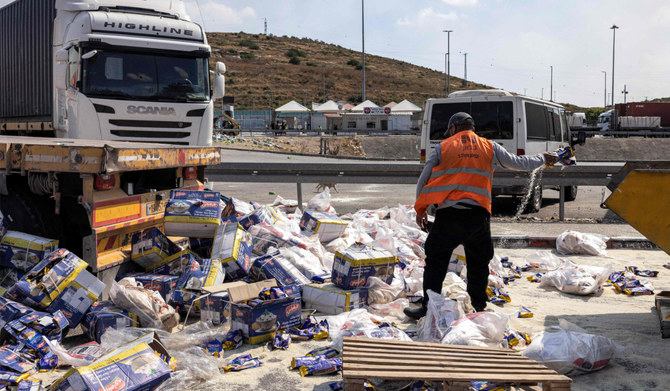
A worker clears spilled goods away from damaged trailer trucks that were carrying humanitarian aid supplies on the Israeli side of the Tarqumiyah crossing with the occupied West Bank on May 13, 2024, after they were vandalised by other activists to protest against aid being sent to the Gaza Strip. (AFP)
5 / 6
A youth walks near the damaged trailer trucks that were carrying humanitarian aid supplies on the Israeli side of the Tarqumiyah crossing with the occupied West Bank on May 13, 2024, after they were vandalised by right-wing Israeli activists to protest against aid being sent to the Gaza Strip. (AFP)
6 / 6
A view of trucks carrying aid to Gaza that were stopped after they were damaged by Israeli settlers near a checkpoint near Hebron in the Israeli-occupied West Bank May 14,2024. (REUTERS)
Short Url
Updated 14 May 2024
Follow

Israeli forces repeatedly target Gaza aid workers, says Human Rights Watch

  • They are among more than 250 aid workers who have been killed in Gaza since the war erupted more than seven months ago, according to UN figures
  • Israel has killed more than 35,000 Palestinians in Gaza, mostly women and children, according to the health ministry in the Hamas-run territory

JERUSALEM: Human Rights Watch said on Tuesday that Israel had repeatedly targeted known aid worker locations in Gaza, even after their coordinates were provided to Israeli authorities to ensure their protection.
The rights watchdog said that it had identified eight cases where aid convoys and premises were targeted, killing at least 15 people, including two children.
They are among more than 250 aid workers who have been killed in Gaza since the war erupted more than seven months ago, according to UN figures.
In all eight cases, the organizations had provided the coordinates to Israeli authorities, HRW said.
This reveals “fundamental flaws with the so-called deconfliction system, meant to protect aid workers and allow them to safely deliver life-saving humanitarian assistance in Gaza,” it said.
“On one hand, Israel is blocking access to critical lifesaving humanitarian provisions and on the other, attacking convoys that are delivering some of the small amount that they are allowing in,” Belkis Wille, HRW’s associate crisis, conflict and arms director, said in Tuesday’s statement.
HRW highlighted the case of the World Central Kitchen, a US-based charity who saw seven of its aid workers killed by an Israeli strike on their convoy on April 1.
This was not an isolated “mistake,” HRW said, pointing to the other seven cases it had identified where GPS coordinates of aid convoys and premises had been sent to Israeli authorities, only to see them attacked by Israeli forces “without any warning.”


Syria announces new currency framework, 2-zero redenomination

Updated 29 December 2025
Follow

Syria announces new currency framework, 2-zero redenomination

  • Under the plan, every 100 Syrian pounds will be converted into one unit of the new Syrian Arab Republic’s pound
  • Governor calls move ‘pivotal milestone within a comprehensive strategy’

DAMASCUS: Syria’s Central Bank announced executive instructions on Sunday to introduce a new Syrian currency, launching a monetary reform that includes removing two zeros from the pound and allowing a 90-day period of dual circulation.

The announcement was made during a press conference at the bank’s headquarters in Damascus.

Central Bank Gov. Abdulkader Husrieh said the step was part of a comprehensive institutional strategy to restore confidence and achieve sustainable economic stability.

He said: “The launch of the new currency is not a formal measure, but a pivotal milestone within a comprehensive strategy based on solid institutional foundations.”

Under the plan, every 100 Syrian pounds will be converted into one unit of the new Syrian Arab Republic’s pound. The old and new currencies will circulate together for 90 days, a period which may be extended.

All bank balances will be converted to the new currency at the beginning of next year, while the overall money supply will be maintained without increase or reduction.

An employee at a currency exchange shop stacks Syrian bills at a shop in Damascus. The old currency is expected to be taken out of the market in the next few months. (AFP file photo)

Husrieh said the economic strategy was based on five pillars: monetary stability, a stable and transparent foreign-exchange market, effective and accountable financial institutions, secure digital transformation, and balanced international economic relations.

He said the move required updating financial laws and regulations, improving data systems, keeping pace with global digital developments, and ensuring sustainable financing and training for the financial sector.

The currency exchange will be provided free of charge, with no commissions, fees, or taxes.

All public and private entities must apply the official conversion standard to prices, salaries, wages, and financial obligations. Official exchange-rate bulletins will be issued in both currencies to ensure transparency and prevent speculation.

The governor said the central bank was closely monitoring markets to stabilize the exchange rate and would supply Syrian pounds if demand for foreign currency rises, adding that citizens will feel the impact more clearly after the exchange process is completed.

“Our policy is financial discipline, with no room for inflation,” Husrieh added.

He confirmed that the decree regulating the exchange limits the process to Syrian territory, and said the measures fell within the bank’s 2026-2030 strategy to align with international standards.

The new banknotes, he added, were being printed by leading international companies to prevent counterfeiting.