Islamabad High Court halts government move to block phone SIMs of non-tax filers

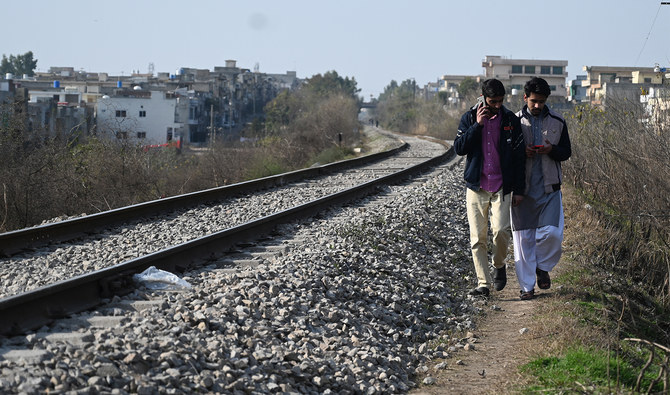
Men use their mobile phones as they walk alongside a railway track in Rawalpindi on January 23, 2021. (REUTERS/File)
Short Url
Updated 14 May 2024
Follow

Islamabad High Court halts government move to block phone SIMs of non-tax filers

  • Pakistan’s tax collection body asked the country’s telecom authority to block over half a million SIMs last month
  • The court issued a stay order until May 27 after a telecom firm challenged the decision and called it unconstitutional

ISLAMABAD: A Pakistani court on Tuesday issued a stay order against a government directive to block cellphone SIMs of users who did not file their tax returns in 2023, as the lawyer of a telecom company argued the decision was taken in violation of the constitution.

Last month, the Federal Board of Revenue (FBR), the country’s tax collection body, ordered the Pakistan Telecommunication Authority (PTA) to block over half a million SIMs belonging to people required to file taxes but who were not appearing on the active taxpayers’ list.

However, telecom companies were reluctant to implement the directives affecting so many subscribers, prompting the PTA to urge the FBR to revisit its directive.

The discussion continued until the telecom companies decided last Friday to initiate a manual process of disabling the SIMs in small batches. It was widely reported in the local media on Tuesday the Islamabad High Court (IHC) had stayed the implementation of the cellphone blockage until May 27.

“Blocking more than 500,000 SIMs will result in a loss of Rs1 billion annually,” Advocate Salman Akram Raja was quoted as saying by Pakistan’s Geo News channel.

Raja, who was representing Zong, told the court the decision taken by the government was in violation to Article 18 of the constitution, which guaranteed freedom of trade, business and profession.

Pakistan has traditionally faced the challenge of convincing people to file tax returns, but the government has now decided to implement stringent measures to address the problem, particularly in the context of negotiations for a new International Monetary Fund (IMF) loan program.

The IMF has urged Pakistan in the past to enhance revenue collection from non-filers as part of broader economic reforms to support social and development initiatives.

In response, the FBR is taking steps like blocking the SIM cards and considering other punitive measures to enforce tax compliance and widen the tax net.


Death toll in Pakistan shopping plaza fire rises to 67, officials say

Updated 22 January 2026
Follow

Death toll in Pakistan shopping plaza fire rises to 67, officials say

  • Rescue teams still searching for damaged Gul Plaza in Karachi where blaze erupted on Saturday, says police surgeon
  • Karachi has a long history of deadly fires, often linked to poor safety standards, weak regulatory enforcement

KARACHI: The death toll from a devastating fire at a shopping plaza in Pakistan’s southern port city of Karachi jumped to 67 on Thursday after police and a hospital official confirmed that the remains of dozens more people had been found.

Police surgeon Dr. Summaiya Syed said rescue teams were still searching the severely damaged Gul Plaza in the Karachi, where the blaze erupted on Saturday.

Most remains were discovered in fragments, making identification extremely difficult, but the deaths of 67 people have been confirmed, she said. Asad Raza, a senior police official in Karachi, also confirmed the death toll. Authorities previously had confirmed 34 deaths.

Family members of the missing have stayed near the destroyed plaza and hospital, even after providing their DNA for testing. Some have tried to enter the building forcibly, criticizing the rescue efforts as too slow.

“They are not conducting the search properly,” said Khair-un-Nisa, pointing toward the rescuers. She stood outside the building in tears, explaining that a relative who had left to go shopping has been missing since the blaze.

Another woman, Saadia Saeed, said her brother has been trapped inside the building since Saturday night, and she does not know what has happened to him.

“I am ready to go inside the plaza to look for him, but police are not allowing me,” she said.

There was no immediate comment from authorities about accusations they have been too slow.

Many relatives of the missing claim more lives could have been saved if the government had acted more swiftly. Authorities have deployed police around the plaza to prevent relatives from entering the unstable structure, while rescuers continue their careful search.

Investigators say the blaze erupted at a time when most shop owners were either closing for the day or had already left. Since then, the Sindh provincial government has said around 70 people were missing after the flames spread rapidly, fueled by goods such as cosmetics, clothing, and plastic items.

The cause of the fire remains under investigation, though police have indicated that a short circuit may have triggered the blaze.

Karachi has a long history of deadly fires, often linked to poor safety standards, weak regulatory enforcement, and illegal construction.

In November 2023, a shopping mall fire killed 10 people and injured 22. One of Pakistan’s deadliest industrial disasters occurred in 2012, when a garment factory fire killed at least 260 people.