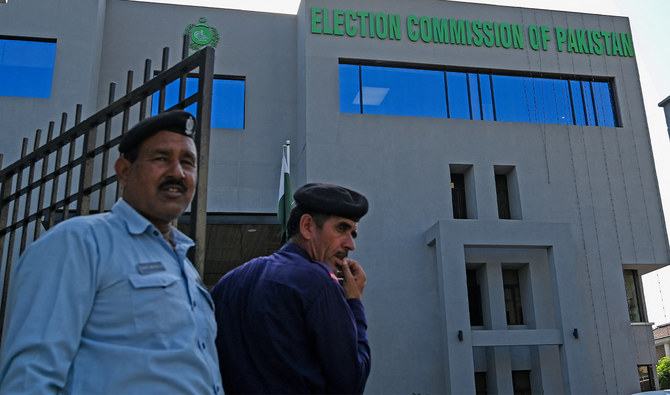

Pakistan’s election regulator has suspended 77 lawmakers elected on reserved seats, dealing a blow to the fragile ruling coalition led by Prime Minister Shehbaz Sharif which has lost the third-thirds parliamentary majority needed to make constitutional amendments.
The Election Commission of Pakistan’s ruling comes a week after the Supreme Court overruled a verdict by the Peshawar High Court (PHC) that a party aligned with candidates backed by former premier Imran Khan was not eligible for reserved seats in the legislature.
Khan’s Pakistan Tehreek-e-Insaf (PTI) party couldn’t contest the Feb. 8 elections under its traditional electoral symbol, a cricket bat, which it was denied on technical grounds, and subsequently struck an alliance with another party, the Sunni Ittehad Council (SIC), in a bid to secure reserved seats for women and minorities in parliament. Under Pakistan’s election rules, political parties are allotted reserved seats in proportion to the number of parliamentary seats they win in the election. This completes the National Assembly’s total strength of 336 seats.
The Election Commission had ruled in March that the SIC was not eligible for reserved seats, a decision the alliance had appealed in the Peshawar High Court, which rejected the petition. The SIC then approached the Supreme Court to appeal the high court’s decision, which last week suspended the PHC’s ruling.
“Pursuant to the order on 6th May, 2024 passed by the honorable Supreme Court of Pakistan, the notifications of the following returned candidates against under mentioned categories of reserved seats are hereby suspended till further orders,” the ECP’s notification read.
With the ECP’s notification, the strength in the National Assembly of PM Sharif’s ruling Pakistan Muslim League-Nawaz (PML-N) has reduced from 121 to 107 while that of its main coalition partner Pakistan Peoples Party (PPP) is down from 72 to 67.
This means the ruling coalition has lost its two-thirds majority in the National Assembly, with its numerical strength decreasing to 209 from 228. In the 336-member National Assembly, the figure to attain two-thirds majority is 224, without which the government cannot enact reforms or amend laws.
Sharif formed a weak coalition with other parties after February general elections produced a hung parliament. The PML-N’s 79 and the PPP’s 54 seats together made a simple majority in parliament to form a government and they also roped in smaller parties in the coalition.
Candidates backed by Khan won the most seats, 93, but did not have the numbers to form a government. Khan and his party have rejected the results of the elections, alleging widespread rigging.
According to the breakdown of the 77 suspended lawmakers, 44 belong to Sharif’s PML-N party, 15 to the Pakistan Peoples Party (PPP), 13 to the Jamiat Ulama-e-Islam-Fazal (JUI-F), and one each to the Muttahida Qaumi Movement-Pakistan (MQM-P), Istehkam-e-Pakistan Party (IPP), Awami National Party (ANP), Pakistan Muslim League Quaid (PML-Q) and Pakistan Tehreek-e-Insaf Parliamentarians (PTI-P).
The 77 suspended lawmakers include 22 legislators elected on reserved seats in the National Assembly, 25 in the Khyber Pakhtunkhwa (KP) Assembly, 27 in the Punjab Assembly, and three in the Sindh Assembly.