

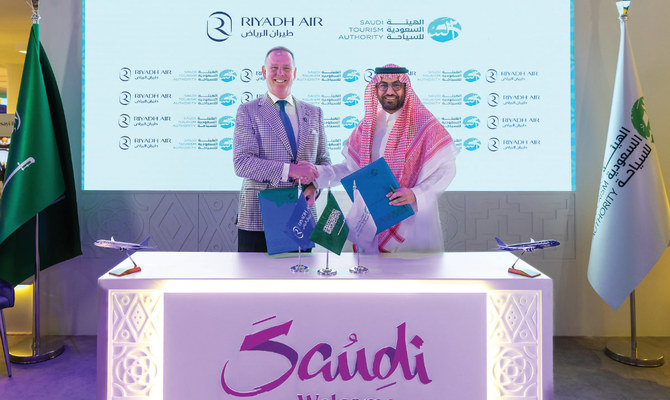
Riyadh Air, STA partner to boost Saudi travel experience

Riyadh Air CEO Tony Douglas and CEO of Saudi Tourism Authority Fahd Hamidaddin sign the agreement.
Short Url
Updated 12 May 2024
Follow

Riyadh Air, STA partner to boost Saudi travel experience

Riyadh Air, Saudi Arabia’s new world-class airline, and Saudi Tourism Authority, have signed an MoU at Dubai’s Arabian Travel Market, which will enhance the travel experience for passengers to and from Saudi Arabia. Riyadh Air aims to fly to more than 100 countries by 2030, and through this partnership, both entities will collaborate on various initiatives to enhance the level of services for tourists.

STA CEO Fahd Hamidaddin said: “Increasing Saudi’s connectivity with the world is a key pillar of our tourism strategy and will ensure we sustain our rapid growth and meet our new ambitious target of 150 million visits by 2030.

“This exciting new partnership with Riyadh Air will support our goals and ensure more visitors can travel to experience the cool mountains, pristine waters and dynamic cities that make Saudi a great year-round destination.”

Hamidaddin added: “We are currently connected to over 180 destinations and are aiming to triple annual passenger traffic to 330 million by 2030 and this new agreement will help turbocharge these efforts.”

Riyadh Air CEO Tony Douglas said: “This is another momentous day in the history of Riyadh Air. Working alongside the STA to elevate the travel experience for our guests and those coming to visit the Kingdom of Saudi Arabia signifies what we’re all about. We are elevating standards across the board in aviation to previously unseen levels. We have a shared commitment to travel and tourism in the Kingdom along with our forward-thinking approach to innovation, sustainability, and the satisfaction of our guests.”

The partnership will focus on several key areas:

New routes and destinations

Riyadh Air and the STA will jointly announce new routes and destinations to raise global awareness among travelers.

Joint marketing activities

Riyadh Air and the STA will promote Saudi Arabia along with other new destinations with an aligned strategy to attract and inform guests around the world. Riyadh Air is expected to contribute to the Kingdom’s non-oil GDP growth by $20 billion while directly and indirectly creating more than 200,000 new jobs globally and locally.

Sponsorship opportunities

The agreement will see Riyadh Air and the STA engage in sponsorship opportunities and enable both parties to leverage each other’s networks and resources to promote tourism in the Kingdom.

Presence at global events

Working in unison, Riyadh Air and the STA will ensure they have a notable presence in key industry trade shows along with major international events in the travel and tourism sector. Their participation will enable both Riyadh Air and the STA to showcase their offerings, make new announcements, and unveil key developments.

Accessibility to STOCH

The MoU will ensure accessibility to tourism-related platforms such as the Sustainable Tourism Observatories in Cities to keep Saudi Arabia and Riyadh Air visible and accessible to tourists and guests year-round.

Collaboration in loyalty programs

Travelers will reap the rewards of both parties’ loyalty programs, through joint promotions and incentives, which will encourage further visits to Saudi Arabia, and beyond, with Riyadh Air.

Distribution and payment solutions

Airline booking processes will be made simpler than ever due to collaboration on payment solutions, leveraging world-leading technology and new digital methods.

Tourism Accelerator Program

Riyadh Air and the STA will both be active in the Tourism Accelerator Program, driving innovation, growth and sustainability within the tourism sector.

Development of tourism products

As globally recognizable entities, both will work in unison to develop and produce various travel and tourism products to enhance the overall experience for travelers.

Visitor feedback

As part of the agreement, Riyadh Air and the STA will gather invaluable feedback and information from travelers to improve services and the overall experience where necessary.


Washing water waste out of fashion

Updated 18 February 2026
Follow

Washing water waste out of fashion

Suat Ozsoy, vice president of commercial operations at Epson META-CW Asia, explores how the fashion industry can innovate and become more sustainable by reducing water consumption.

We have all had that perfect pair of jeans — the ones that fit just right, in the perfect color, and with a style that feels like it was made for us. But when you look a little closer, we might realize they are not as perfect as they seem. Why? Because it takes nearly 3,781 liters of water to make the average pair of jeans according to the World Economic Forum. That’s enough to fill around 50 baths.

The garment industry has grown up around waterways, which have provided the transportation, power for mills and water sources for production. But it has also led to pollution and huge water waste as per WWF’s report on ‘The Water Risks and Opportunities Facing Apparel and Textile Clusters’.

As the fashion industry continues to grow, the environmental cost of producing clothing is becoming an increasingly urgent issue. Reducing water consumption is essential to creating a more sustainable future for fashion.

Local initiatives and Vision 2030
The UAE, as a hub for innovation and sustainability in the Middle East, increasingly recognizes the need to address environmental challenges like water conservation. Under the framework of Vision 2030, the UAE government has prioritized sustainability, with significant investments in water management and innovative technologies to address water scarcity. The National Water Strategy 2036 aims to ensure the sustainable use of water resources, improving efficiency and reducing waste across various sectors, including textiles. With growing awareness of global water issues, local stakeholders are looking at cutting-edge solutions such as digital textile printing and sustainable manufacturing practices to minimize the ecological impact of industries such as fashion.

An XXXL sized problem
The textile industry has a heavy environmental footprint — both globally and in the Middle East. According to Tadweer Group, the UAE’s annual textile consumption stands at around 500 million items, of which approximately 210,000 tonnes end up as discarded material — up to 90 percent of which currently goes to landfill. This waste is especially significant for a region with ambitious sustainability goals and highlights the urgency for the textile and fashion industries to embrace redesign, recycling and more sustainable manufacturing methods.

Why all the water?
Water waste in clothing production begins with the raw materials. Most textiles are woven from cotton, which requires more water than any other crop. As per Florida State University’s research ‘Clothed in Conservation: Fashion & Water’, producing just 1 kg of raw cotton requires between 7,000 and 29,000 liters of water, whereas 1,827 liters of water are used to produce 1 kg of wheat and cereal grains only need 1,000 liters per kg. The manufacturing process also needs huge volumes of water. The cotton must be bleached, dyed, printed and rinsed. Dyed cotton requires up to 150 liters of water per kg according to the report ‘Why Does it Take So Much Water to Make a Cloth?’ by Decathlon Sustainability.What technology is available to reduce the huge waste associated with traditional analogue methods used in clothing manufacture?

Technology that is making an impact
The pre- and -post treatment of fabrics for printing is an area where new technology can significantly reduce water use. Epson’s Monna Lisa ML-13000 is an example of a modern digital printer that uses pigment ink, simplifying the whole process and reducing water use by up to 97 percent compared to traditional textile printing.

Digital textile printing also allows for on-demand production, removing unnecessary water and textile waste associated with traditional analogue processes that are not well-suited for low print volumes, resulting in over production. Digital printers are also compact in size and can help shorten supply chain processes, keeping production closer to where it is consumed.

Cutting waste in other ways
Epson’s digital printing is just one of the technologies that is helping the textile industry move toward more sustainable production. Another is Epson’s Dry Fiber Technology for textiles.

A prototype is in development that defibrates used clothing and mill ends into base fibers, which can be supplied for subsequent processes to create new non-woven materials. The defibering process is waterless, although moderate humidity is required. If used widely, this could help solve two of the industry’s major challenges: the huge volume of water needed for production and the current low volume of clothing recycling.

To highlight the possibilities of sustainable technology, renowned UAE-based fashion designer Michael Cinco collaborated with Epson during Arab Fashion Week 2023. Using Epson’s digital printing technology, Cinco was able to print intricate designs for his runway collection inspired by Gustav Klimt, showcasing the power of sustainable, high-quality textile printing. This collaboration underscores the growing importance of environmentally conscious practices in the fashion industry, especially in the UAE, where sustainability is becoming an increasingly integral part of the fashion landscape.

A change of mindset
Next time you choose a garment, think about the innovation behind it and envision a future where informed choices help drive responsible production and help protect our environment for the next generation.

To learn more about Epson’s innovation for the textile industry, visit: https://www.epson.ae/discover/sustainable-technologies