

Suspected pirate attack in Gulf of Aden raises concerns about growing Somali piracy

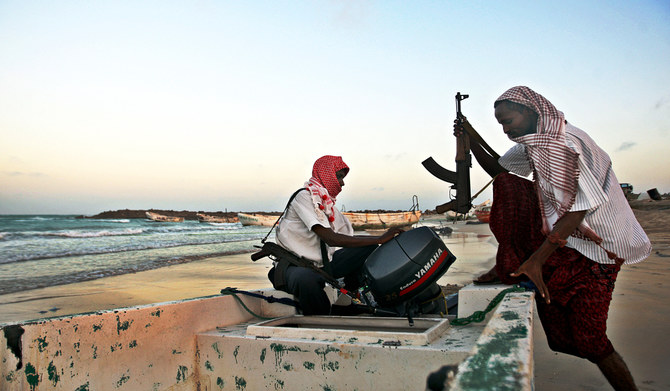
Armed Somali pirates carrying out preparations to a skiff in Hobyo, northeastern Somalia, ahead of new attacks on ships sailing in the Gulf of Aden. (AFP file photo)
Short Url
Updated 11 May 2024
Follow

Suspected pirate attack in Gulf of Aden raises concerns about growing Somali piracy

  • Somali piracy in the region at the time cost the world’s economy some $7 billion — with $160 million paid out in ransoms, according to the Oceans Beyond Piracy monitoring group

DUBAI: A European naval force detained six suspected pirates on Friday after they opened fire on an oil tanker traveling through the Gulf of Aden, officials said, likely part of a growing number of piracy attacks emanating from Somalia.
The attack on the Marshall Islands-flagged Chrystal Arctic comes as Houthis have also been attacking ships traveling through the crucial waterway, the Red Sea, and the Bab Al-Mandeb Strait connecting them.
The assaults have slowed commercial traffic through the key maritime route onward to the Suez Canal and the Mediterranean Sea.
The pirates shot at the tanker from a small ship “carrying weapons and ladders,” according to the British military’s UK Maritime Trade Operations Center, which oversees Mideast shipping routes.
The pirates opened fire first at the Chrystal Arctic, whose armed onboard security team returned fire at them, the UKMTO said.

BACKGROUND

Maritime sources say pirates may be encouraged by a relaxation of security or may be taking advantage of the chaos caused by attacks on shipping by the Houthis.

The pirates then abandoned their attempt to take the tanker, which continued on its way with all its crew safe, the UKMTO said.
Hours later, the EU naval force in the region known as Operation Atalanta said a frigate operating in the region detained six suspected pirates.
The frigate seized the pirates, given “the unsafe condition of their skiff” and said that some had “injuries of varied severity.”
It was not immediately clear if those injured suffered gunshot wounds from the exchange of fire with the Chrystal Arctic.
The EU force declined to elaborate “due to the security of the operations.”
Once-rampant piracy off the Somali coast diminished after a peak in 2011. That year, there were 237 reported attacks in waters off Somalia.
Somali piracy in the region at the time cost the world’s economy some $7 billion — with $160 million paid out in ransoms, according to the Oceans Beyond Piracy monitoring group.
Increased naval patrols, a strengthening central government in Mogadishu, Somalia’s capital, and other efforts saw the piracy beaten back.
However, concerns about new attacks have grown in recent months.
According to the International Maritime Bureau, five incidents were reported off Somalia in the first quarter of 2024.
“These incidents were attributed to Somali pirates who demonstrate mounting capabilities, targeting vessels at great distances from the Somali coast,” the bureau warned in April.
It added that there had been “several reported hijacked dhows and fishing vessels, which are ideal mother ships to launch attacks at distances from the Somali coastline.”
In March, the Indian navy detained dozens of pirates who seized a bulk carrier and took its 17 crew hostage.
In April, pirates release 23 crew members of the Bangladesh-flagged cargo carrier MV Abdullah after seizing the vessel.
The terms of the release are not immediately known.
These attacks come as the Houthi campaign has targeted shipping since November as part of their pressure campaign to stop the Israel-Hamas war raging in the Gaza Strip.


US Congress moves toward repeal of tough ‘Caesar’ sanctions on Syria

Updated 13 sec ago
Follow

US Congress moves toward repeal of tough ‘Caesar’ sanctions on Syria

  • The Caesar sanctions, the most stringent restrictions, can only be removed permanently by an act of Congress
  • Several Saudi Arabian firms are planning billion-dollar investments in the country as part of Riyadh’s drive to support the country’s recovery

WASHINGTON: A set of tough US sanctions imposed on Syria under its former leader Bashar Assad could be lifted within weeks, after their repeal was included in a sweeping defense policy bill unveiled during the weekend and due for votes in Congress within days. The Senate and House of Representatives included repeal of the so-called Caesar sanctions, a move seen as key to Syria’s economic recovery, in a compromise version of the National Defense Authorization Act, or NDAA, a sweeping annual defense policy bill that was unveiled late on Sunday.
The provision in the 3,000-page defense bill repeals the 2019 Caesar Act and requires regular reports from the White House certifying that Syria’s government is fighting Daesh militants, upholding religious and ethnic minority rights within the country and not taking unilateral, unprovoked military action against its neighbors, including Israel.

HIGHLIGHTS

• Sanctions relief seen as key to Syrian economic revival

• US bill including repeal expected to pass within weeks

• Trump has temporarily lifted sanctions, Congress must approve permanent relief

The NDAA is expected to pass by the end of this year and be signed into law by President Donald Trump, whose fellow Republicans hold majorities in both the House and Senate and lead the committees that wrote the bill. Lifting the sanctions is considered a key to the success of Syria’s new government. Several Saudi Arabian firms are planning billion-dollar investments in the country as part of Riyadh’s drive to support the country’s recovery. The US sanctions have been a significant obstacle to Syria’s economic revival.
Trump announced plans to lift all sanctions on Syria during a meeting with Syrian President Ahmed Al-Sharaa in May, and his administration has suspended them temporarily. However, the Caesar sanctions, the most stringent restrictions, can only be removed permanently by an act of Congress.
The 2019 Caesar Act imposed wide-ranging sanctions on Syria targeting individuals, companies and institutions linked to Assad, who was the president of Syria from 2000 until his ouster in 2024 by rebel forces led by Sharaa. Syrian central bank Governor AbdulKader Husrieh told Reuters last week that the country’s economy was growing faster than had been expected. He described the repeal of many US sanctions as “a miracle.”
The sanctions are named after a Syrian military photographer, code-named “Caesar,” who smuggled out thousands of gruesome photos documenting torture and war crimes by Assad’s government.