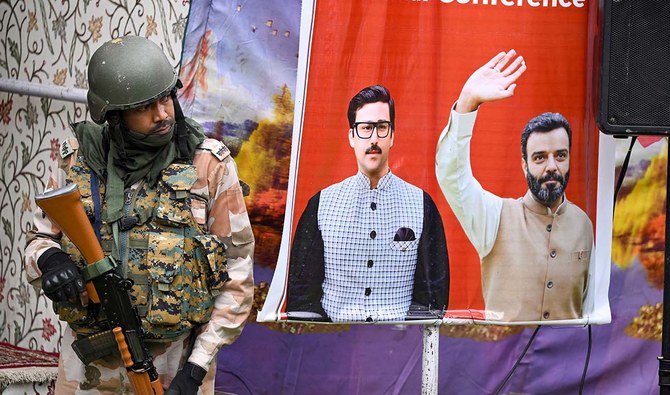
NEW DELHI: Opposition leaders in India’s troubled Kashmir valley have accused Prime Minister Narendra Modi’s administration of denying or canceling permissions to hold campaign events, to help his party’s “proxies.”
Omar Abdullah, a leader of the largest regional political party, the National Conference, said Modi’s government was trying to sabotage his campaign ahead of voting in the first of Kashmir’s three seats on Monday.
Modi’s Bharatiya Janata Party (BJP) is skipping elections in Kashmir for the first since 1996, which analysts and politicians in the region say belies his narrative of integrating Kashmir with the rest of the country and bringing peace and normality to the valley ravaged by a 35-year-old uprising against India’s rule.
In 2019, Modi revoked Jammu and Kashmir state’s partial autonomy, removed its statehood and divided it into two federally-controlled territories: Muslim-majority Kashmir with Hindu-dominated Jammu, and a mountainous Buddhist territory of Ladakh.
While the BJP has not fielded any candidate in Kashmir’s three seats, it has said that, as part of its grand strategy, it would instead support other smaller regional parties, without naming which.
In a letter to the federal poll watchdog, the Election Commission of India, on Thursday, Abdullah said the police, which are under the federal government’s control, canceled permissions for his rallies, asking him to reschedule without providing any reasons.
He said on social media platform X that it was done to help the BJP’s “proxy candidates.”
His rival Mehbooba Mufti, who heads the other regional political powerhouse the People’s Democratic Party (PDP), also accused the police of not allowing her to hold campaign events.
“This attitude of the police, in which they curtail our movement to support the proxy parties of the BJP, is against the guidelines of the Election Commission of India,” she said at a rally in Srinagar on Thursday.
V.K. Birdi, the police official responsible for Kashmir, did not immediately respond to a request seeking comment.
Both Abdullah and Mufti have said they were opposed to the BJP and would support an opposition Congress-led alliance of more than two dozen parties federally.
The state unit of the election watchdog has also asked PDP’s Srinagar candidate, Waheed ur Rehman Para to refrain from calling this election a “referendum” against scrapping of semi-autonomy of the region in 2019 in his speeches.
While Srinagar will vote on May 13, the elections in the other two seats will be held on May 20 and 25.
Nuclear-armed neighbors India and Pakistan control parts of Kashmir, but claim it in full, and have fought two of their three wars over the region.


![]()

Opposition leaders in Kashmir accuse Indian government of sabotaging their campaigns
Short Url
https://arab.news/ma76a
Opposition leaders in Kashmir accuse Indian government of sabotaging their campaigns
- Omar Abdullah says police canceled permissions for his rallies, asking him to reschedule without giving reasons
- Mehbooba Mufti of People’s Democratic Party also accused the police of not allowing her to hold campaign events
Latest updates


© 2026 SAUDI RESEARCH & PUBLISHING COMPANY, All Rights Reserved And subject to Terms of Use Agreement.