Pakistan and Ireland go toe-to-toe in inaugural T20I series today

1 / 2
Ireland Captain Paul Stirling gestures with his Pakistani counterpart Babar Azam holding trophy in Dublin on May 9, 2024, ahead of the inaugural T20 series between Pakistan and Ireland. (Photo courtesy: PCB)
2 / 2
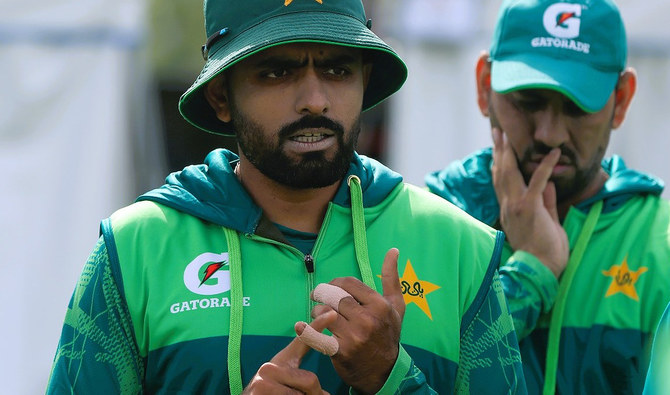
Pakistan skipper Babar Azam speaks to his team during a practice session in Dublin on May 9, 2024, ahead of the inaugural T20 series between Pakistan and Ireland. (Photo courtesy: PCB)
Short Url
Updated 10 May 2024
Follow

Pakistan and Ireland go toe-to-toe in inaugural T20I series today

  • Both Pakistan and Ireland are in the same group of the T20 World Cup
  • Mohammad Amir expected to be available for second and third T20Is

ISLAMABAD: The Pakistan cricket team will kick off its Europe tour today, Friday, with the first of three Twenty20 Internationals (T20Is) against Ireland at the Castle Avenue, the Pakistan Cricket Board (PCB) said.
This marks the first time Ireland will host Pakistan for a T20I series. The two sides have previously met only once in the ICC Men’s T20 World Cup 2009 where Pakistan won by 39 runs with Kamran Akmal receiving the player of the match award for his 51-ball 57 and two stumpings.
Interestingly, both Pakistan and Ireland are in the same group for the ICC Men’s T20 World Cup 2024 and will face each other in Florida on June 16. Apart from the two sides, India, USA, and Canada are also in the same group, with the top two teams advancing to the second stage.
“Our preparations for the ICC Men’s T20 World Cup 2024 began with the home series against New Zealand and now it’s all about putting the final touches on those preparations. We have clarity on our game plans, strategies and combinations. It’s about bringing everything together before we arrive in the United States,” the PCB quoted Pakistan head coach Azhar Mahmood as saying.
“We’ve only played Ireland once, so they will be a relatively new opponent for us. However, any team in T20 cricket can be dangerous as the match can swing in one over. The three T20Is will provide us with good information about their players and how they approach T20 cricket.”
The remaining two matches will also take place at the same venue in Ireland on Sunday and Tuesday, before Pakistan head to Headingley, Leeds on Wednesday for a series of four T20Is against England.
Following the England series, with matches scheduled at Headingley (22 May), Birmingham (25 May), Cardiff (28 May), and The Oval, London (30 May), both England and Pakistan will head to the ICC Men’s T20 World Cup 2024, according to the PCB.
England will face Scotland in Barbados on June 4 in their opening match, while Pakistan will launch their campaign against the United States (US) in Dallas on June 6.
Meanwhile, fast bowler Mohammad Amir will miss the first T20I due to delays in the issuance of his visa. He is expected to join the side on Friday.
Squads
Ireland: Paul Stirling (captain), Mark Adair, Ross Adair, Andrew Balbirnie, Curtis Campher, Gareth Delany, George Dockrell, Graham Hume, Barry McCarthy, Neil Rock, Harry Tector, Lorcan Tucker, Ben White, Craig Young
Pakistan: Babar Azam (captain), Abrar Ahmed, Azam Khan, Fakhar Zaman, Haris Rauf, Hasan Ali, Iftikhar Ahmed, Imad Wasim, Mohammad Abbas Afridi, Mohammad Amir (unavailable for first T20I), Mohammad Rizwan, Muhammad Irfan Khan, Naseem Shah, Saim Ayub, Salman Ali Agha, Shadab Khan, Shaheen Shah Afridi and Usman Khan


IMF warns against policy slippage amid weak recovery as it clears $1.2 billion for Pakistan

Updated 11 December 2025
Follow

IMF warns against policy slippage amid weak recovery as it clears $1.2 billion for Pakistan

  • Pakistan rebuilt reserves, cut its deficit and slowed inflation sharply over the past one year
  • Fund says climate shocks, energy debt, stalled reforms threaten stability despite recent gains

ISLAMABAD: Pakistan’s economic recovery remains fragile despite a year of painful stabilization measures that helped pull the country back from the brink of default, the International Monetary Fund (IMF) warned on Thursday, after it approved a fresh $1.2 billion disbursement under its ongoing loan program.

The approval covers the second review of Pakistan’s Extended Fund Facility (EFF) and the first review of its climate-focused Resilience and Sustainability Facility (RSF), bringing total disbursements since last year to about $3.3 billion.

Pakistan entered the IMF program in September 2024 after years of weak revenues, soaring fiscal deficits, import controls, currency depletion and repeated climate shocks left the economy close to external default. A smaller stopgap arrangement earlier that year helped avert immediate default, but the current 37-month program was designed to restore macroeconomic stability through strict monetary tightening, currency adjustments, subsidy rationalization and aggressive revenue measures.

The IMF’s new review shows that Pakistan has delivered significant gains since then. Growth recovered to 3 percent last year after shrinking the year before. Inflation fell from over 23 percent to low single digits before rising again after this year’s floods. The current account posted its first surplus in 14 years, helped by stronger remittances and a sharp reduction in imports. And the government delivered a primary budget surplus of 1.3 percent of GDP, a key program requirement. Foreign exchange reserves, which had dropped dangerously low in 2023, rose from US$9.4 billion to US$14.5 billion by June.

“Pakistan’s reform implementation under the EFF arrangement has helped preserve macroeconomic stability in the face of several recent shocks,” IMF Deputy Managing Director Nigel Clarke said in a statement after the Board meeting.

But he warned that Islamabad must “maintain prudent policies” and accelerate reforms needed for private-sector-led and sustainable growth.

The Fund noted that the 2025 monsoon floods, affecting nearly seven million people, damaging housing, livestock and key crops, and displacing more than four million, have set back the recovery. The IMF now expects GDP growth in FY26 to be slightly lower and forecasts inflation to rise to 8–10 percent in the coming months as food prices adjust.

The review warns Pakistan against relaxing monetary or fiscal discipline prematurely. It urges the State Bank to keep policy “appropriately tight,” allow exchange-rate flexibility and improve communication. Islamabad must also continue raising revenues, broadening the tax base and protecting social spending, the Fund said.

Despite the progress, Pakistan’s structural weaknesses remain severe.

Power-sector circular debt stands at about $5.7 billion, and gas-sector arrears have climbed to $11.3 billion despite tariff adjustments. Reform of state-owned enterprises has slowed, including delays in privatizing loss-making electricity distributors and Pakistan International Airlines. Key governance and anti-corruption reforms have also been pushed back.

The IMF welcomed Pakistan’s expansion of its flagship Benazir Income Support Program, which raises cash transfers for low-income families and expands coverage, saying social protection is essential as climate shocks intensify. But it warned that high public debt, about 72 percent of GDP, thin external buffers and climate exposure leave the country vulnerable if reform momentum weakens.

The Fund said Pakistan’s challenge now is to convert short-term stabilization into sustained recovery after years of economic volatility, with its ability to maintain discipline, rather than the size of external financing alone, determining the durability of its gains.