

Biden says US will withhold weapons from Israel if it invades Rafah

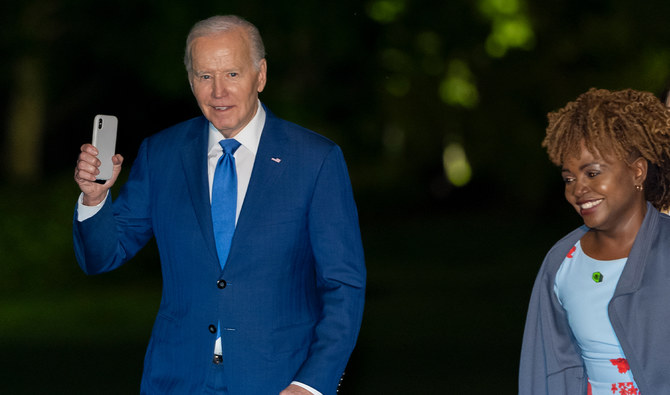
President Joe Biden waves as he walks with White House press secretary Karine Jean-Pierre from Marine One as he arrives on the South Lawn of the White House, Wednesday, May 8, 2024, in Washington. Biden is returning from Wisconsin and Chicago. (AP/File)
Short Url
Updated 09 May 2024
Follow

Biden says US will withhold weapons from Israel if it invades Rafah

  • Biden’s comments represent his strongest public language to date in effort to deter Israeli assault on Rafah 
  • Remarks underscore a growing rift on Gaza war between the US and its strongest ally in the Middle East 

President Joe Biden on Wednesday publicly warned Israel for the first time that the US would stop supplying it weapons if Israeli forces make a major invasion of Rafah, a refugee-packed city in southern Gaza.

“I made it clear that if they go into Rafah ..., I’m not supplying the weapons that have been used historically to deal with Rafah, to deal with the cities – that deal with that problem,” Biden said in an interview with CNN.

Biden’s comments represent his strongest public language to date in his effort to deter an Israeli assault on Rafah while underscoring a growing rift between the US and its strongest ally in the Middle East.

Biden acknowledged US weapons have been used by Israel to kill civilians in Gaza, where Israel has mounted a seven-month-old offensive aimed at annihilating Hamas. Israel’s campaign has so far killed 34,789 Palestinians, mostly civilians, the Gaza Health Ministry said.

“Civilians have been killed in Gaza as a consequence of those bombs and other ways in which they go after population centers,” he said when asked about 2,000-pound bombs sent to Israel.

Israel this week attacked Rafah, where more than one million Palestinians have sought refuge, but Biden said he did not consider Israel’s strikes a full-scale invasion because they have not struck “population centers.”

A senior US official, speaking on condition of anonymity, said Washington had carefully reviewed the delivery of weapons that might be used in Rafah and as a result paused a shipment consisting of 1,800 2,000-pound (907-kg) bombs and 1,700 500-pound bombs.

The interview was released hours after Defense Secretary Lloyd J. Austin III acknowledged publicly Biden’s decision last week to hold up the delivery of thousands of heavy bombs was taken out of concern for Rafah, where Washington opposes a major Israeli invasion without civilian safeguards.

Israel’s campaign in Gaza was triggered by Hamas ‘ Oct. 7 attack on Israel. That killed about 1,200 people with about 250 others abducted, of whom 133 are believed to remain in captivity in Gaza, according to Israeli tallies.

Biden said the US would continue to provide defensive weapons to Israel, including for its Iron Dome air defense system.

“We’re going to continue to make sure Israel is secure in terms of Iron Dome and their ability to respond to attacks that came out of the Middle East recently,” he said. “But it’s, it’s just wrong. We’re not going to – we’re not going to supply the weapons and artillery shells.”


Syria’s leader set to visit Berlin with deportations in focus

Updated 58 min 15 sec ago
Follow

Syria’s leader set to visit Berlin with deportations in focus

  • Sharaa is scheduled to meet his counterpart Frank-Walter Steinmeier, the German president’s office said

BERLIN: Syrian President Ahmed Al-Sharaa is expected in Berlin on Tuesday for talks, as German officials seek to step up deportations of Syrians, despite unease about continued instability in their homeland.
Sharaa is scheduled to meet his counterpart Frank-Walter Steinmeier, the German president’s office said.
Chancellor Friedrich Merz’s office has yet to announce whether he would also hold talks with Sharaa during the visit.
Since ousting Syria’s longtime leader Bashar Assad in late 2024, Sharaa has made frequent overseas trips as the former Islamist rebel chief undergoes a rapid reinvention.
He has made official visits to the United States and France, and a series of international sanctions on Syria have been lifted.
The focus of next week’s visit for the German government will be on stepping up repatriations of Syrians, a priority for Merz’s conservative-led coalition since Assad was toppled.
Roughly one million Syrians fled to Germany in recent years, many of them arriving in 2015-16 to escape the civil war.
In November Merz, who fears being outflanked by the far-right AfD party on immigration, insisted there was “no longer any reason” for Syrians who fled the war to seek asylum in Germany.
“For those who refuse to return to their country, we can of course expel them,” he said.

- ‘Dramatic situation’ -

In December, Germany carried out its first deportation of a Syrian since the civil war erupted in 2011, flying a man convicted of crimes to Damascus.
But rights groups have criticized such efforts, citing continued instability in Syria and evidence of rights abuses.
Violence between the government and minority groups has repeatedly flared in multi-confessional Syria since Sharaa came to power, including recent clashes between the army and Kurdish forces.
Several NGOs, including those representing the Kurdish and Alawite Syrian communities in Germany, have urged Berlin to axe Sharaa’s planned visit, labelling it “totally unacceptable.”
“The situation in Syria is dramatic. Civilians are being persecuted solely on the basis of their ethnic or religious affiliation,” they said in a joint statement.
“It is incomprehensible to us and legally and morally unacceptable that the German government knowingly intends to receive a person suspected of being responsible for these acts at the chancellery.”
The Kurdish Community of Germany, among the signatories of that statement, also filed a complaint with German prosecutors in November, accusing Sharaa of war crimes, genocide and crimes against humanity.
There have also been voices urging caution within government.
On a trip to Damascus in October, Foreign Minister Johann Wadephul said that the potential for Syrians to return was “very limited” since the war had destroyed much of the country’s infrastructure.
But his comments triggered a backlash from his own conservative Christian Democratic Union party.