

First pilgrims from India arrive for 2024 Hajj

1 / 3
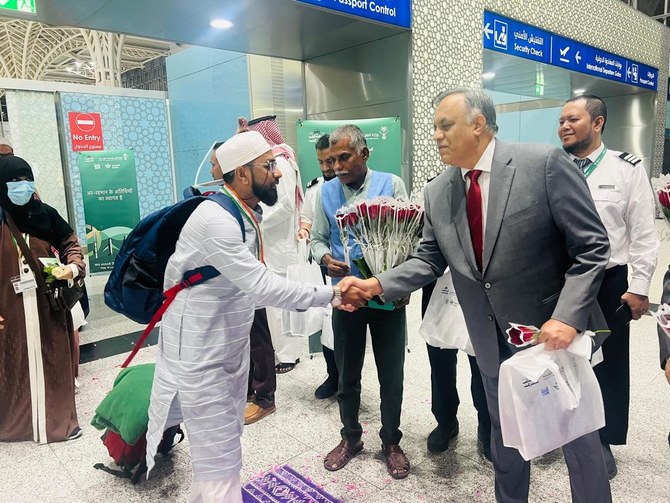
Indian Ambassador to Saudi Arabia Suhel Ajaz Khan, right, shakes hands with an arriving pilgrim from the South Asian country in Madinah. (Indian Haj Mission)
2 / 3
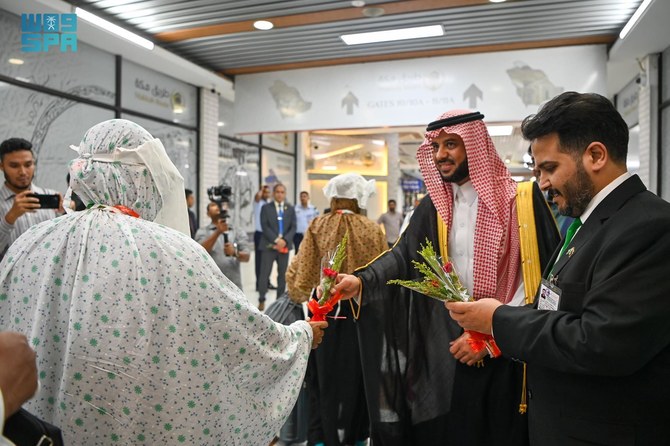
7,700 flights will arrive through six airports during the Hajj season (SPA)
3 / 3
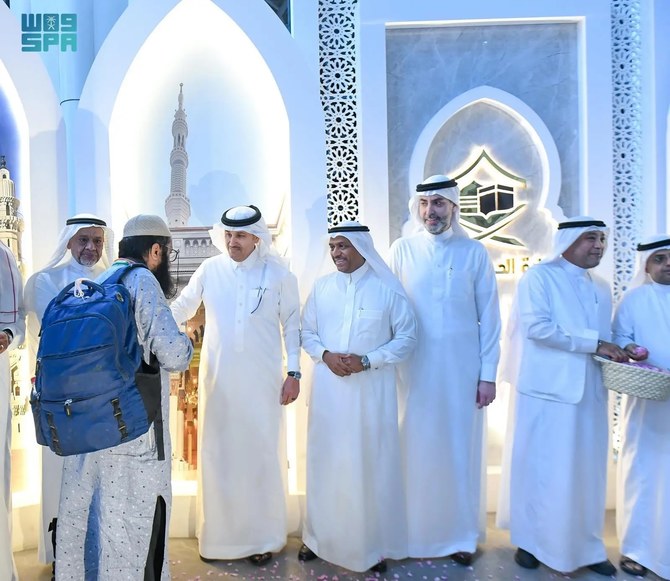
7,700 flights will arrive through six airports during the Hajj season (SPA)
Short Url
Updated 09 May 2024
Follow

First pilgrims from India arrive for 2024 Hajj

  • India is sending a total of 175,025 pilgrims in this pilgrimage season
  • Special Hajj flights for Indian pilgrims depart from 10 cities on Thursday

NEW DELHI: The first group of pilgrims from India arrived in Saudi Arabia on Thursday to perform this year’s Hajj, as the world’s most populous country launched special flights for the annual pilgrimage.

With over 200 million Indians professing Islam, the Hindu-majority country has the world’s largest Muslim-minority population. Under the 2024 Hajj quota, 175,025 worshippers will travel to Saudi Arabia for the spiritual journey that is one of the five pillars of Islam.
This year, Hajj is expected to begin on June 14 and end on June 19. While the pilgrimage can be performed over five or six days, many pilgrims choose to arrive early for what may be a once-in-a-lifetime opportunity to fulfill their religious duty.
One of the first Hajj flights for Indian pilgrims departed on Thursday from the Indira Gandhi International Airport in New Delhi.
“The flight carrying the first lot of 285 people took off at 2:20 a.m. on Thursday,” Kausar Jahan, chairperson of the Delhi State Hajj Committee, told Arab News.
In Madinah, the pilgrims were welcomed by the Indian Ambassador to Saudi Arabia, Suhel Ajaz Khan, and his team, as well as the Saudi Minister of Transport and Logistics Service, Saleh bin Nasser Al-Jasser, and the Saudi Vice Minister of Hajj and Umrah, Abdul Fattah Mashat.


“First flight of Indian Hajj pilgrims arrives in Madinah (and) receives a warm reception,” the Indian Hajj Mission in Jeddah wrote on Facebook. “With the arrival of the first flight … India’s Hajj 2024 has begun.”
A.P. Abdullakutty, chairman of the Hajj Committee of India, said several flights took off from different parts of India on Thursday.
“We have several embarkation points, and on May 9th, the first day of the Hajj flights, several planes will be taking off from at least 10 places across India,” he told Arab News.
The list of cities includes Bangalore, Hyderabad, Jaipur, and Srinagar, capital of the Indian-administered Jammu and Kashmir, a Muslim-majority territory between India and Pakistan, both of which claim it in full and rule in part.
India’s Hajj contingent this year includes more than 4,000 women who will perform the Hajj on their own, without a mahram, or male guardian, Abdullakutty said.
They represent a group of women pilgrims who have been able to travel to Saudi Arabia alone since last year, following the Kingdom’s 2022 decision to lift a rule that required women to be accompanied by a mahram. Those who had no such companion could only travel in large groups of other women.
India’s preparations for this year’s Hajj were overseen by Muktesh K. Pardeshi, secretary of consular, passport, visa and overseas Indian affairs at the Ministry of External Affairs, who concluded an official visit to Saudi Arabia on Tuesday.
“During his visit, the secretary conducted a review of preparations for Hajj 2024 in Jeddah and Madinah,” the ministry said in a statement.
“He met with (Saudi) Vice Hajj Minister Dr. Abdul Fattah Mashat, and discussed logistical arrangements and infrastructure developments aimed at the welfare and comfort for pilgrims.”


Economic growth and resilience at heart of 2nd AlUla Emerging Market Economies Conference

Updated 03 February 2026
Follow

Economic growth and resilience at heart of 2nd AlUla Emerging Market Economies Conference

  • Event on Feb. 8 and 9 will bring together ministers, governors of central banks, policymakers, economic experts and international financial institutions
  • Emerging-market economies a ‘pivotal element’ in global economic system due to effect they have on growth and stability, says Saudi Finance Minister Mohammed Al-Jadaan

RIYADH: The second annual AlUla Conference for Emerging Market Economies, which Saudi Arabia will host next week, offers a platform to exchange views on global developments and discuss policies and reforms that support inclusive growth and strengthen economic resilience, the Kingdom’s finance minister said.

The event on Feb. 8 and 9 will bring together finance ministers, governors of central banks and policymakers, alongside economic experts and representatives of international financial institutions.

Organized by the Saudi Ministry of Finance in partnership with the International Monetary Fund, it takes place as emerging-market economies face mounting challenges amid rapid global economic change.

Finance Minister Mohammed Al-Jadaan said the decision to host the conference reflects Saudi Arabia’s ongoing commitment to efforts that support global financial and economic stability, and highlights the growing influence of emerging economies on worldwide growth.

Emerging-market economies represent a “pivotal element” in the global economic system due to the direct impact they have on economic growth and stability, he added.

“The AlUla Conference for Emerging Market Economies provides a unique platform for exchanging views on global economic developments, and discussing policies and reforms that will support inclusive growth and enhance economic resilience, in light of broader international cooperation that contributes to confronting common challenges,” Al-Jadaan said.

Kristalina Georgieva, managing director of the IMF, said the event would help emerging economies deal with growing uncertainty driven by technological change, demographic shifts and geopolitical tensions.

“The AlUla conference provides a vital platform for emerging economies to discuss how they can navigate the risks and embrace the opportunities ahead,” she said.

“In these times of sweeping transformations in the global economy, policymakers face a more challenging and uncertain environment. Countries should work together to strengthen resilience through sound macroeconomic and financial policies.”