

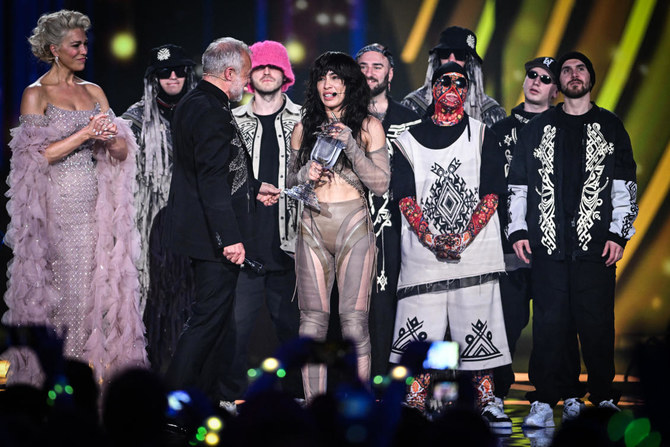

MALMO, Sweden: Competition in the 68th Eurovision Song Contest kicked off Tuesday in Sweden, with the war in Gaza casting a shadow over the sequin-spangled pop extravaganza.
Performers representing countries across Europe and beyond took the stage in the first of two semifinals in the Swedish city of Malmo. It and a second semifinal on Thursday will winnow a field of 37 nations to 26 who will compete in Saturday’s final against a backdrop of both parties and protests.
Ten of the 15 acts performing Tuesday were voted through to the final by viewers. They include Croatian singer-songwriter Baby Lasagna, whose infectious electro number “Rim Tim Tagi Dim” is the current favorite to win, and Ukrainian duo alyona alyona and Jerry Heil, flying the flag for their war-battered nation with the anthemic “Teresa & Maria.”
Also making the cut were goth-style Irish singer Bambie Thug, 1990s-loving Finnish prankster Windows95man and Portuguese crooner Iolanda. Iceland, Azerbaijan, Poland, Moldova and Australia were eliminated.
Other bookmakers’ favorites who will perform Thursday include Swiss singer Nemo, Italian TikTok star Angelina Mango and the Netherlands’ Joost Klein with his playful pop-rap song “Europapa.”
Security is tight in the Swedish city, which expects an influx of some 100,000 Eurovision fans, along with tens of thousands of pro-Palestinian protesters. Israel is a Eurovision participant, and demonstrations are planned on Thursday and Saturday against the Israel-Hamas war, which has left almost 35,000 Palestinians dead.
Israel’s government warned its citizens of a “tangible concern” Israelis could be targeted for attack in Malmo during the contest.
Organizers told Israel to change the lyrics of its entry, originally titled “October Rain” in apparent reference to Hamas’ cross-border Oct. 7 attack that killed some 1,200 Israelis and triggered the war. The song was renamed “Hurricane” and Israeli singer Eden Golan was allowed to remain in the contest.
Jean Philip De Tender, deputy director-general of Eurovision organizer the European Broadcasting Union, told Sky News that banning Israel “would have been a political decision, and as such (one) which we cannot take.”
Police from across Sweden have been drafted in for Eurovision week, along with reinforcements from neighboring Denmark and Norway.
Sweden’s official terrorism threat level remains “high,” the second-highest rung on a five-point scale, after a string of public desecrations of the Qur’an last year sparked angry demonstrations across Muslim countries and threats from militant groups. The desecrations were not related to the music event.
Eurovision’s motto is “United by Music,” but national rifts and political divisions often cloud the contest despite organizers’ efforts to keep politics out.
Flags and signs are banned, apart from participants’ national flags and the rainbow pride flag. That means Palestinian flags will be barred inside the Malmo Arena contest venue.

Eric Saade, a former Swedish Eurovision contestant, had a keffiyeh, a headscarf associated with the Palestinian cause, tied around his wrist. (AFP)
Some musicians seem determined to make a point. Eric Saade, a former Swedish Eurovision contestant who performed as part of Tuesday’s show, had a keffiyeh, a headscarf associated with the Palestinian cause, tied around his wrist as he sang.
Afterwards, organizers said in a statement that “we regret that Eric Saade chose to compromise the non-political nature of the event.”
Performers are feeling political pressure, with some saying they have been inundated with messages on social media urging them to boycott the event.
“I am being accused, if I don’t boycott Eurovision, of being an accomplice to genocide in Gaza,” Germany’s contestant, Isaak, said in an interview published by broadcaster ZDF. He said he did not agree.
“We are meeting up to make music, and when we start shutting people out categorically, there will be fewer and fewer of us,” he said. “At some point there won’t be an event anymore.”
One person who knows how Eurovision unity can collide with bitter reality is singer Manizha Sangin, who represented Russia at the contest in 2021. The country was expelled the following year over its invasion of Ukraine.
Manizha, who performs under her first name, spoke out against the war. As a result, her performances were canceled in Russia and her music banned from public spaces. The singer remains in Russia but has found it all but impossible to work.
“People are afraid to work with me here because they’re afraid to have consequences after, problems after that,” she said.
Despite the difficulties, Manizha has recorded a single, “Candlelight,” which she is releasing on Wednesday as “a message of hope.”
“Music cannot stop war,” she said. But “what music can do is inspire people.”
Manizha thinks Russia will one day return to the Eurovision fold – but not soon.
“Maybe next generation,” she said. “But for now, relationships are too complicated. And then that makes me sad, you know, because that’s why people are not hearing each other. Because we are separated from each other. And the thing, is music should unite.”


