

Heavy rainfall in Iraq ends five years of drought

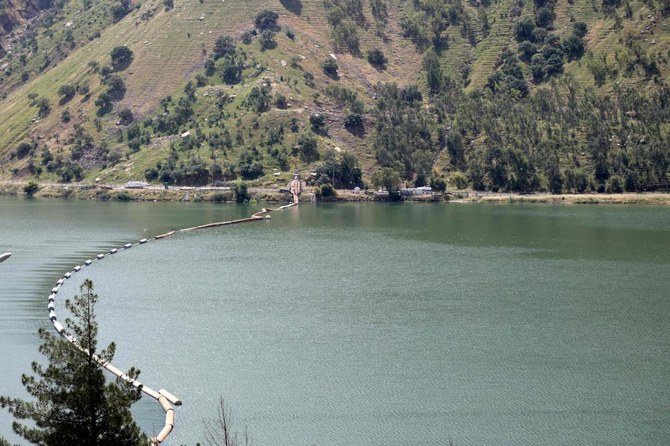
A picture showing the Darbandikhan Dam in northeastern Iraq. Iraq has suffered four consecutive years of drought, with irregular rainfall badly affecting water resources, forcing many farmers to abandon their land. (AFP)
Short Url
Updated 09 May 2024
Follow

Heavy rainfall in Iraq ends five years of drought

  • Country’s major reservoirs are almost full for the first time since 2019
  • Iraq is considered by the United Nations to be one of the five countries most vulnerable to some impacts of climate change

JEDDAH: Iraqis are celebrating after heavy rainfall ended five consecutive years of drought. The reservoir behind the massive Darbandikhan dam on the River Sirwan in the autonomous Kurdistan region of northeast Iraq is one of many that are almost full again.

“The dam’s storage capacity is 3 million cubic meters. Today, with the available reserves, the dam is only missing 25 cm of water to be considered full,” reservoir director Saman Ismail said.

Built on the River Sirwan, the dam is located south of the city of Sulaimaniyah in Iraq’s autonomous Kurdistan region. 

“In the coming days, we will be able to say that it’s full,” said Ismail, with the water just a few meters below the road running along the edge of the basin.
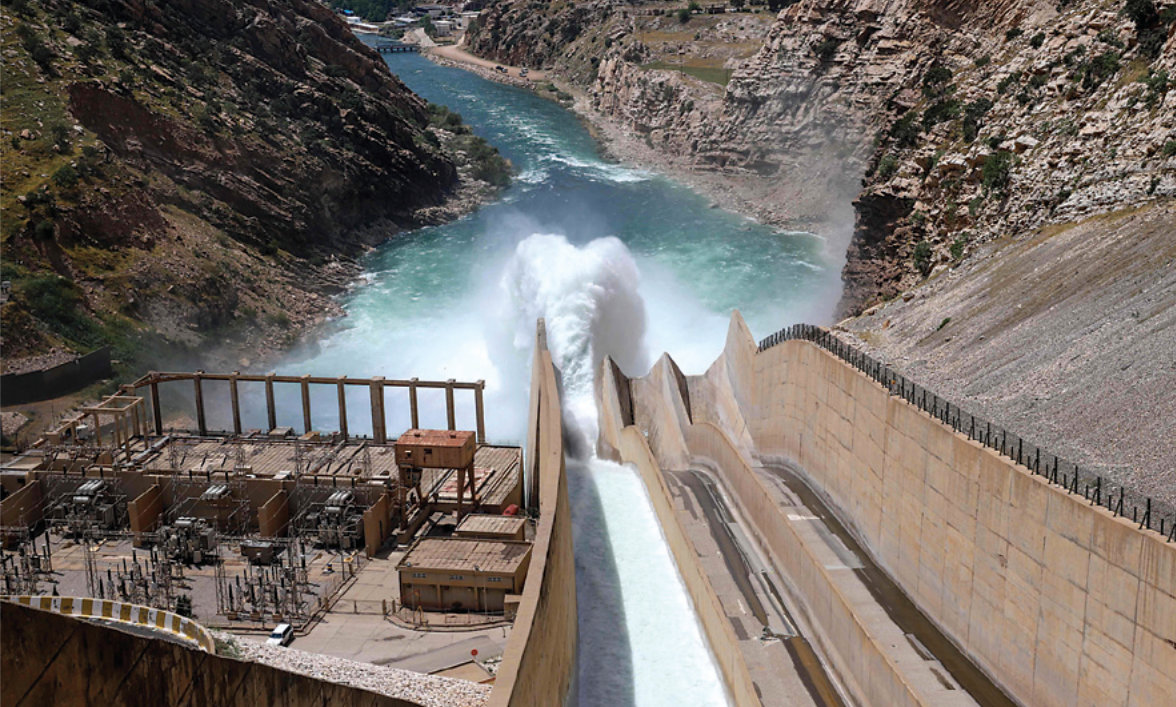


The Darbandikhan dam’s storage capacity is 3 million cubic meters. (AFP)

The last time Darbandikhan was full was in 2019, and since then “we’ve only had years of drought and shortages,” said Ismail. He blamed climate change, and dam construction beyond Kurdistan.

The central government in Baghdad says upstream dams built in Iran and Turkiye have heavily reduced water flow in Iraq’s rivers, on top of rising temperatures and irregular rainfall.

This winter, however, bountiful rains have helped to ease shortages in Iraq, considered by the United Nations to be one of the five countries most vulnerable to some impacts of climate change.

In Iraq, rich in oil but where infrastructure is often run-down, torrential rains have also flooded the streets of Kurdistan’s regional capital Irbil.

Four hikers died last week in floods in Kurdistan, and in Diyala, a rural province in central Iraq, houses were destroyed.

Ali Radi Thamer, director of the dam authority at Iraq’s water resources ministry, said that most of the country’s six biggest dams have experienced a rise in water levels.

At the Mosul dam, the largest reservoir with a capacity of about 11 billion cubic meters, “the storage level is very good, we have benefitted from the rains and the floods,” said Thamer.

Last summer, he added, Iraq’s “water reserves... reached a historic low.”

“The reserves available today will have positive effects for all sectors,” Thamer said, including agriculture and treatment plants that produce potable water, as well as watering southern Iraq’s fabled marshes that have dried up in recent years.

He cautioned that while 2019 saw “a sharp increase in water reserves,” it was followed by “four successive dry seasons.”

Water has been a major issue in Iraq, a country of 43 million people that faces a serious environmental crisis from worsening climate change, with temperatures frequently hitting 50 degrees Celsius in summer.

“Sure, today we have rain and floods, water reserves that have relatively improved, but this does not mean the end of drought,” Thamer said.

About five kilometers (three miles) south of Darbandikhan, terraces near a small riverside tourist establishment are submerged in water.

But owner Aland Salah prefers to see the glass half full.

“The water of the Sirwan river is a blessing,” he said. “When the flow increases, the area grows in beauty. We have some damage, but we will keep working.”

(With AFP)


Netanyahu says Israel and Hamas will enter ceasefire’s second phase soon

Updated 08 December 2025
Follow

Netanyahu says Israel and Hamas will enter ceasefire’s second phase soon

  • Says the second phase addresses the disarming of Hamas and withdrawal of Israeli troops from Gaza
  • Second stage also includes the deployment of an international force to secure Gaza and forming a temporary Palestinian government

TEL AVIV, Israel: Israeli Prime Minister Benjamin Netanyahu said Sunday that Israel and Hamas are “very shortly expected to move into the second phase of the ceasefire,” after Hamas returns the remains of the last hostage held in Gaza.
Netanyahu spoke during a news conference with visiting German Chancellor Friedrich Merz and stressed that the second phase, which addresses the disarming of Hamas and the withdrawal of Israeli troops from Gaza, could begin as soon as the end of the month.
Hamas has yet to hand over the remains of Ran Gvili, a 24-year-old police officer who was killed in the Hamas-led Oct. 7, 2023, attack that sparked the war. His body was taken to Gaza.
The ceasefire’s second stage also includes the deployment of an international force to secure Gaza and forming a temporary Palestinian government to run day-to-day affairs under the supervision of an international board led by US President Donald Trump.
A senior Hamas official on Sunday told The Associated Press the group is ready to discuss “freezing or storing or laying down” its weapons as part of the ceasefire in a possible approach to one of the most difficult issues ahead.

Netanyahu says second phase will be challenging
Netanyahu said few people believed the ceasefire’s first stage could be achieved, and the second phase is just as challenging.
“As I mentioned to the chancellor, there’s a third phase, and that is to deradicalize Gaza, something that also people believed was impossible. But it was done in Germany, it was done in Japan, it was done in the Gulf States. It can be done in Gaza, too, but of course Hamas has to be dismantled,” he said.
The return of Gvili’s remains — and Israel’s return of 15 bodies of Palestinians in exchange — would complete the first phase of Trump’s 20-point ceasefire plan.
Hamas says it has not been able to reach all remains because they are buried under rubble left by Israel’s two-year offensive in Gaza. Israel has accused the militants of stalling and threatened to resume military operations or withhold humanitarian aid if all remains are not returned.
A group of families of hostages said in a statement that “we cannot advance to the next phase before Ran Gvili returns home.”
Meanwhile, Israeli military Chief of Staff Lt. Gen. Eyal Zamir on Sunday called the so-called Yellow Line that divides the Israeli-controlled majority of Gaza from the rest of the territory a “new border.”
“We have operational control over extensive parts of the Gaza Strip and we will remain on those defense lines,” Zamir said. “The Yellow Line is a new border line, serving as a forward defensive line for our communities and a line of operational activity.”
Germany says support for Israel is unchanged
Merz said Germany, one of Israel’s closest allies, is assisting with the implementation of the second phase by sending officers and diplomats to a US-led civilian and military coordination center in southern Israel, and by sending humanitarian aid to Gaza.
The chancellor also said Germany still believes that a two-state-solution is the best possible option but that “the German federal government remains of the opinion that recognition of a Palestinian state can only come at the end of such a process, not at the beginning.”
The US-drafted plan for Gaza leaves the door open to Palestinian independence. Netanyahu has long asserted that creating a Palestinian state would reward Hamas and eventually lead to an even larger Hamas-run state on Israel’s borders.
Netanyahu also said that while he would like to visit Germany, he hasn’t planned a diplomatic trip because he is concerned about an arrest warrant issued by the International Criminal Court, the UN’s top war crimes court, last year in connection with the war in Gaza.
Merz said there are currently no plans for a visit but he may invite Netanyahu in the future. He added that he is not aware of future sanctions against Israel from the European Union nor any plans to renew German bans on military exports to Israel.
Germany had a temporary ban on exporting military equipment to Israel, which was lifted after the ceasefire began on Oct. 10.
Israel kills militant in Gaza
The Israeli military said it killed a militant who approached its troops across the Yellow Line.
Gaza’s Health Ministry says Israeli forces have killed more than 370 Palestinians since the start of the ceasefire, and that the bodies of six people killed in attacks had been brought to local hospitals over the past 24 hours.
In the original Hamas-led attack in 2023, the militants killed around 1,200 people and took more than 250 others hostage. Almost all the hostages or their remains have been returned in ceasefires or other deals.
Israel’s offensive in Gaza has killed at least 70,360 Palestinians, according to Gaza’s Health Ministry, which operates under the Hamas-run government. The ministry does not differentiate between civilians and combatants, but says that nearly half the dead have been women and children. The ministry is part of Gaza’s Hamas government and its numbers are considered reliable by the UN and other international bodies.